
Response Checks and Calibration: What Each One Establishes
Learn how response checks and calibration support different decisions, and how to keep the geometry, reference result and follow-up record meaningful.
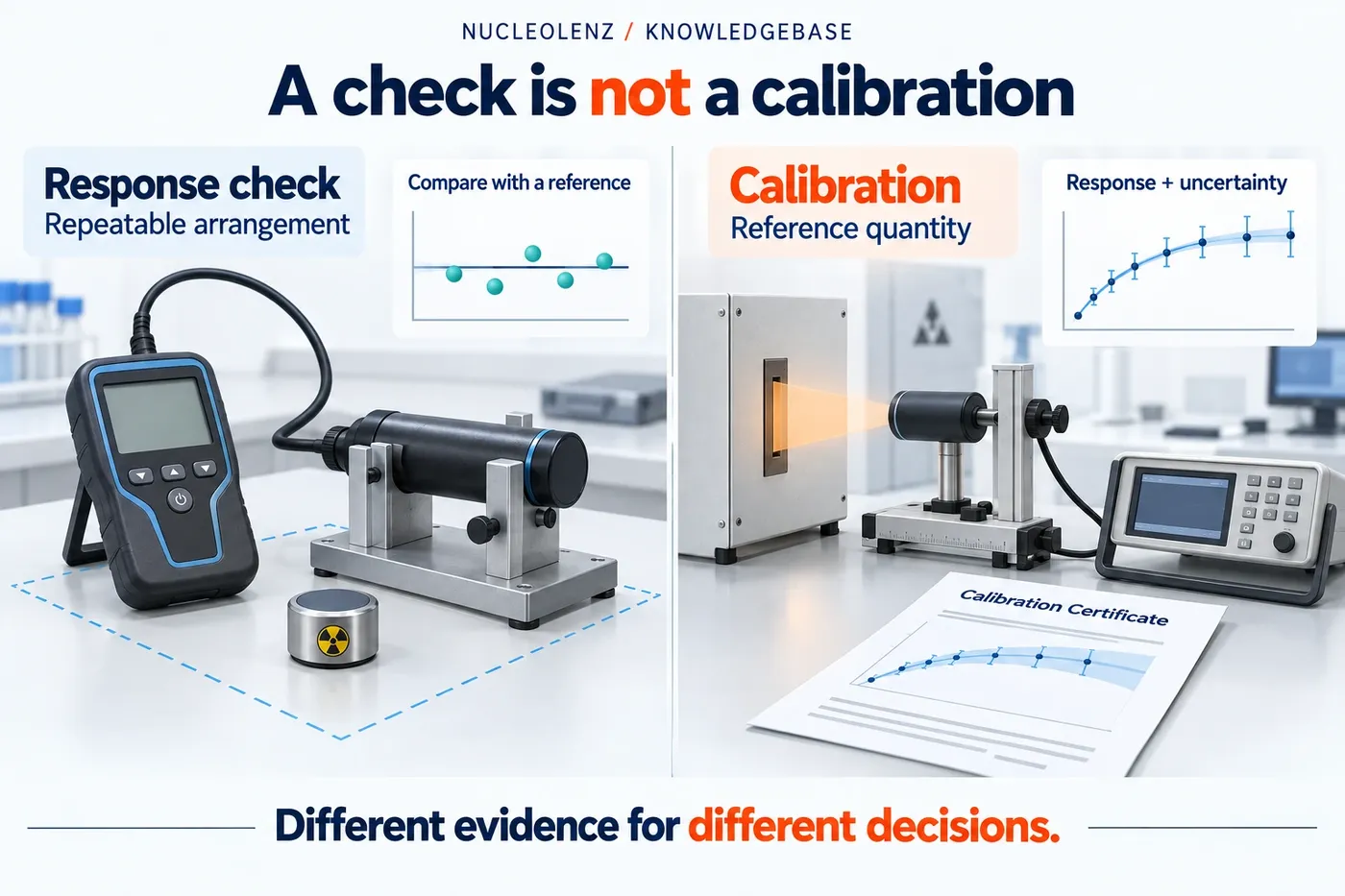
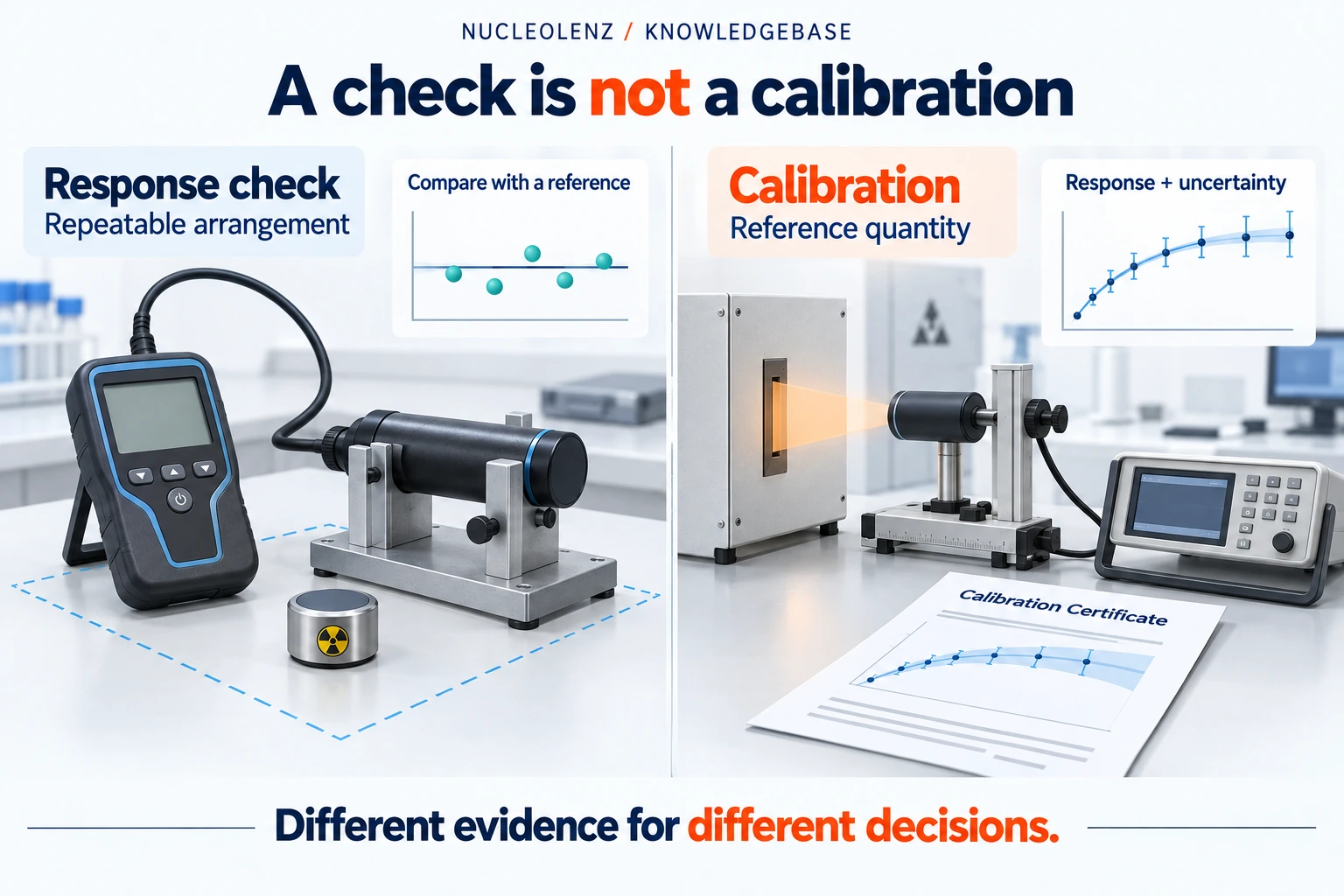
Open the concept graphic at full size ↗
Three key ideas
Check function. Characterize measurement.
- Response check: Compare continuing response with a defined reference.
- Calibration: Relate indication to a reference quantity and uncertainty.
- Review together: Use each record for the decision it actually supports.
At a glance
A practical review guide
| Review point | Evidence to look for | What it does not establish |
|---|---|---|
| Response check | Repeatable arrangement and comparison result | Full-range calibration |
| Calibration | Reference quantities, conditions and uncertainty | Absence of later damage |
| Physical inspection | Condition of the accessible assembly | Quantitative radiation response |
| Follow-up | Preserved observations and review decision | An explanation based only on the final passing attempt |
Use the applicable instrument documentation and the approved site programme for operational decisions.
A radiation instrument can respond to a source without giving a sufficiently characterized measurement. It can also have a current calibration record and develop a fault afterward. This explains why an equipment programme may include both calibration and routine response checks. The activities complement one another, but their records should describe different questions and conclusions.
Two questions, two kinds of evidence
Calibration establishes a relationship between an indication and a reference quantity under stated conditions, including the relevant uncertainty. A routine source response check compares continuing response with an established reference arrangement. It can help reveal change, but it does not provide a fresh characterization of the full measurement range. Neither activity is defined simply by bringing a source near a detector. Its method, reference and purpose determine what the result supports.
Make a routine comparison repeatable
A comparison is easier to interpret when the setup is reproducible. The record should identify the instrument and detector, check source, geometry, orientation, mode and reference result. Use the approved acquisition and background arrangements. The manufacturer's instructions and the local programme establish the applicable criteria; a percentage used in an example for another instrument is not a universal acceptance rule. Even a familiar check needs an identifiable reference and a route for handling an unexpected result.
Keep calibration evidence available
The person preparing a measurement needs more than an equipment register entry. The certificate may describe the radiation used, measurement points, corrections and limitations that affect the task. Review the complete system identity, particularly after detector replacement or repair. If the certificate contains a reference response-check reading, preserve its stated geometry. The calibration certificate guide explains how to turn these document details into practical questions before a survey.
Practice: the check that changed after transport
Consider a fictional team that records an unexpected response after moving a meter to another facility. Its previous reading was obtained with the source in a defined holder; the new check used a hand-held arrangement. The records do not yet establish whether instrument response has changed. The first investigation question is whether the comparison used equivalent conditions. The team retains the original result, documents the setup difference and follows its approved review process.
If the correct arrangement still gives an unacceptable result, the failed check remains significant. If a later result is acceptable, that does not erase the need to explain the earlier observation. This distinction prevents a series of undocumented attempts from becoming a misleading single entry marked “pass.”
A useful check record
- Identify the meter-detector combination and relevant configuration.
- Link the approved method, reference arrangement and acceptance basis.
- Keep the actual indication and relevant status information.
- Record deviations, review decisions and any restriction on use.
- Link maintenance, recalibration or other authorized follow-up where required.
What to ask when arranging a service
Describe whether the need is a functional inspection, a routine response-check arrangement or calibration for a stated measurement. Explain the quantity, range and operating conditions rather than asking only whether the equipment can be “tested.” These details help the supplier or laboratory define a suitable scope and a useful report. A completed record should make clear which question was answered and which assumptions still need confirmation before operational use.
Check your understanding
Put the idea to work
Choose an answer, then reveal the explanation. Your answers stay in this browser.