
Verifying a Radiation Alarm: State Which Part of the Chain Was Tested
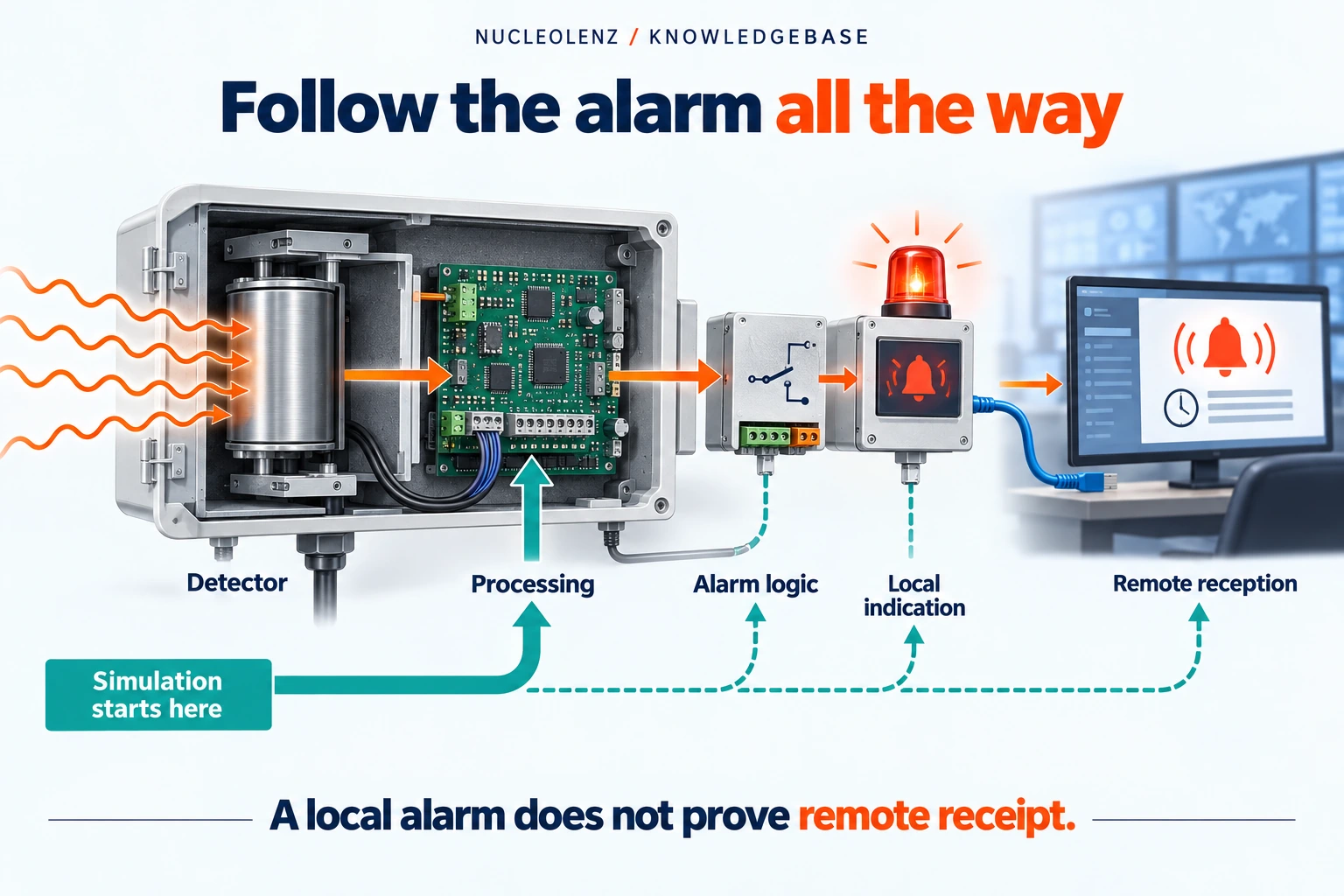
Map the detector, alarm logic, local indication and remote path. An alarm test is meaningful only when its exercised scope and acceptance basis are clear.
Open the concept graphic at full size ↗
Three key ideas
Show which parts of the alarm chain were tested
- Input: Radiation response or a defined simulation?
- Indication: Which logic and local outputs were observed?
- Reception: Did the intended receiving system get valid information?
At a glance
A practical review guide
| Review point | Evidence to look for | What it does not establish |
|---|---|---|
| Source response | Defined detector response observation | Every downstream communication function |
| Simulation | Specified logic and outputs exercised | Detector response to radiation |
| Local indication | Observed display, sounder or light function | Correct remote receipt |
| Operational restoration | Confirmed final configuration and status | Closure from a successful test signal alone |
Use the applicable instrument documentation and the approved site programme for operational decisions.
“The alarm was tested” is an incomplete statement. Did the activity exercise the detector's radiation response, the alarm logic, the local sounder, a relay or the complete receiving system? A useful verification account names the parts actually exercised and the evidence observed. This avoids treating a demonstration of one function as proof of the entire monitoring chain.
Map the chain before defining the test
Draw the detector, signal processing, alarm decision, local indication and any external outputs or receiving systems. Mark which functions exist in the supplied configuration and which matter to the site's requirement. The diagram can be simple; its purpose is to expose boundaries. A sound heard beside the instrument tells a different story from a recorded message received at the responsible control point.
Distinguish simulation from radiation response
An approved electrical or software simulation may exercise selected logic or outputs without testing the detector's response to radiation. A source response check may show continuing detector response without verifying every external interface. Both can be useful when their purposes are clear. Neither should be described as a complete end-to-end test unless the method and observations actually support that scope.
Any source-based activity needs the authorized equipment, competent personnel and protection arrangements. A general explanation should not become improvised source-placement instructions or a reason to bypass operational controls. The manufacturer's method and site test plan determine how a verification activity is carried out.
Define the observation and the criterion
For each test objective, record the expected behavior and how the result will be judged. Then keep the actual observation, including timestamps, messages and relevant status where the method calls for them. A result and an acceptance decision are different fields: the first describes what happened; the second explains whether it met the requirement. Document unavailable functions or deviations rather than replacing them with a broad pass statement.
Practice: a sounder demonstration
A fictional commissioning video shows a local sounder operating when the instrument's approved test function is selected. The video is useful evidence of that local function under the demonstrated conditions. It does not establish that radiation reached the detector, that a configured relay changed correctly or that a remote operator received a valid message. The review should name these untested parts and link any additional evidence needed for the project's requirement.
This exercise is especially useful when different teams own the instrument and receiving system. Each team can mark its tested boundary, then agree how the interfaces will be verified. The resulting account is clearer than assuming that both sides used the same meaning of “alarm test.”
Record the supplied arrangement
Nucleolenz's Indoor Area Gamma Monitor includes documented local and interface functions. A project-specific test plan should identify the functions actually supplied and connected. The public description is not a commissioning result. Include the instrument identity, configuration, method, acceptance basis, observations and responsible reviewer in the test record.
Establish the final operational state
After the approved activity, the responsible process must confirm the correct operational configuration and status. Preserve any required restoration evidence and outstanding follow-up. A successful test does not justify leaving a temporary configuration in place or closing an unexplained observation. The finished record should allow an independent reviewer to see what was tested, what passed and which parts of the required chain still need evidence.
Check your understanding
Put the idea to work
Choose an answer, then reveal the explanation. Your answers stay in this browser.