
Environmental Instrument Testing: What Does the Report Actually Prove?
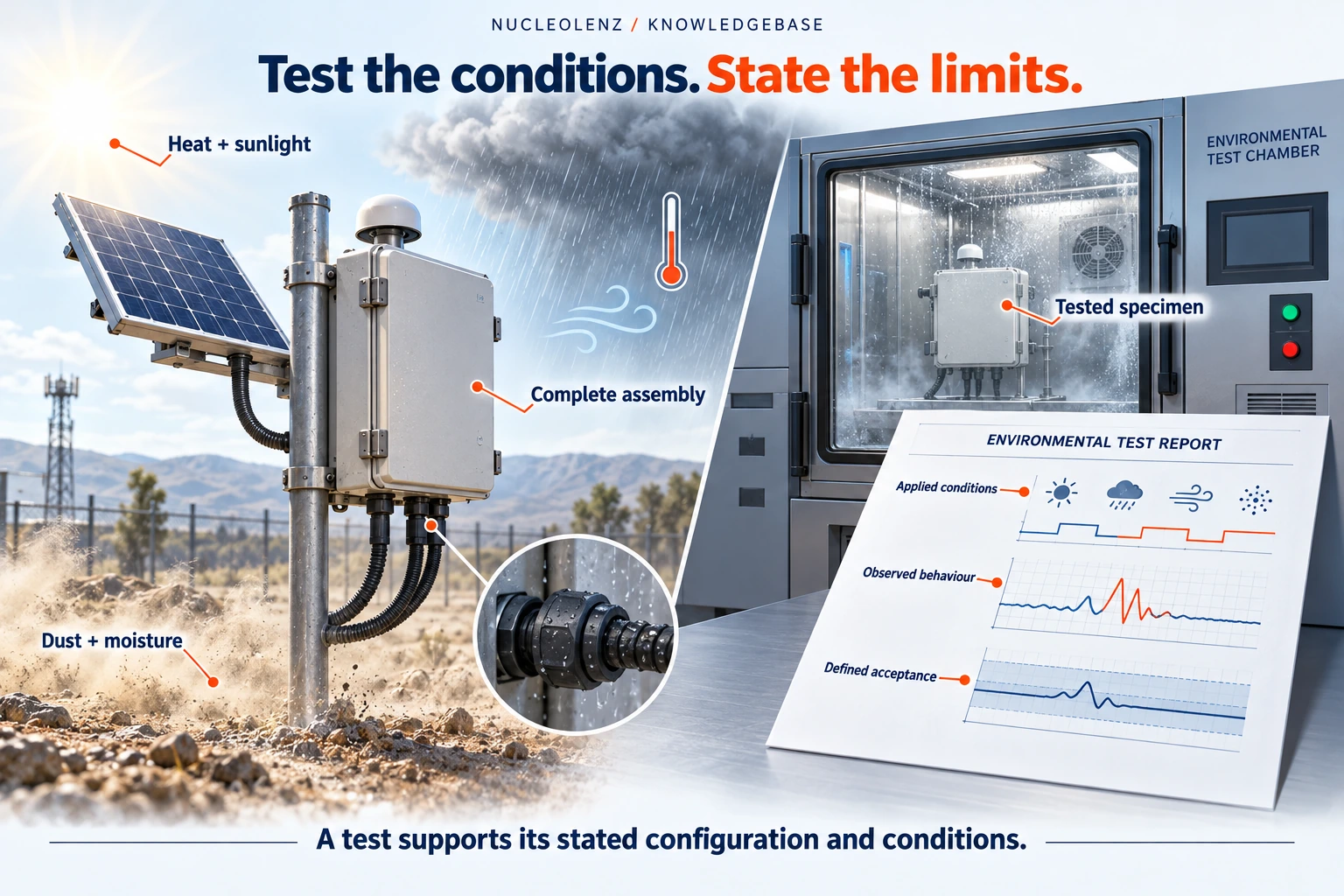
Read environmental test reports by specimen, conditions, measured behavior and acceptance criteria. Keep every claim within the evidence actually supplied.
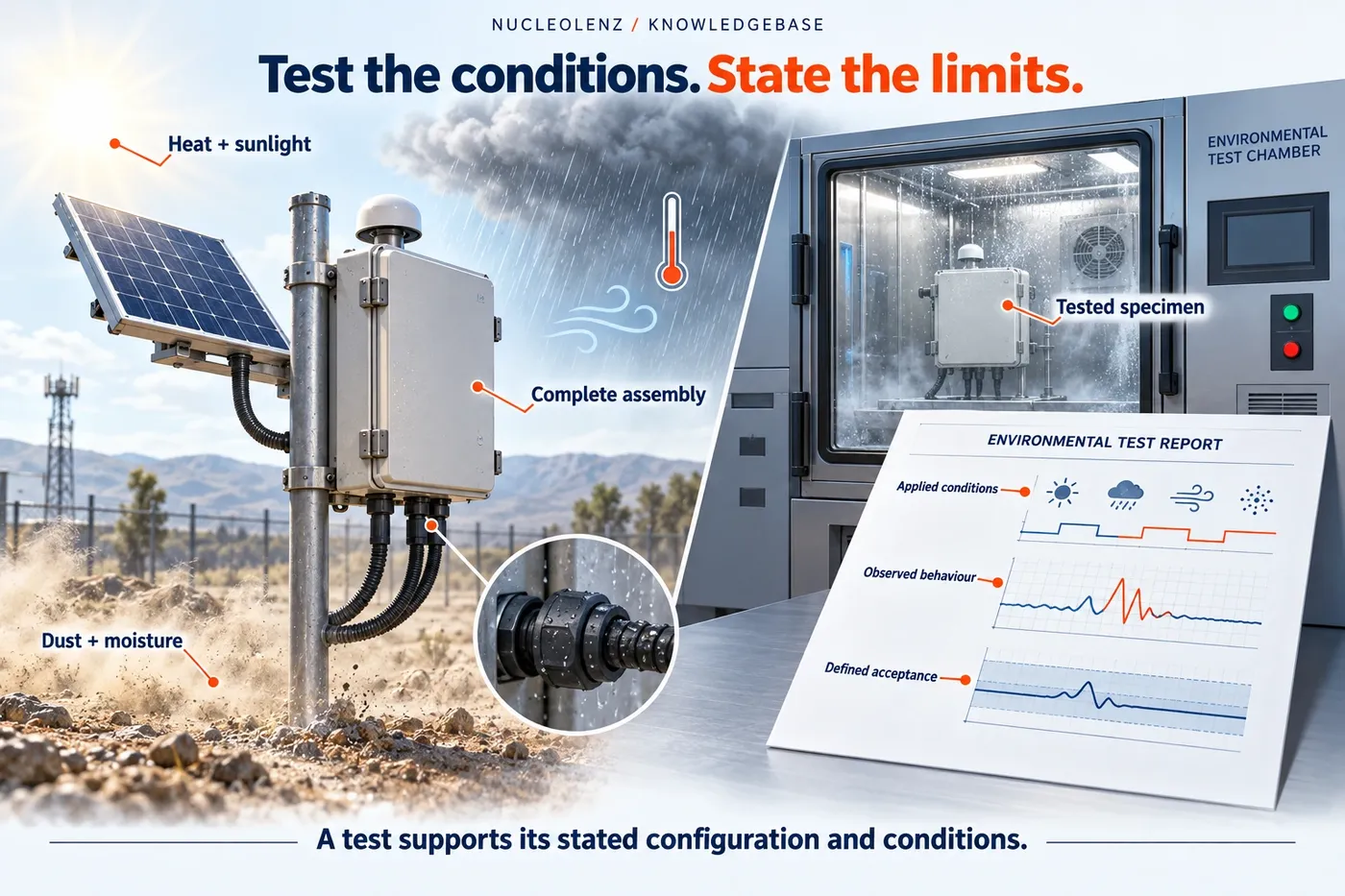
Open the concept graphic at full size ↗
Three key ideas
A test report is a chain of evidence
- Specimen: Identify the exact configuration and operating state.
- Conditions: Read the method, duration and measured behavior.
- Conclusion: Match the claim to the criteria and actual results.
At a glance
A practical review guide
| Review point | Evidence to look for | What it does not establish |
|---|---|---|
| Specimen | Model, identity, accessories and configuration | Coverage of every product variant |
| Test state | Powered, unpowered, operation or storage | Interchangeable conclusions for all states |
| Observed behavior | Measurements during and after exposure | Performance from a chamber photograph |
| Claim scope | Conditions, criteria and supported result | Other environmental or explosion-protection claims |
Use the applicable instrument documentation and the approved site programme for operational decisions.
A photograph of an instrument in a test chamber shows an activity, not the full result. To understand what an environmental test establishes, read the report as a connection between a requirement, a particular specimen, applied conditions and observed behavior. That connection is what supports a defensible claim about the equipment.
Identify what was tested
Start with the model, specimen identity and supplied configuration. Include the detector, enclosure, accessories and software or firmware where relevant to the test. Check whether the activity concerned operation, storage or transport. A system surviving storage conditions is not automatically demonstrated to measure correctly while operating under those same conditions. Likewise, one tested configuration does not automatically represent every option sold under the same family name.
Read the applied conditions
Identify the method, conditions, duration and any sequence of exposures. Note whether the specimen was powered, how it was mounted and which accessories were connected. These details help determine whether the report fits the proposed use. A statement such as “temperature tested” leaves too many questions unanswered to support a specific installation decision. Ask for the actual conditions and scope rather than filling the gaps from a photograph or summary slide.
Find the measured behavior and acceptance basis
What was assessed during the exposure, afterward, or both? An intact enclosure, functioning display and acceptable measurement response are different observations. The report should describe the criteria used to judge the relevant behavior. A recorded observation without an acceptance basis may be informative, but it does not explain which requirement was satisfied. Preserve unusual behavior and interruptions rather than letting an overall pass label obscure them.
Keep different environmental claims separate
Temperature evidence does not establish water ingress performance, electromagnetic compatibility or explosion protection. Each question needs appropriate evidence for its scope. Public manufacturer test reports can illustrate how results are documented, but they are not evidence of another manufacturer's performance. For Nucleolenz equipment, obtain the model-specific documentation or applicable report before making a concrete environmental claim.
Practice: the unpowered specimen
In a fictional report-reading exercise, a summary says that a specimen passed a high-temperature exposure. The detailed method shows that it was unpowered, and the final check verified startup after returning to normal conditions. That can support the stated test's conclusion. It does not, by itself, demonstrate measurement performance while operating at the exposure temperature. The reviewer should express the narrower supported conclusion and identify the evidence needed for the intended operating claim.
The exercise does not imply that the test was poorly designed. It shows why the purpose matters: a storage assessment and an operating-performance assessment can both be legitimate while answering different questions.
A report review worksheet
- Identify the requirement and intended product claim.
- Record the tested specimen and configuration.
- Summarize the applied conditions and operating state.
- Identify what was measured and when it was measured.
- Link acceptance criteria, results and unresolved observations.
- State the supported conclusion and the limits of its application.
Connect the report to deployment
Compare the proposed installation with the documented conditions and configuration. Record any difference requiring engineering assessment, including changed accessories or an added enclosure. Keep that review with the installation record so future changes can be checked against the same evidence. A useful technical account is precise about both demonstrated performance and the questions the report was never intended to answer.
Check your understanding
Put the idea to work
Choose an answer, then reveal the explanation. Your answers stay in this browser.