
Before Instrument Dispatch: What an Acceptance Record Should Establish
An acceptance record should connect the delivered configuration with agreed requirements, observed results and usable handover documents.

Open the concept graphic at full size ↗
Three key ideas
Acceptance connects delivery to evidence
- Identify: Record exactly which system and accessories are supplied.
- Verify: Link agreed requirements to scoped test results.
- Handover: Provide records, limitations and remaining site tasks.
At a glance
A practical review guide
| Review point | Evidence to look for | What it does not establish |
|---|---|---|
| Configuration | Delivered identities and approved substitutions | Equivalence of an undocumented replacement |
| Functional check | Named function and observed behavior | Full measurement characterization |
| Calibration | Reference quantity, conditions and uncertainty | Successful customer-site integration |
| Handover | Documents and outstanding-item disposition | Completion of an unstated site task |
Use the applicable instrument documentation and the approved site programme for operational decisions.
An instrument dispatch record should explain what is being delivered and which agreed requirements have been demonstrated. A powered display and a packed case are useful observations, but they cannot establish every aspect of measurement performance or integration. Good acceptance evidence gives the recipient a clear starting point for installation, use and later change control.
Identify the delivered configuration
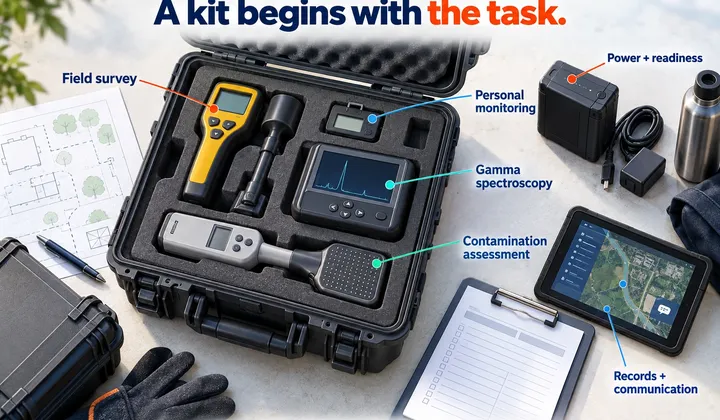
Record the instrument, detector and relevant accessories by model and identity. Include configuration, software or firmware information where it affects the agreed system. Match the documentation to the supplied arrangement, including any options selected during procurement. If a component has changed, record the substitution and its assessment. Otherwise, the recipient may receive an apparently complete package whose paperwork describes a different configuration.
A configuration list is most useful when it connects to the requirement and the evidence. The person receiving the system should be able to identify which item performs each agreed function and where the relevant result is recorded. This is particularly valuable for assemblies with separate detectors, analyzers, power supplies or software.
State the purpose of each check
Visual inspection, functional demonstration, response check and calibration establish different things. Describe the method, conditions, expected behavior, observed result and acceptance basis. Do not label a routine response comparison as a calibration or treat a successful startup as evidence for the entire measurement range. The record should let the reader distinguish what was inspected, measured or demonstrated and how each finding was assessed.
Define the integration boundary
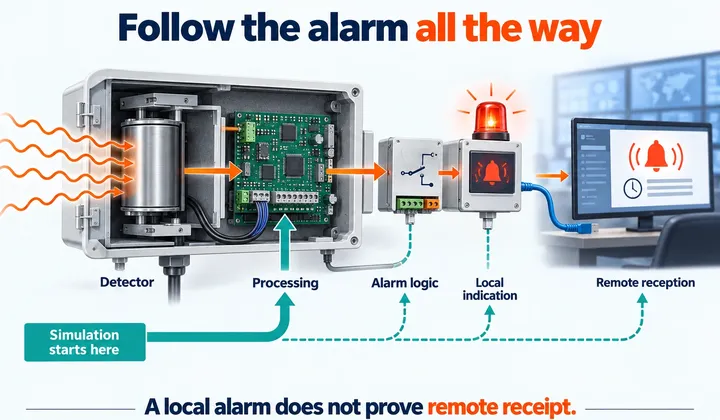
If communication, outputs or external software are included in the requirement, state which arrangement was tested. A local display test does not establish successful receipt by a customer's supervisory system. A supplier-side interface demonstration may support dispatch acceptance while site integration remains a separate activity. Make that boundary explicit and identify the later evidence needed. An outstanding site task is easier to manage when it is visible rather than implied to be complete.
Practice: the substituted cable
In a fictional dispatch review, the instrument passes its documented bench checks, but the packing list includes a different communication cable from the one used in the tested assembly. The change may be acceptable, yet the existing record does not explain it. The reviewer asks for the approved configuration decision and any verification it requires before signing off the supplied arrangement. The issue is traceability between the test and the delivery, not simply the presence of a cable in the box.
Make handover documents useful to the recipient
- Include the supplied configuration and identification list.
- Link each agreed acceptance requirement with its supporting result.
- Provide applicable operating and maintenance instructions.
- Keep calibration, response-check and functional records distinguishable.
- Identify limitations, outstanding items and their agreed disposition.
- State the installation or site-verification activities still required.
Nucleolenz's public laboratory spectroscopy workstation case study describes an integrated system. A dispatch account for a particular delivery would still need its actual configuration and acceptance records; this educational checklist is not evidence that every shipment underwent a stated test.
Carry the record into service
Keep the acceptance file accessible during installation and later maintenance. When a probe, accessory or software configuration changes, the original record provides a baseline for assessing what remains applicable. A useful handover leaves the recipient able to answer three questions: what was supplied, what was verified and what still needs to happen at the site.
Check your understanding
Put the idea to work
Choose an answer, then reveal the explanation. Your answers stay in this browser.