
Which Radiation Instrument Would You Choose? Three Practice Scenarios
Practise choosing instruments for a fixed location, an individual record and gamma energy information. Each scenario includes the evidence needed to defend the choice.
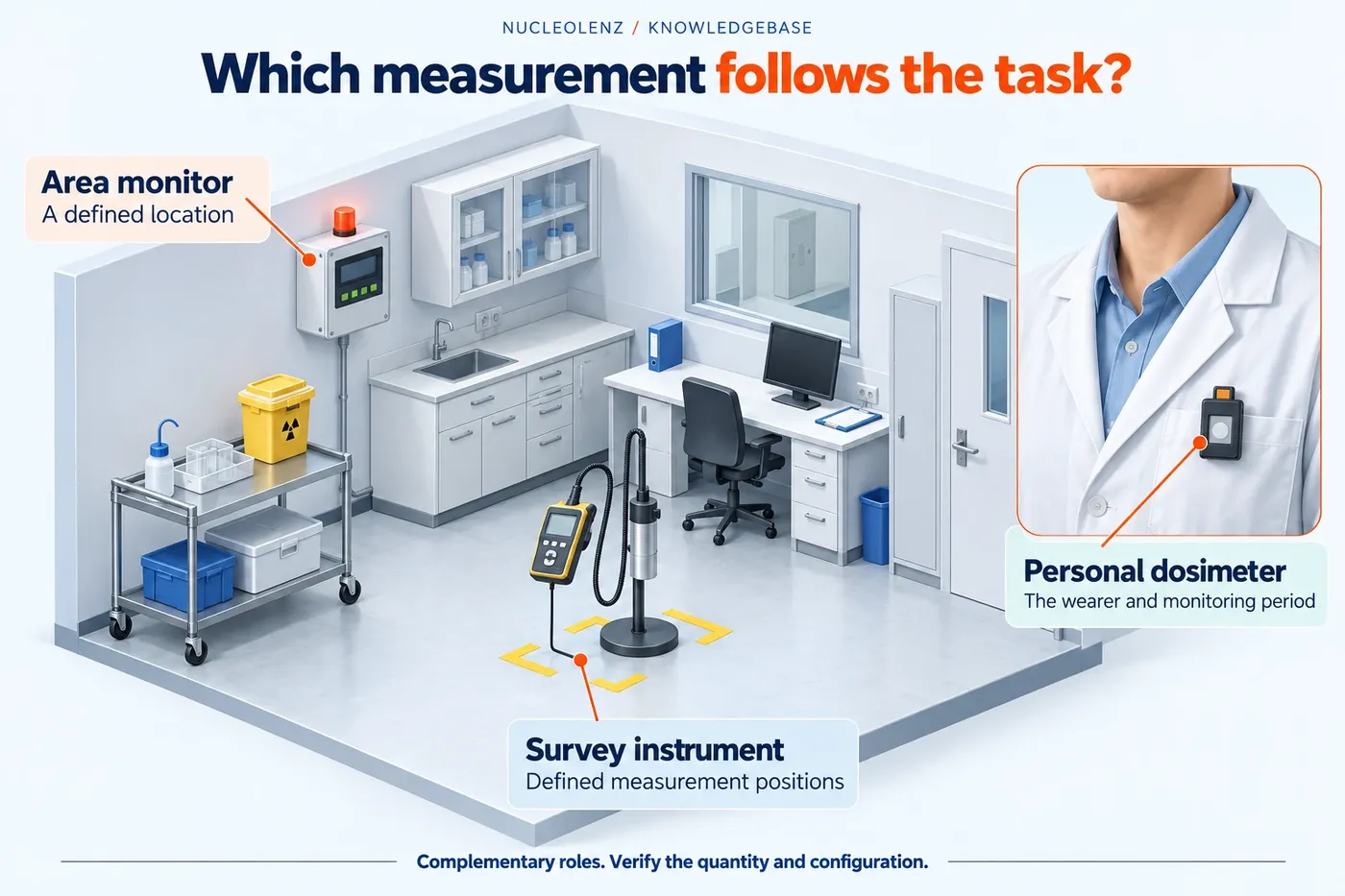
Open the concept graphic at full size ↗
Three key ideas
Three questions, three starting points
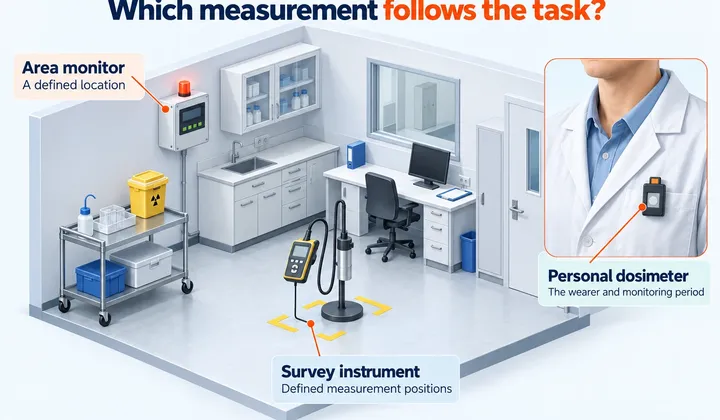
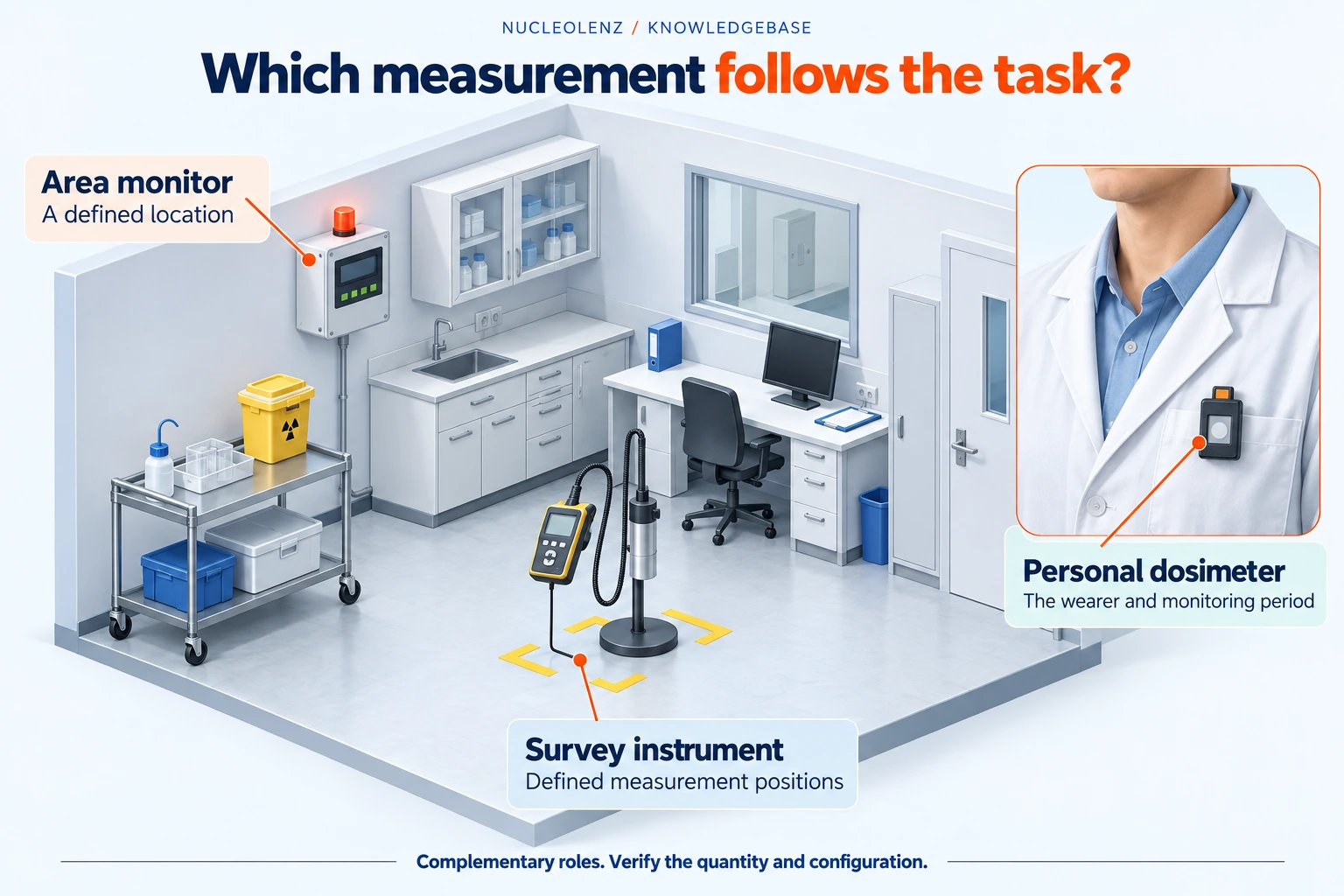
- A defined location: Consider fixed monitoring and assess what the position represents.
- An individual record: Consider personal dosimetry within the applicable programme.
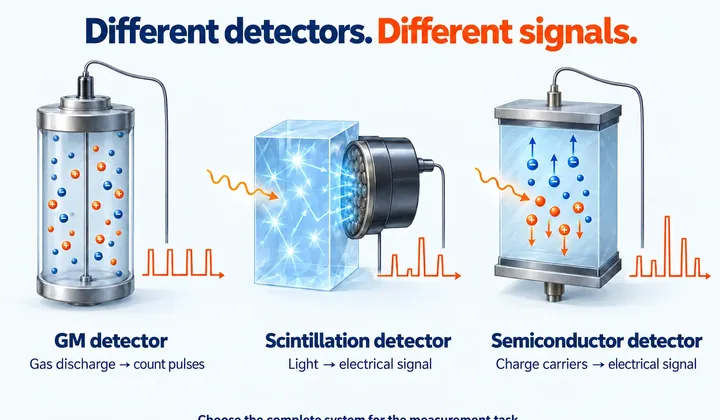
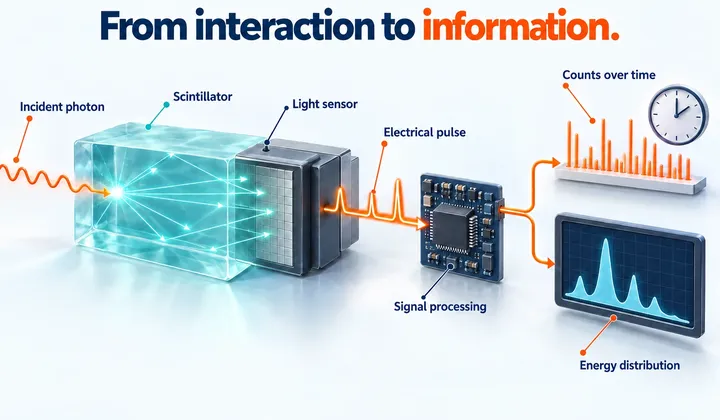
- Gamma energy information: Consider spectroscopy with the required calibration and analysis.
At a glance
Compare the key distinctions
| Focus | What it establishes or needs | Important limit or evidence |
|---|---|---|
| Observe one location over time | Fixed area monitoring | Coverage, configuration and alarm reception |
| Assess an individual monitoring record | Personal dosimetry | Quantity, wearing arrangement and period |
| Investigate gamma energy features | Gamma spectroscopy | Energy calibration, acquisition and analysis |
All scenarios are fictional learning exercises, not equipment prescriptions for a specific workplace.
Instrument selection becomes clearer when it starts with a task. These fictional scenarios are educational exercises, not operational recommendations or claims about completed Nucleolenz deployments.
Scenario one: follow conditions at a defined location
A team wants a continuing indication at a specified workstation. Ask what radiation and quantity need to be observed, which conditions the location represents and how an alarm will reach the responsible person.
This points toward a fixed-monitoring requirement, subject to the site assessment. The Nucleolenz Indoor Area Gamma Monitor provides a product context for a defined gamma-monitoring discussion. Its placement and supplied configuration still need verification.
Scenario two: understand a worker's monitoring record
A team needs information associated with an individual during an assigned task. Ask which dosimetric quantity and monitoring arrangements are required, how the device is worn and how the period of use is recorded.
The Nucleolenz Teledosimeter is described with dose and rate displays, but its suitability must be assessed against the actual personal-monitoring requirement. A nearby area measurement is not automatically the answer to the individual's record.
Scenario three: investigate gamma energy information
A laboratory or field team needs more than a total count. Ask which spectral features or radionuclides are of interest and which calibration, acquisition conditions and analysis method are required.
The Nucleolenz GS200 provides a gamma-spectroscopy product context. Do not infer a validated activity assay from an identification function alone.
Explain the choice and its limits
For each scenario, write the required output, supporting evidence and unresolved questions before choosing a model. Ask what the proposed instrument will not establish. This also reveals when additional methods are needed.
Use an answer card before opening a catalogue
For each scenario, write four items: the question, the required output, the conditions the result must represent, and the evidence needed to trust it. Leave the product name blank until the other entries are clear. The exercises below are fictional training situations; they do not specify a complete monitoring programme for an actual facility.
A good answer can identify a missing requirement. For example, “We need to know which dose quantity and radiation energies apply” is more useful than selecting a familiar model and assuming the gaps will resolve themselves. The comparison and quiz at the end let you check the reasoning.
Change one fact and reassess the answer
Return to the fixed-location scenario and add a second occupied position behind a different structure. The first detector's reading does not automatically represent that new position. The monitoring plan needs an assessment of coverage; simply copying the original alarm settings does not establish it.
For the personal-record scenario, imagine that the device was left on a desk during part of the shift. A reading from that interval cannot be described as though the device remained with the wearer. For the spectrum scenario, change the sample container after calibration. The implications for any quantitative analysis must be reviewed. These changes expose assumptions that are easy to miss when choosing equipment by name.
Mark the explanation, not the brand
- Does the answer identify the quantity or information needed?
- Does it connect the instrument role to the location, wearer or sample?
- Does it name calibration, configuration or method evidence?
- Does it state what the proposed result will not establish?
A fully reasoned answer may require more than one method. For instance, a spectral investigation does not remove a separate need for an appropriate field survey. Ask learners to explain the gap in plain language. The aim is to make instrument selection defensible when the scenario changes, rather than teach a fixed match between a product photograph and a question.
The existing instrument roles guide provides the conceptual comparison. These exercises apply that comparison to separate questions, helping learners explain a selection rather than memorize a product name.
Check your understanding
Put the idea to work
Choose an answer, then reveal the explanation. Your answers stay in this browser.