
GM, Scintillation and Semiconductor Detectors: Start With the Task
GM, scintillation and semiconductor detectors preserve different information. Compare their roles using the radiation, quantity, resolution and operating conditions your task requires.
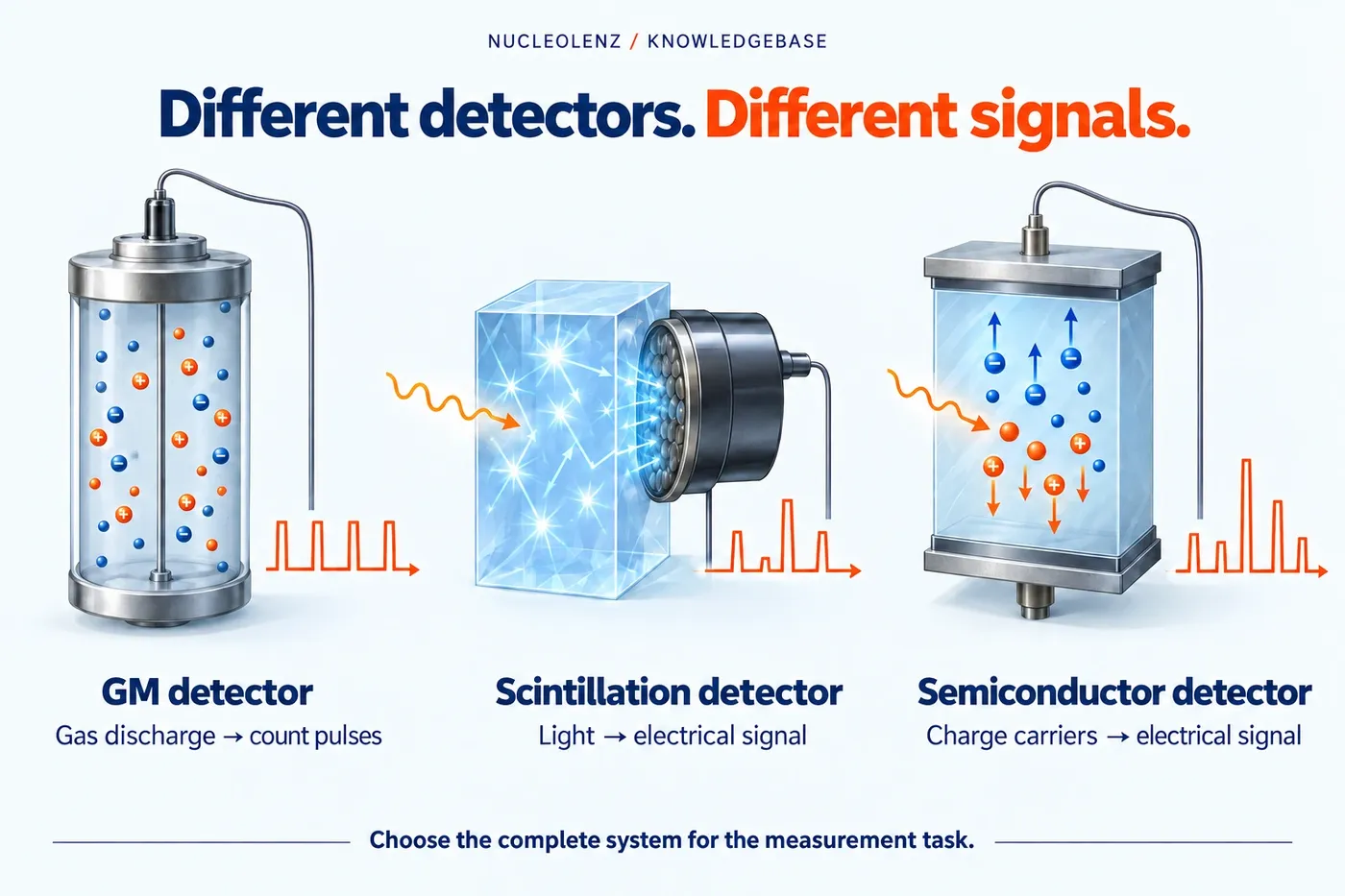
Open the concept graphic at full size ↗
Three key ideas
Different mechanisms, different information
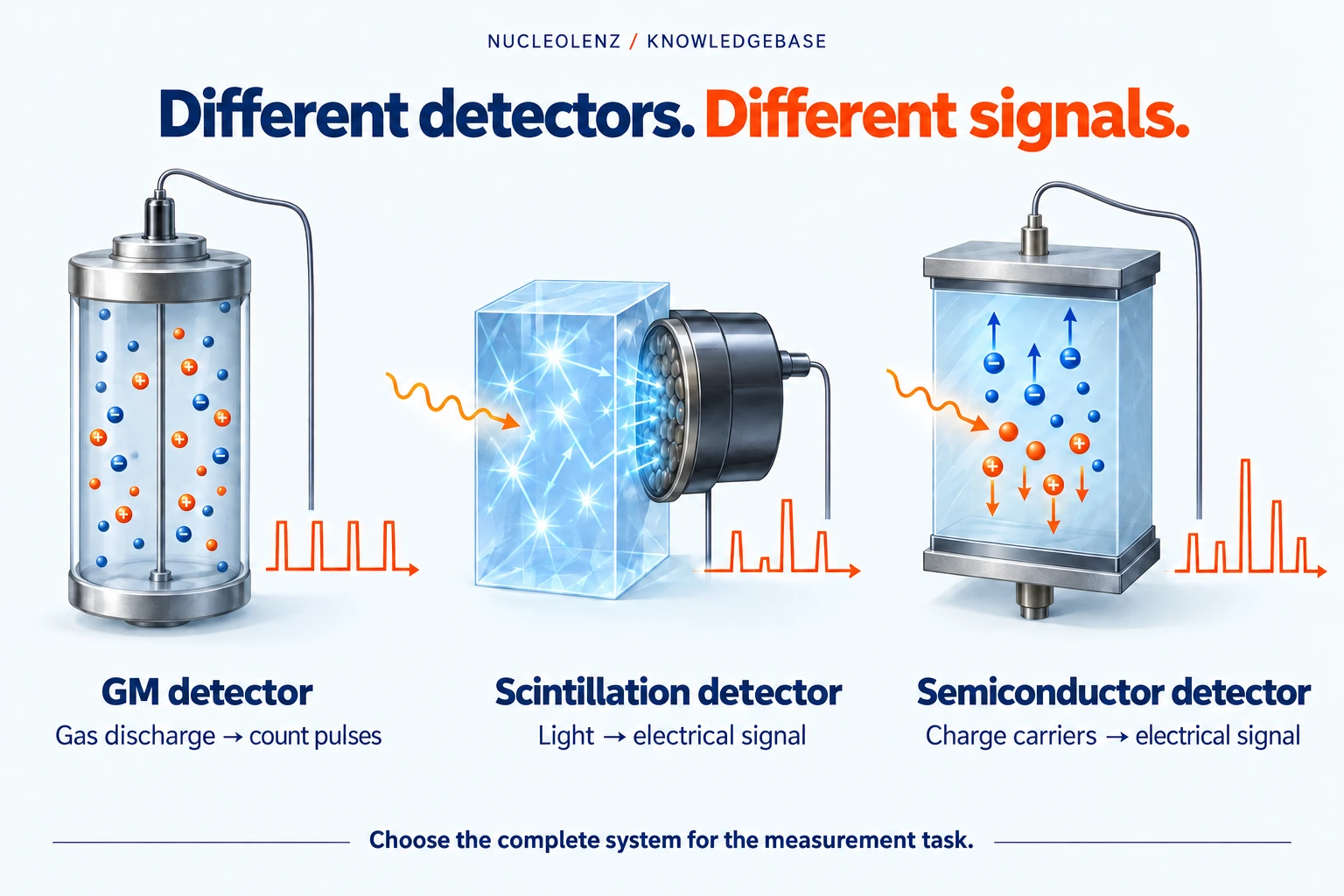
- GM detector: Gas discharge provides countable events; no useful pulse-height energy data.
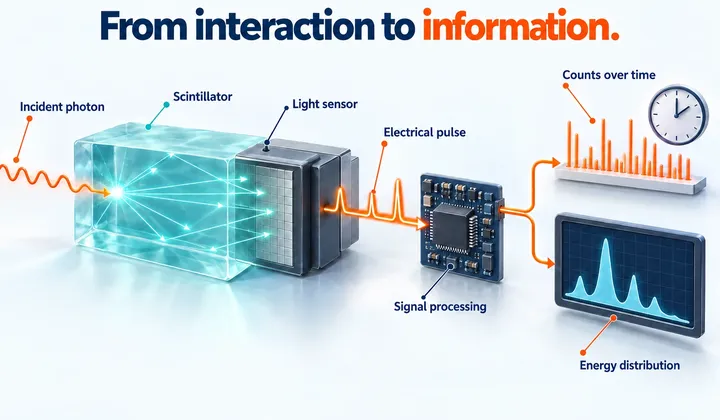
- Scintillator: Light from interactions is converted into an electrical signal.
- Semiconductor: Interactions create charge carriers collected by an electric field.
At a glance
Compare the key distinctions
| Focus | What it establishes or needs | Important limit or evidence |
|---|---|---|
| GM | Useful event counting in suitable instruments | Pulse height does not provide gamma spectroscopy |
| Scintillation | Counting or spectroscopy in suitable systems | Material and complete readout determine performance |
| Semiconductor | Charge collection; spectroscopy in suitable systems | Device type and supporting infrastructure matter |
This is a mechanism comparison, not a specification or universal ranking of detector families.
Detector technology influences the signal an instrument can use, but a technology name is not a complete specification. Selection should connect the physical response to the intended measurement and operating conditions.
Compare how useful information is produced
A Geiger–Müller detector uses a gas discharge to register events. Its pulses do not normally provide the energy information needed for gamma spectroscopy. A scintillator produces light from suitable radiation interactions; an associated sensor and processing chain can use that light. A semiconductor detector collects charge generated by interactions in its sensitive material.
These descriptions introduce the mechanisms. They do not establish the response range, environmental limits or performance of a particular assembled instrument.
Compare requirements, not isolated labels
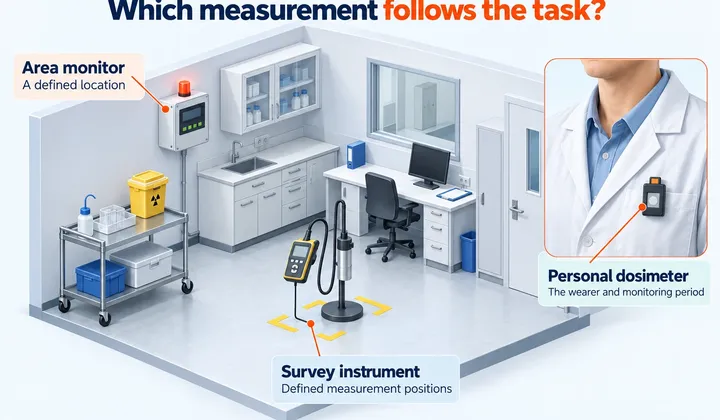
Define the radiation types and energies, required quantity, expected rate and measurement arrangement. If spectroscopy is needed, consider resolution and the analysis method. If the task is field monitoring, consider the supported quantity and response. Detector windows, dimensions and accessories can also change suitability.
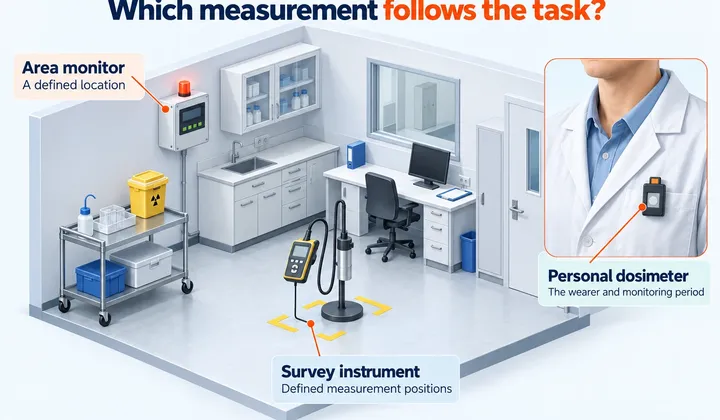
The Nucleolenz GS200 is described with a NaI(Tl) scintillation detector. Nucleolenz's Indoor Area Gamma Monitor lists detector configurations involving energy-compensated GM tubes or scintillators. Confirm which configuration is actually supplied rather than assuming that every option is present in one device.
Ask for evidence at the system level
Avoid ranking technologies solely by sensitivity or resolution without naming the conditions and quantity. A technically sophisticated detector can still be the wrong choice for a specific survey method.
A technology label is not a performance ranking
Two detectors in the same family can have different sensitive volumes, windows, packaging and electronics. A scintillator intended for gamma spectroscopy is not interchangeable with every other scintillation detector. Semiconductor is also a broad family: a laboratory HPGe spectrometer and a compact semiconductor device can have very different operating requirements.
For an equipment comparison, request the particular model and configuration behind each claimed result. If a response curve or resolution value is provided, keep its radiation energy and measurement conditions attached. Comparing isolated numbers from unlike tests can produce a convincing spreadsheet and a poor instrument choice.
Work through two different requirements
A fictional teaching team wants students to see counts change between defined arrangements. A second team wants to separate closely spaced features in a gamma spectrum. Both need a suitable detector and controlled method, but the second question explicitly requires energy information and adequate resolution. The decision cannot be made from the presence of an audible count signal.
Next, add practical constraints: the instrument's location, available services, acquisition time, software and training. Some high-resolution systems require cooling and supporting infrastructure. This does not make them unsuitable in general; it makes those requirements part of the system to evaluate. Avoid transferring a laboratory performance claim into a portable field task without evidence.
Document the tradeoff you accepted
- Name the measurement output and the radiation conditions it must support.
- Explain which detector characteristic matters for that output.
- Record the supporting performance evidence and its test conditions.
- List the required accessories, services and maintenance arrangements.
- State which tasks remain outside the chosen setup's scope.
This short decision record is useful months later when someone proposes a new application or replacement probe. It preserves the reason for the original choice. A detector family explains part of the physics; a documented system comparison explains why a particular instrument fits the job.
The useful conclusion is a matched system: detector, electronics, processing, calibration and working arrangement. That conclusion is more actionable than a general claim that one detector family is always superior.
Check your understanding
Put the idea to work
Choose an answer, then reveal the explanation. Your answers stay in this browser.