
Area Monitor, Survey Meter or Personal Dosimeter?
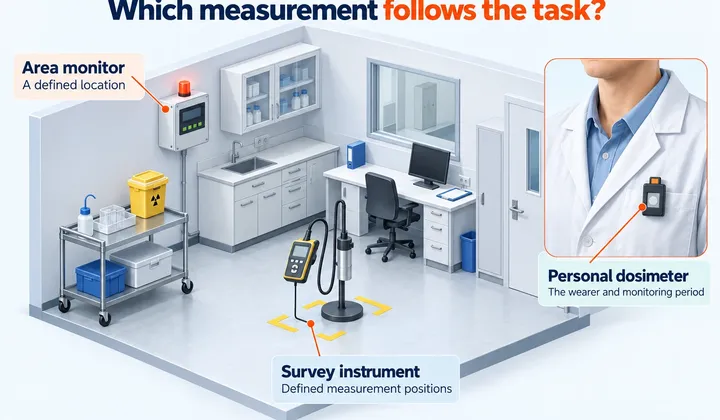
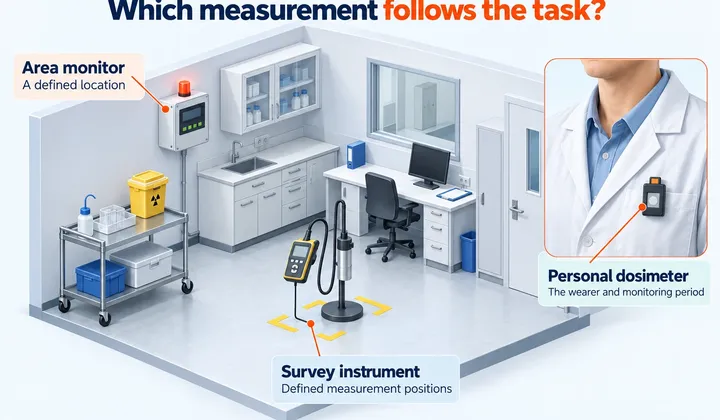
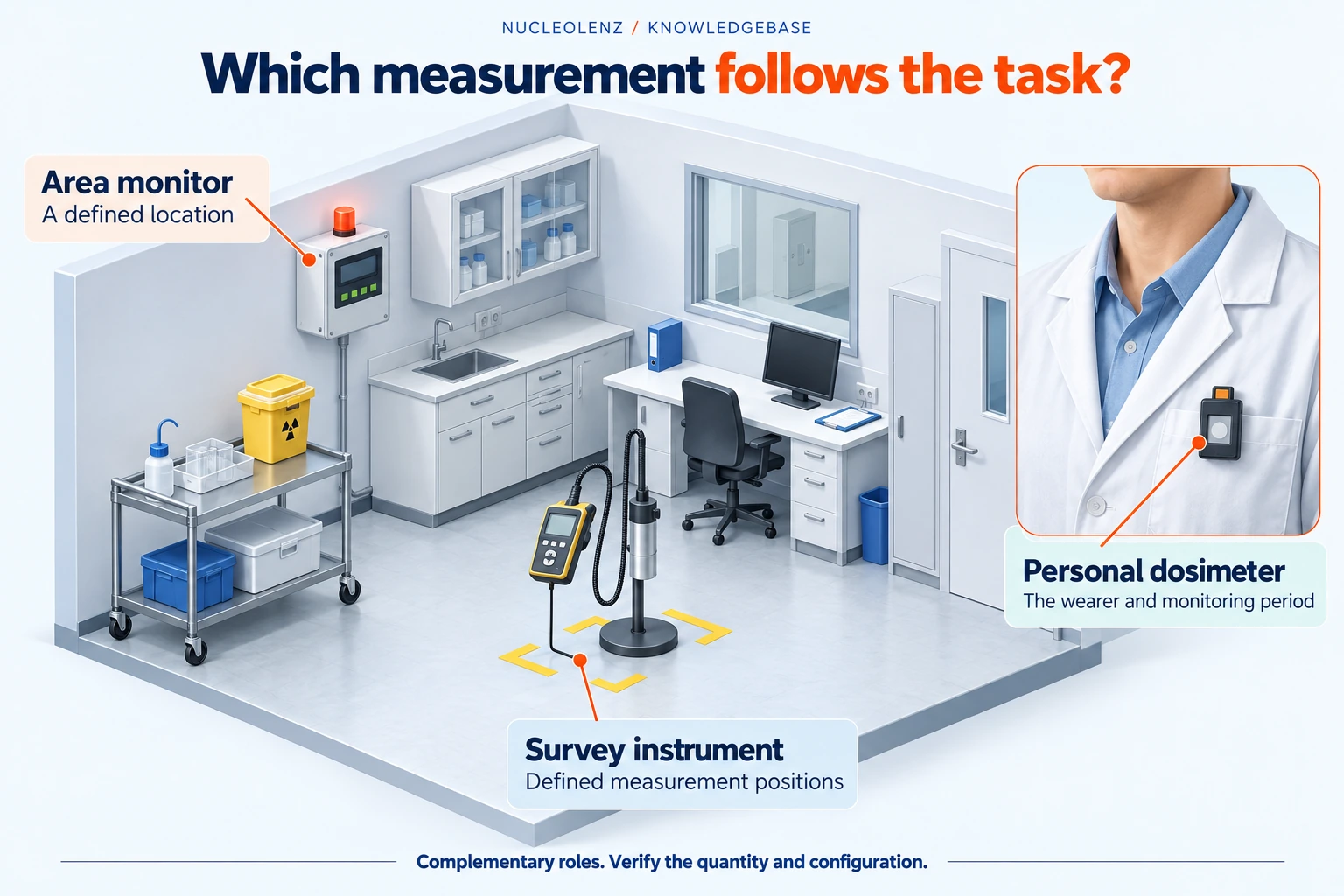
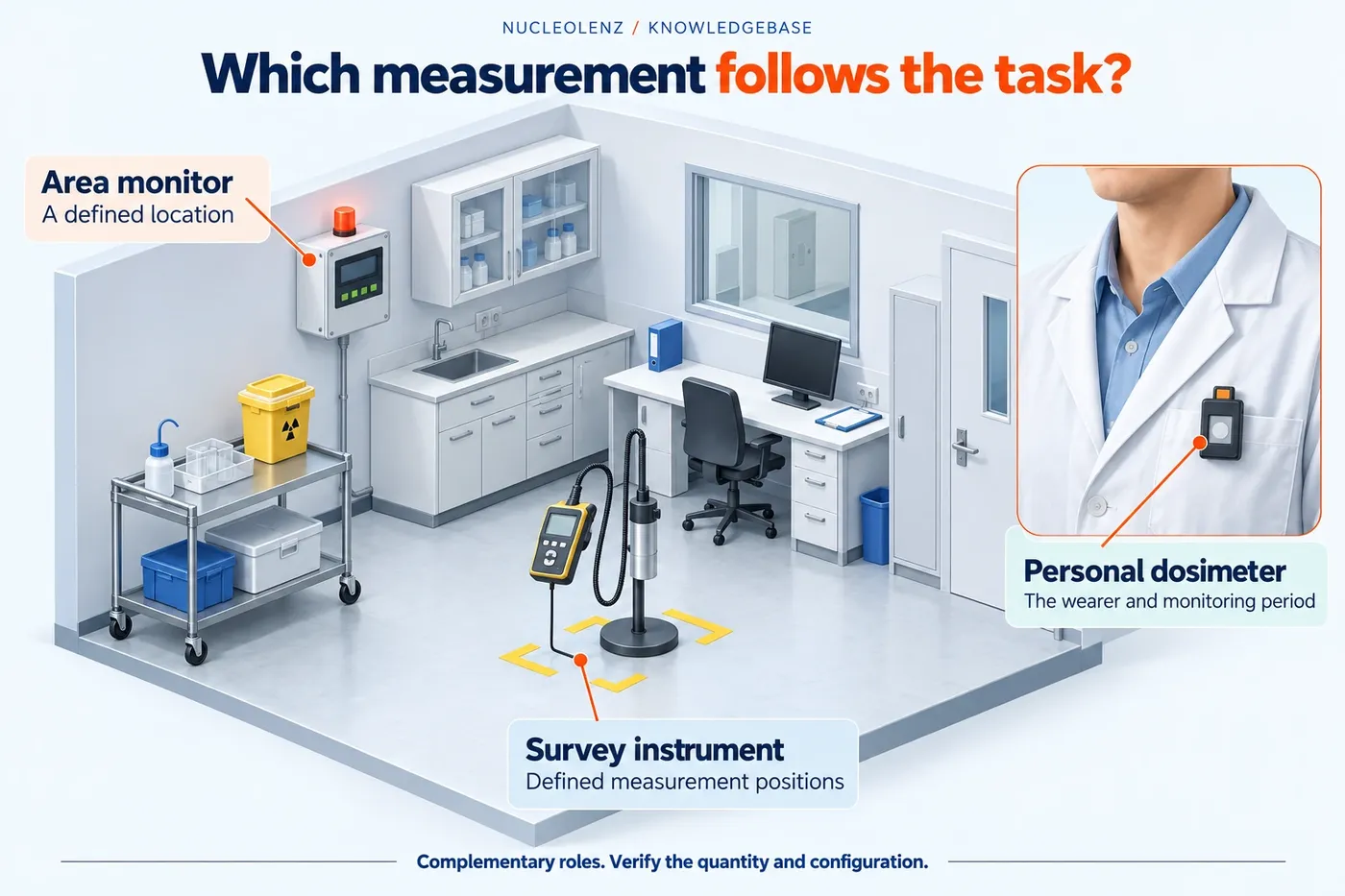
A fixed monitor follows a location, a survey meter follows a measurement plan, and a personal dosimeter follows the wearer. Learn how their records work together.
Open the concept graphic at full size ↗
Three key ideas
Location, survey and wearer
- Area monitor: Observes conditions at an installed detector position.
- Survey meter: Investigates defined positions using a suitable method.
- Personal dosimeter: Supports a record associated with the wearer.
At a glance
Compare the key distinctions
| Focus | What it establishes or needs | Important limit or evidence |
|---|---|---|
| Area monitor | Fixed detector position | Representativeness of placement and operating state |
| Survey meter | Selected points or survey path | Detector suitability, geometry and timing |
| Personal dosimeter | Wearer and monitoring period | Calibrated quantity and wearing arrangement |
These are distinct measurement roles; suitability depends on the complete method.
Three instruments can be present in the same workplace without duplicating each other's job. Their roles depend on what is monitored, where the detector is located and how the result will be used.
A fixed location needs a defined purpose
An area monitor observes conditions at its installed detector position. It can provide a continuing indication or alarm relevant to that location. Its placement and configuration determine what it can represent; one fixed point does not automatically describe every occupied position.
For example, a Nucleolenz Indoor Area Gamma Monitor is an instrument to discuss when the requirement concerns fixed gamma monitoring. The site assessment must determine the coverage and response arrangements.
A portable survey follows a question
A survey instrument can be moved between defined locations to investigate a field or material, depending on its detector and method. The operator provides much of the measurement context: position, orientation, duration and relevant conditions.
A personal record follows the individual
Personal dosimetry concerns the wearer and the quantities supported by the dosimeter and monitoring programme. A dosimeter's wearing position, response and recording arrangements matter. A nearby area reading should not automatically be substituted for an individual's dose record.
Nucleolenz's Teledosimeter is described with cumulative and rate displays. Confirm its calibrated quantity and the site's requirements when assessing a personal-monitoring application.
Write three separate requirements before buying: the fixed location to observe, the portable measurements to perform and the individual record needed. This prevents a general request for “a radiation meter” from concealing several different tasks.
Follow a maintenance shift through three records
Consider a fictional maintenance shift in an authorized radiation workplace. An installed monitor records conditions at its detector position. A planned portable survey records several defined positions before or during the work. A worker's assigned dosimeter records the supported personal quantity over the period of use. The records concern the same shift, but they sample different aspects of it.
If two indications differ, first compare what each actually represents. The worker may have moved, the fixed detector may be behind a different structure, or the survey may describe a different operating state. An apparent disagreement is a reason to examine location, time and quantity, rather than average the numbers together.
Write a location, route and wearer brief
- Location: state what the fixed detector position is intended to represent, how data are received and what status information is available.
- Survey: list the questions, positions, detector configuration and conditions to record during portable measurements.
- Wearer: identify the applicable monitoring programme, assigned device, wearing arrangement and period of use.
For all three, establish how equipment readiness and calibration are checked. The required details will differ, but the record should always let a reviewer understand which configuration produced the result. A model name alone cannot reconstruct an entire shift.
What if only one type is available?
Availability does not change the measurement question. An organization should assess whether the available evidence is adequate under its radiation protection programme and identify any additional monitoring needed. A calculation based on workplace measurements may be part of a defined assessment, but it requires appropriate information and a competent method; a nearby meter reading is not automatically a personal dose record.
The useful outcome of this comparison is a plan with complementary roles. Ask which location needs continued observation, which questions require movement between positions, and which records must be associated with individuals. Then select and document the methods that answer those requirements.
The instruments can support one another when their roles and limitations are explicit. A complete programme also needs trained people, records, calibration and a defined response to findings.
Check your understanding
Put the idea to work
Choose an answer, then reveal the explanation. Your answers stay in this browser.