
Why Radiation Detectors Count When No Source Is Nearby
Background counts can come from the environment and the measurement setup. Learn to compare durations, recognize variation and preserve a useful blank record.
Open the concept graphic at full size ↗
Three key ideas
A count needs a measurement context
- Environment: Natural radiation contributes to the observation.
- Setup: Detector, shielding and settings shape the response.
- Comparison: Match duration and conditions before interpreting.
At a glance
A practical comparison
| Observation | What it tells you | What else you need |
|---|---|---|
| More total counts | More accepted events during that acquisition | Duration and comparable settings |
| Different background after moving | The observation changed with the setup | Location, geometry and instrument status |
| Zero accepted events | No events were registered in that interval | Detection capability and the intended question |
Educational comparison; apply the method specified for the instrument and task.
An instrument does not need a deliberately introduced source to register events. A reading in an apparently empty room can reflect the environment, the detector and the conditions of the measurement.
A blank is a measurement of the setup
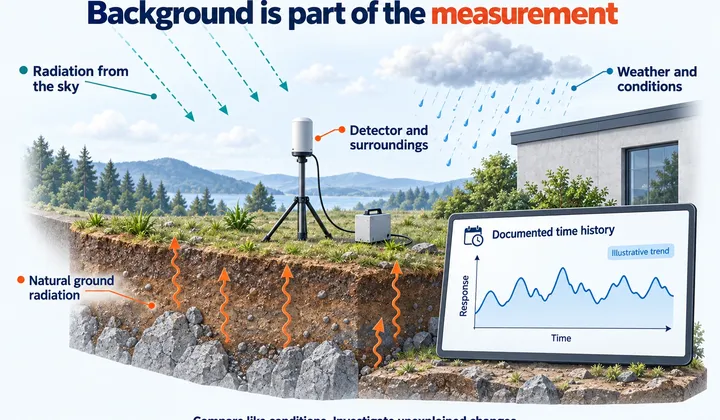
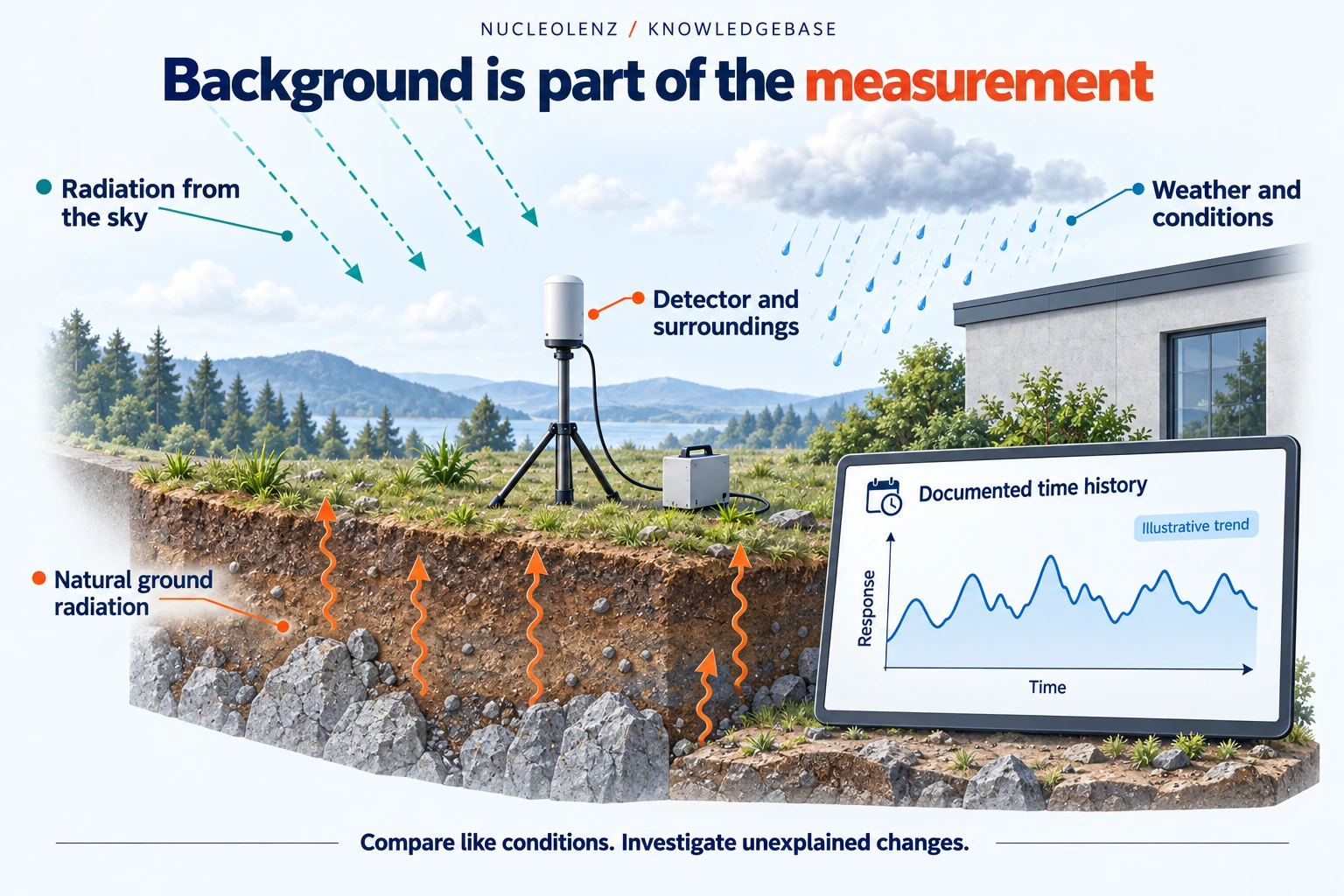
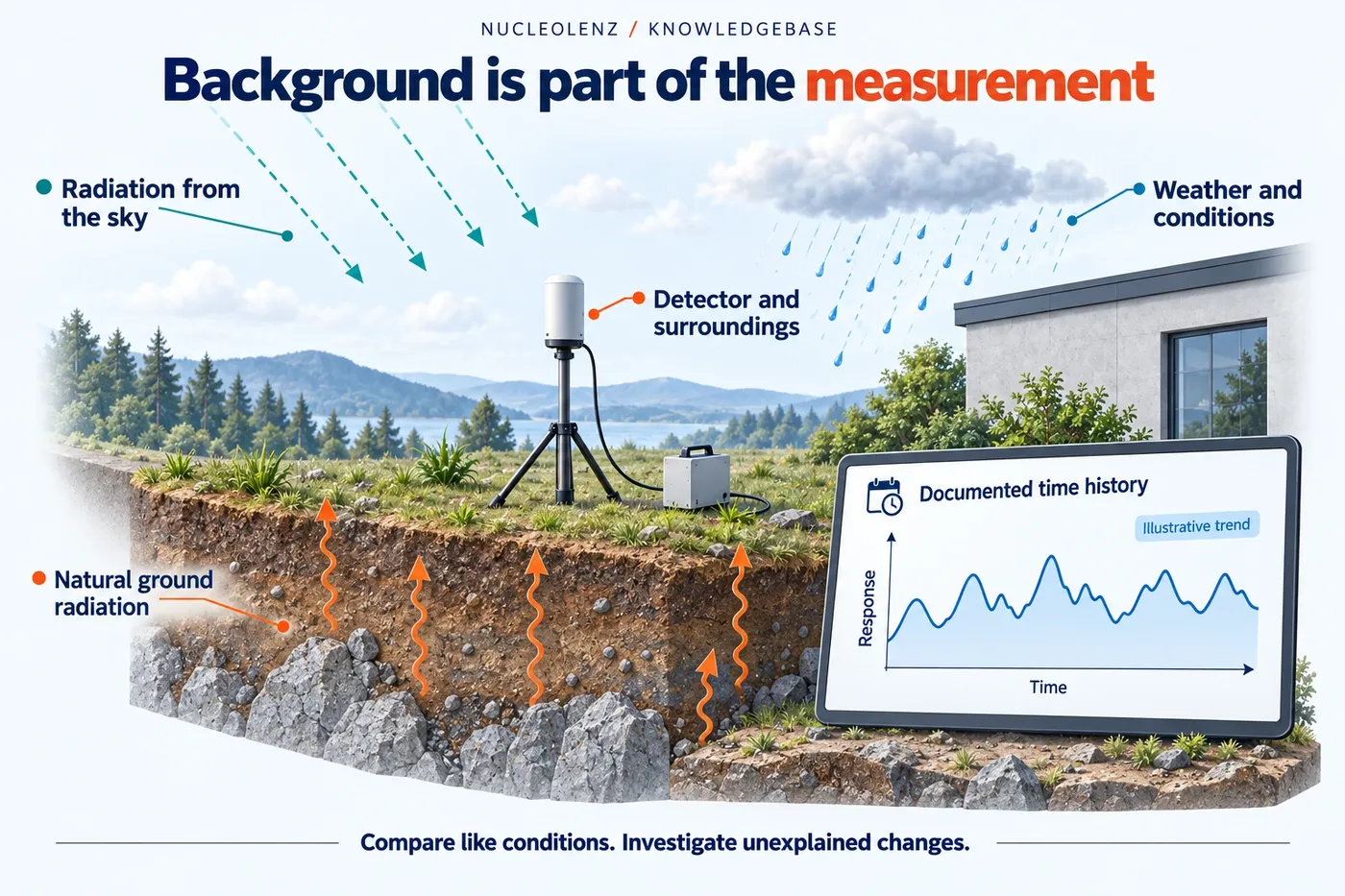
Natural radionuclides occur in the environment, and radiation can reach an instrument from outside the immediate work area. Background also varies with detector type and the surroundings. An empty sample holder therefore does not mean an absence of all detectable radiation.
A blank measurement is useful because it describes the setup without the sample or source of interest. To make the comparison meaningful, preserve the position, shielding, acquisition settings and measurement duration. A blank measured in another room may answer a different question.
Expect individual counts to fluctuate
Random event detection means successive short measurements can differ even when the underlying conditions remain similar. A brief spike is not automatically evidence of a new source; a persistent change should not automatically be dismissed as random variation either.
Keep enough context to repeat it
Record the instrument and detector identities, location, date, acquisition mode, counting time and nearby changes. If you move the setup or change shielding, explain why the earlier background may no longer represent the new arrangement.
With a gamma spectroscopy instrument such as the Nucleolenz GS200, a background spectrum can provide more context than a single total count. Review the spectrum and counting conditions using the instrument's documentation and an appropriate analysis method.
“No source nearby” is a useful observation, but it is not a measurement definition. A documented background makes that observation reproducible and helps prevent a normal environmental contribution from being mistaken for a sample result.
Try the comparison before naming the cause
In a fictional classroom worksheet, three one-minute observations contain 60, 54 and 67 counts. A fourth observation contains 128 counts but lasted two minutes. The fourth total looks much larger, yet its average rate is 64 counts per minute. Correcting the time comparison is the first useful step; it does not, by itself, prove that the setup was stable or that a source was present.
Keep the totals and durations, rather than saving only rounded rates. Then check whether the detector, location, energy window and shielding stayed the same. Repeatability concerns comparable observations. Combining unrelated setups into one average can hide the change you are trying to understand.
Background, blank and zero are different ideas
- Background: The contribution present under the chosen measurement conditions, apart from the signal being investigated.
- Blank: A defined measurement without the sample constituent of interest. Its holder, collection medium or preparation can matter.
- Zero recorded counts: No accepted events in that acquisition. It does not establish that all radiation or radioactive material was absent.
For a sample measurement, ask whether the blank reproduces the parts of the setup that need to be accounted for. For a field survey, ask whether the reference location and conditions are relevant. The most convenient nearby number is not automatically the correct reference.
Natural background can change with surroundings and weather, while instrument settings can change which events are accepted. Record an unexplained shift as an observation and investigate it through the applicable method. Calling every change noise loses information; calling every change contamination makes a claim the count record may not support.
Check your understanding
Put the idea to work
Choose an answer, then reveal the explanation. Your answers stay in this browser.