
NORM Screening: Why a Field Reading Is Only Part of the Assessment
A NORM field reading is a starting point, not a complete material assay. Separate screening observations from radionuclide, activity-concentration and handling decisions.
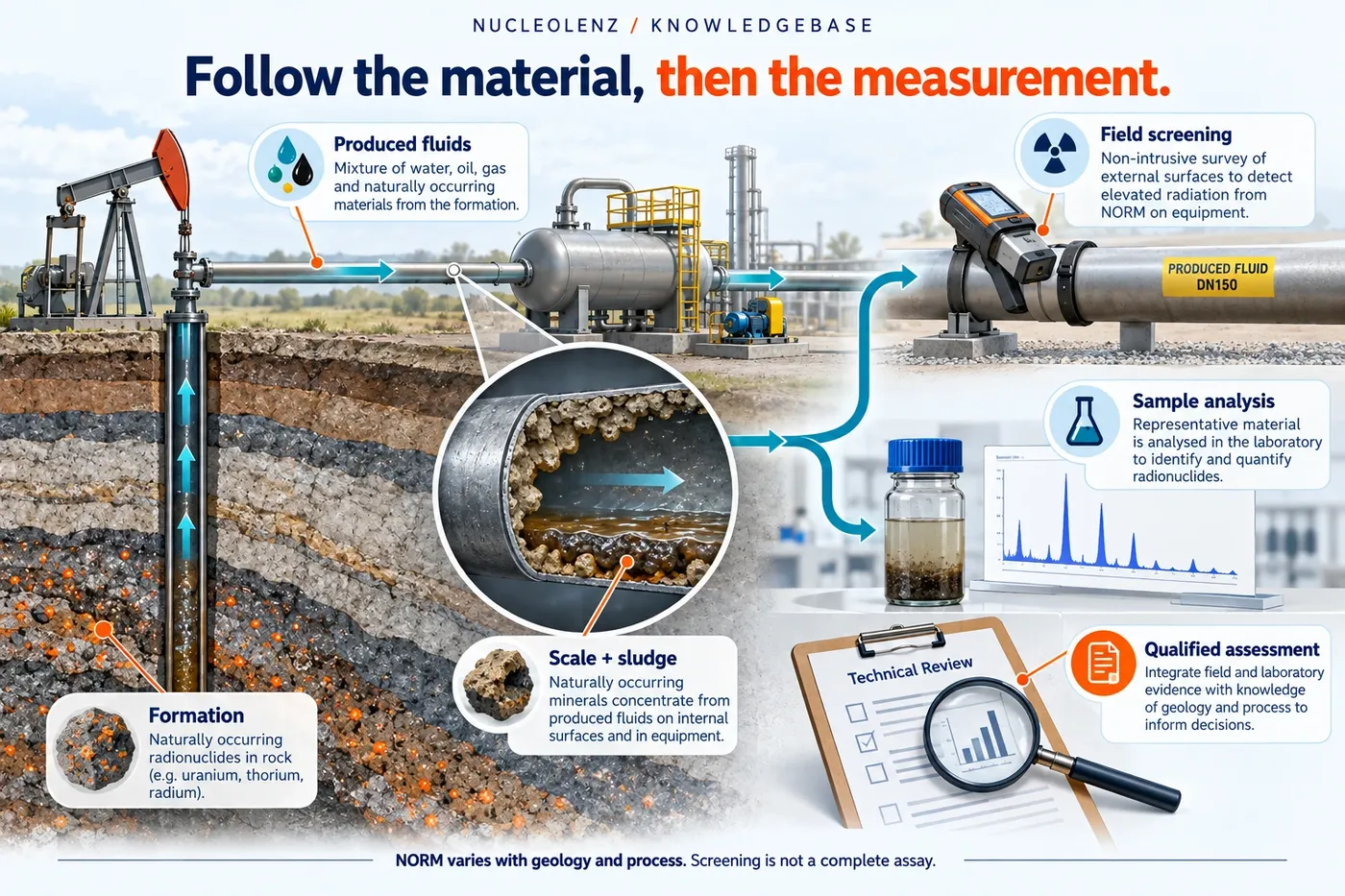
Open the concept graphic at full size ↗
Three key ideas
A field reading begins the assessment
- Screen: Record the response and exact arrangement.
- Define: Name the remaining material or exposure question.
- Assess: Use the method that supports the required decision.
At a glance
A practical comparison
| Observation | What it tells you | What else you need |
|---|---|---|
| External field reading | Response at a defined detector position | Geometry, background and intended field assessment |
| Spectral observation | Evidence about detected gamma features | Validated identification and analysis scope |
| Sample activity concentration | A result for the analysed sample | Representative sampling and method limitations |
| Handling or disposal decision | A programme-level conclusion | Applicable requirements and qualified review |
Educational comparison; apply the method specified for the instrument and task.
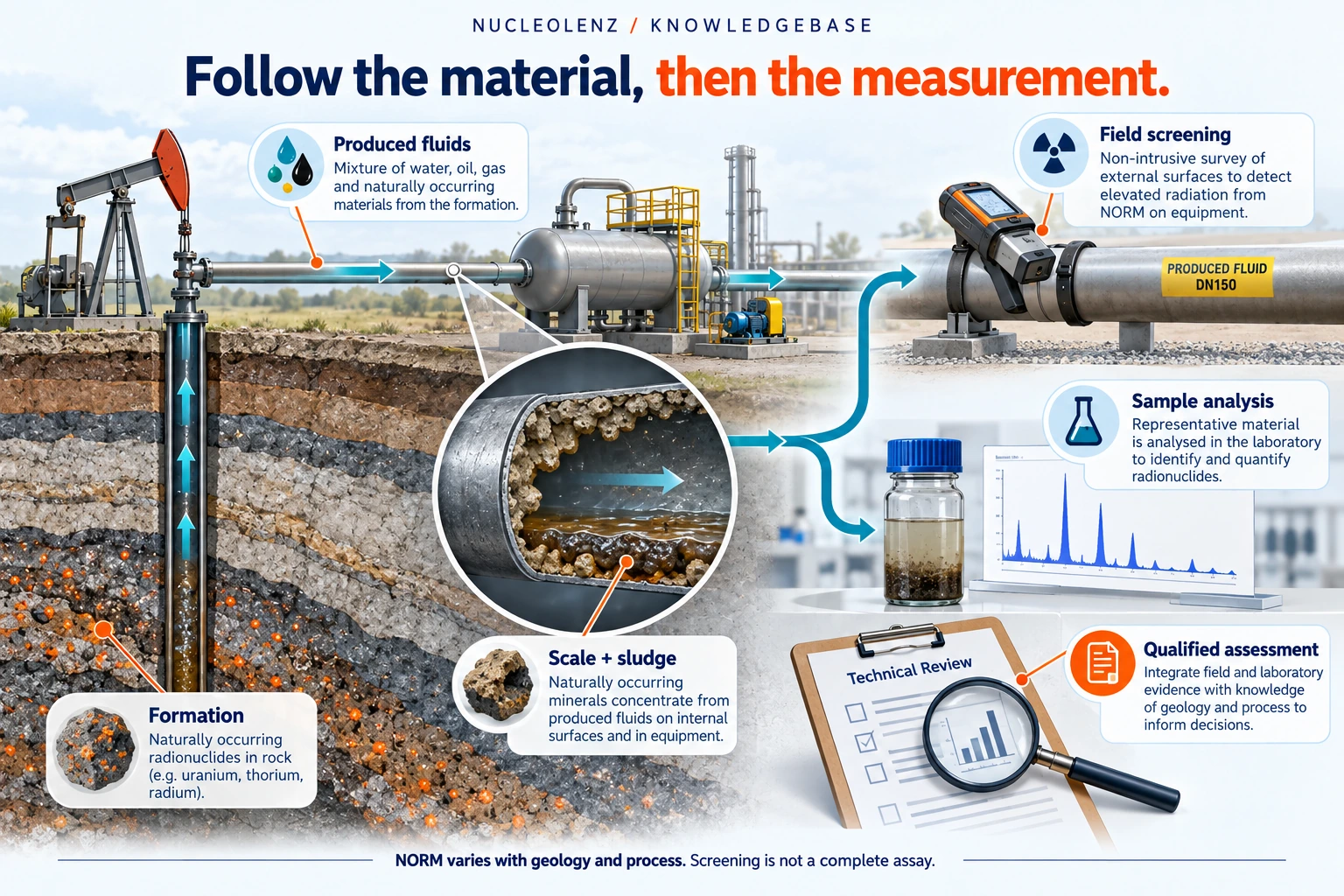
A reading beside an item can help identify a condition that needs attention. It cannot automatically describe the radionuclides, activity concentration or complete exposure implications of the material inside it.
State what the screening result represents
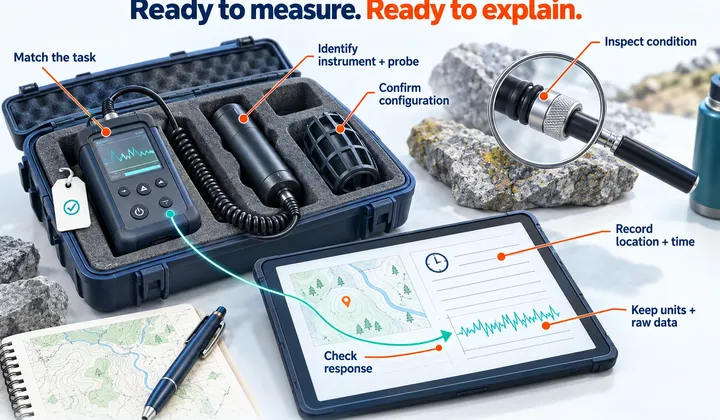
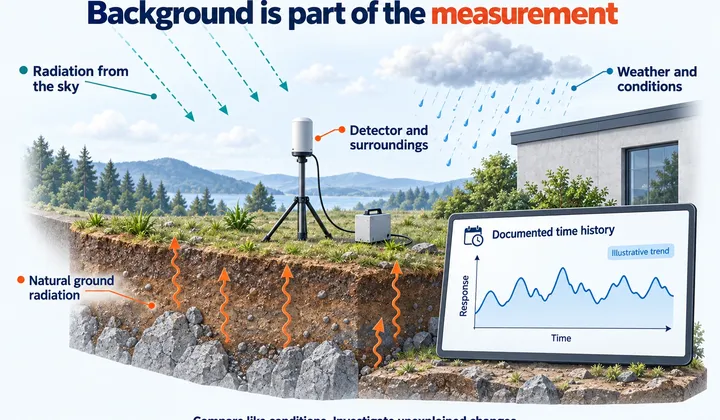
Identify the instrument, supported quantity, detector position and material arrangement. Pipe walls, container contents and shielding can affect the response. Background and acquisition conditions are part of the comparison.
Naturally occurring radioactive material (NORM) can be associated with residues and equipment from relevant processes, but the material's origin does not provide its measurement result. A historical process description and a current instrument indication should remain distinct in the record.
Decide what information is still missing
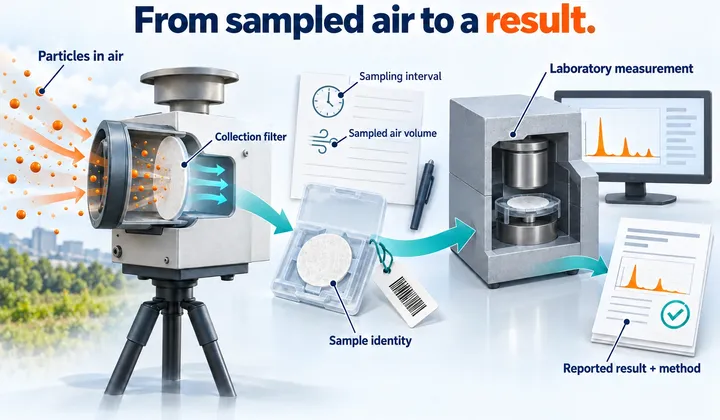
The next requirement may concern the radionuclides present, the distribution of material, a sample's activity concentration or the conditions of a maintenance task. Each can require a different method. A sample analysis must remain connected to how and where the sample was obtained.
Keep interpretation within its validated scope
Do not apply a universal count-to-activity or count-to-dose conversion without the relevant response and arrangement. Do not declare material cleared for handling, transport or disposal from an unexplained spot reading. Those decisions require the applicable programme and qualified review.
The Nucleolenz GS200 can be discussed when gamma spectral information is required. A spectral observation and a quantified material assay are different claims; establish the analysis and calibration needed for the intended result.
NORM screening is most useful when it creates a traceable starting point for assessment. Preserve the original reading and conditions, record why additional work is required and connect the final conclusion to the method that actually supports it.
One tagged item, several unanswered questions
Consider a fictional stored pipe section with an external gamma reading recorded at a labelled position. The record can describe the instrument's response at that position under the stated arrangement. It does not alone establish the activity per kilogram of deposits inside the pipe, whether material is removable, or the conditions that would arise during a later maintenance task.
Those are not minor omissions from one universal measurement. They are different questions. The steel wall, distribution of deposits and detector position influence the field observation. A sample result would introduce its own question: how well does the submitted portion represent the material being assessed?
Choose the next question before the next instrument
- External field: Which locations and operating conditions need characterization?
- Material identity: Which radionuclides or decay-chain contributions are relevant to the assessment?
- Material quantity: Is an activity concentration needed, and what sampling and analytical method supports it?
- Work activity: Does the planned task change access, containment or possible exposure pathways?
A gamma spectrum can add evidence about gamma-emitting components, but it does not automatically characterize every alpha or beta contributor. Nor should a decay-chain relationship be assumed to supply missing activity results without a method that supports that assumption. The analyst should state the radionuclides and quantities actually evaluated.
A useful screening handover
Give the reviewer the item identifier, process history, exact measurement position, equipment configuration, background context and original result. Add a short statement of the decision still required. For the fictional pipe, that might be an assessment of the proposed maintenance or a material-characterization plan; it is not an implied permission to open, move or dispose of the item.
Keep screening outcomes and final decisions connected through the record. An initial indication can justify further assessment while remaining explicitly limited to what the screening method observed.
Check your understanding
Put the idea to work
Choose an answer, then reveal the explanation. Your answers stay in this browser.