
Protective Bags and Detector Response: What the Cover Changes
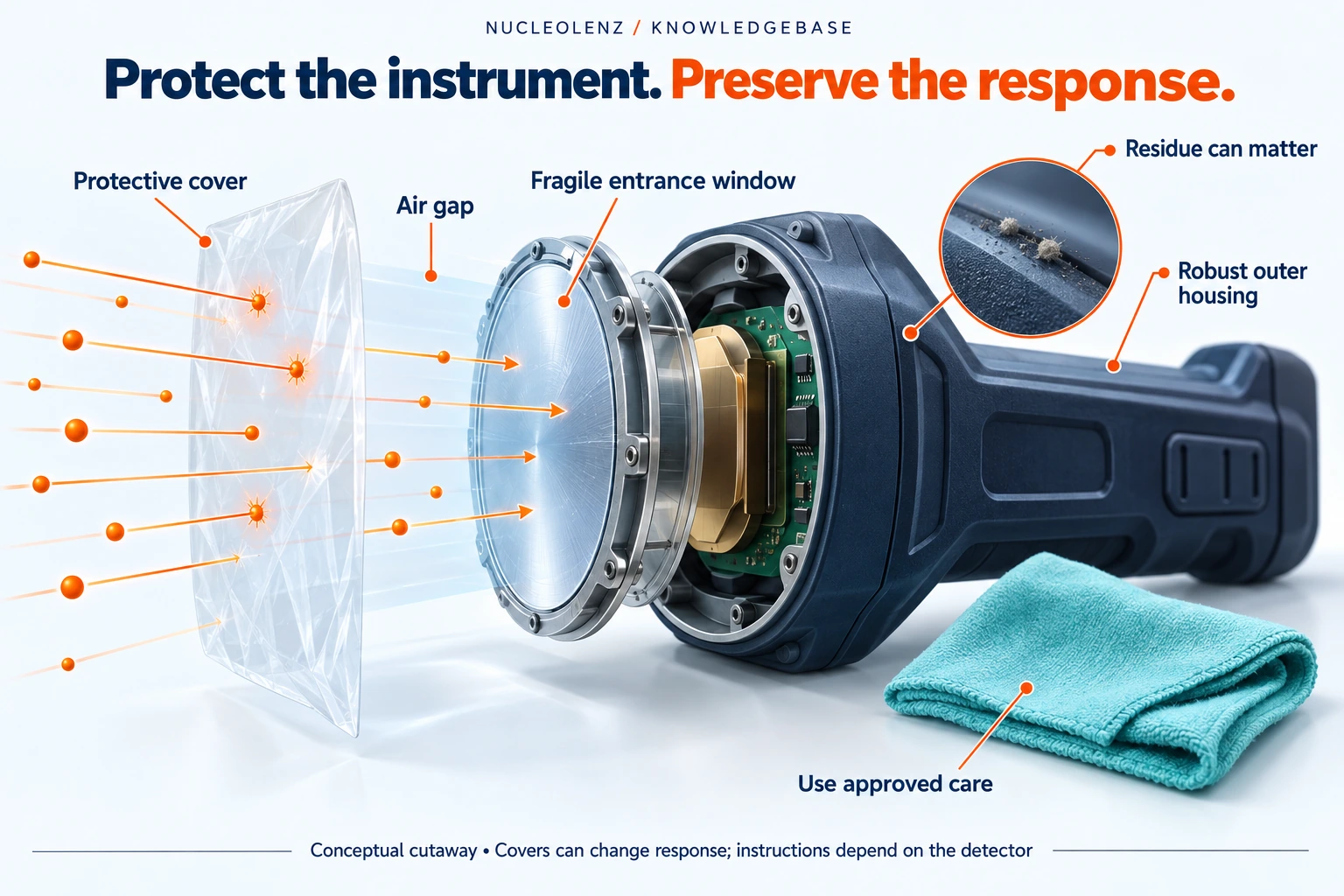
Protective covers can change the radiation reaching a detector. Evaluate the emission, material, geometry and documented response before treating a covered reading as equivalent.
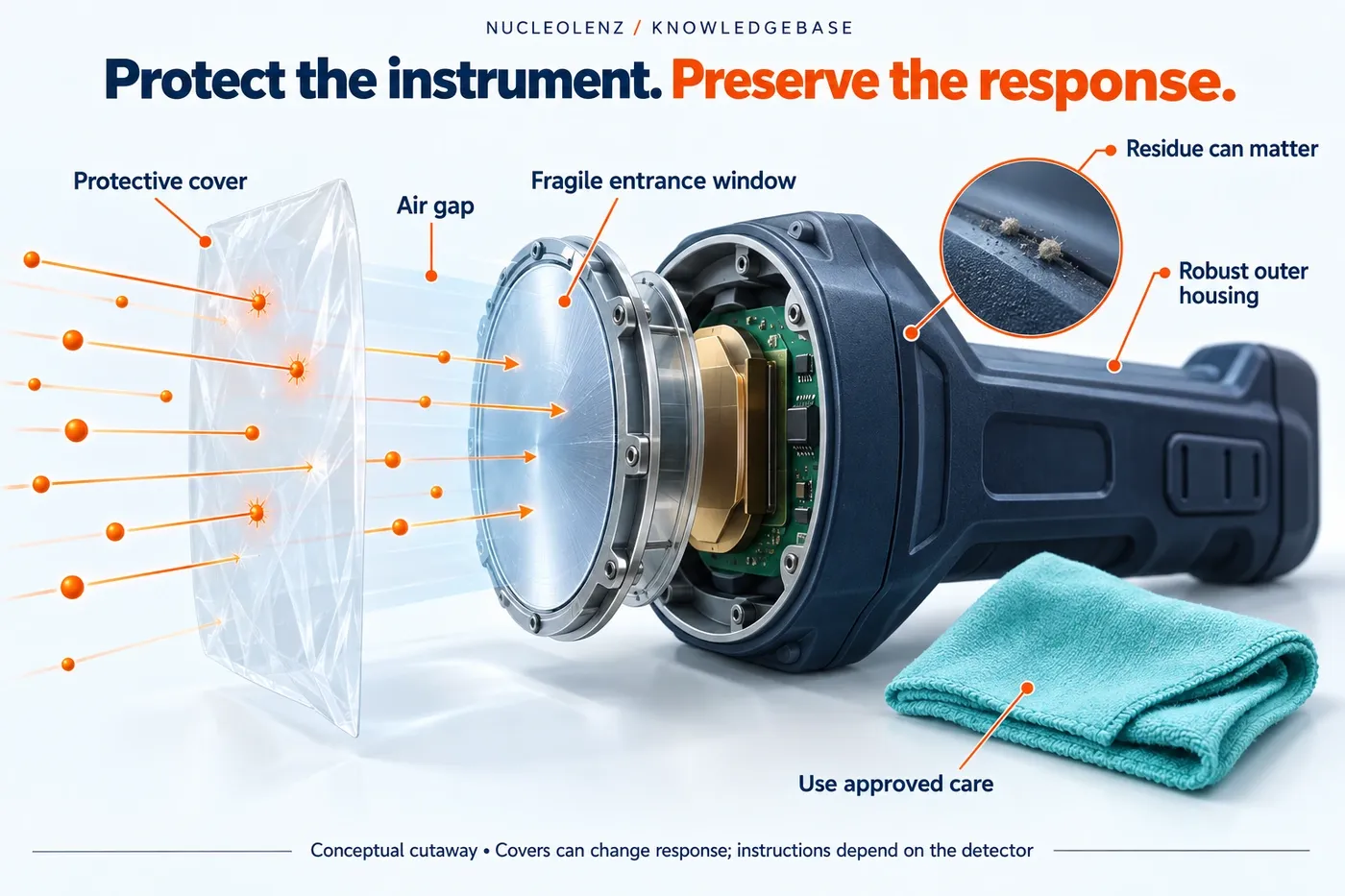
Open the concept graphic at full size ↗
Three key ideas
The cover is part of the measurement path
- Emission: Identify the radiation the survey must detect.
- Barrier: Account for cover, window and added spacing.
- Response: Use evidence for the actual arrangement.
At a glance
A practical comparison
| Observation | What it tells you | What else you need |
|---|---|---|
| Alpha contamination task | Barriers can strongly suppress the response | A detector and uncovered/covered arrangement permitted by the method |
| Beta contamination task | Response depends on energy and intervening material | Cover suitability for the expected emissions |
| Gamma field task | Effect depends on photon energy and geometry | Evidence that the planned arrangement remains suitable |
Educational comparison; apply the method specified for the instrument and task.
A bag may protect equipment from material on a surface, but it can also become part of the measurement arrangement. The important question is whether the covered setup still supports the intended survey.
Follow the radiation path
Radiation must reach the sensitive part of the detector to produce the expected response. A covering, gap or detector window can change that path. Alpha response is particularly sensitive to barriers; beta response depends on the particle energy and material encountered.
Do not generalize from a covered gamma-field measurement to an alpha or beta contamination survey. The emissions, detector and covering all need to be considered together.
Validate the arrangement you will actually use
Identify the cover material, placement and any change in detector-to-surface distance. Check whether the manufacturer and approved survey method permit the arrangement. A response check performed without the cover may not represent the covered survey setup.
Keep protection and measurement requirements connected
Equipment protection should be planned with the radiation protection team, including the handling of potentially contaminated covers. Removing a cover without an approved process can create a different problem from the one the cover was intended to prevent.
Document the approved arrangement in the survey record or procedure. If a covering is changed, assess whether the original reference and measurement sensitivity remain applicable.
The Nucleolenz radiation types guide explains why different emissions interact differently with barriers. Use that foundation to ask a specific equipment question: “What response has been established for this detector with this cover in this geometry?” A clear answer is more useful than assuming that a clean instrument automatically produced a valid contamination measurement.
A cover changes more than cleanliness
A cover adds material between the source of an emission and the detector. It can also create folds, hold the detector farther from a surface or obscure the active window. These are measurement changes, even if the cover looks thin and transparent. Optical transparency does not establish transparency to the radiation of interest.
Gamma response is not universally unchanged by a cover either. The photon energies and intervening material matter. The appropriate question is whether the added material and geometry have a significant effect for this particular measurement, supported by the manufacturer's documentation and the established method.
Work through a fictional equipment request
A team proposes placing every portable detector in the same disposable bag. Their equipment list includes a gamma survey instrument and a thin-window contamination probe. The common purchasing item does not create a common measurement arrangement. The review needs separate answers for each detector and task, including whether any cover is permitted over the sensitive region.
Suppose an earlier functional check used the bare probe while the planned survey uses the bagged probe. The earlier result remains a record of the bare setup. It cannot alone demonstrate the covered setup's response. The correct next step is a documented suitability review, not an improvised correction factor.
Questions for the method owner
- Which emissions and energy range must reach the detector?
- Does the approved method permit this material, placement and added spacing?
- Which response evidence applies to the actual covered arrangement?
- How are covers identified, changed and handled within the contamination-control procedure?
Record the approved configuration in a way that another operator can reproduce. If the material or placement changes, refer the change for review. A cover is useful only when equipment protection and the required measurement remain compatible.
Check your understanding
Put the idea to work
Choose an answer, then reveal the explanation. Your answers stay in this browser.