
Personal Dosimetry and Area Monitoring: How to Read Them Together
Personal and area monitoring describe different references. Use quantities, synchronized timelines and work locations to read their records together without treating them as interchangeable.
Open the concept graphic at full size ↗
Three key ideas
Connect location, person and time
- Area record: A defined detector position in the workplace.
- Personal record: A stated wearing arrangement and monitoring period.
- Work timeline: Locations and task times explain the relationship.
At a glance
A practical comparison
| Observation | What it tells you | What else you need |
|---|---|---|
| Fixed monitor trend | Conditions at the installed detector | Placement, quantity and logging interval |
| Personal dosimeter record | The supported quantity for its wearing arrangement | Issue period, wearing practice and task history |
| Task log | Where and when work occurred | Clock alignment and relevant process changes |
Educational comparison; apply the method specified for the instrument and task.
A fixed monitor and a dosimeter worn by a worker can observe different radiation conditions during the same shift. The difference is often a reason to examine the work context, not to assume one instrument is wrong.
Match each record to its reference
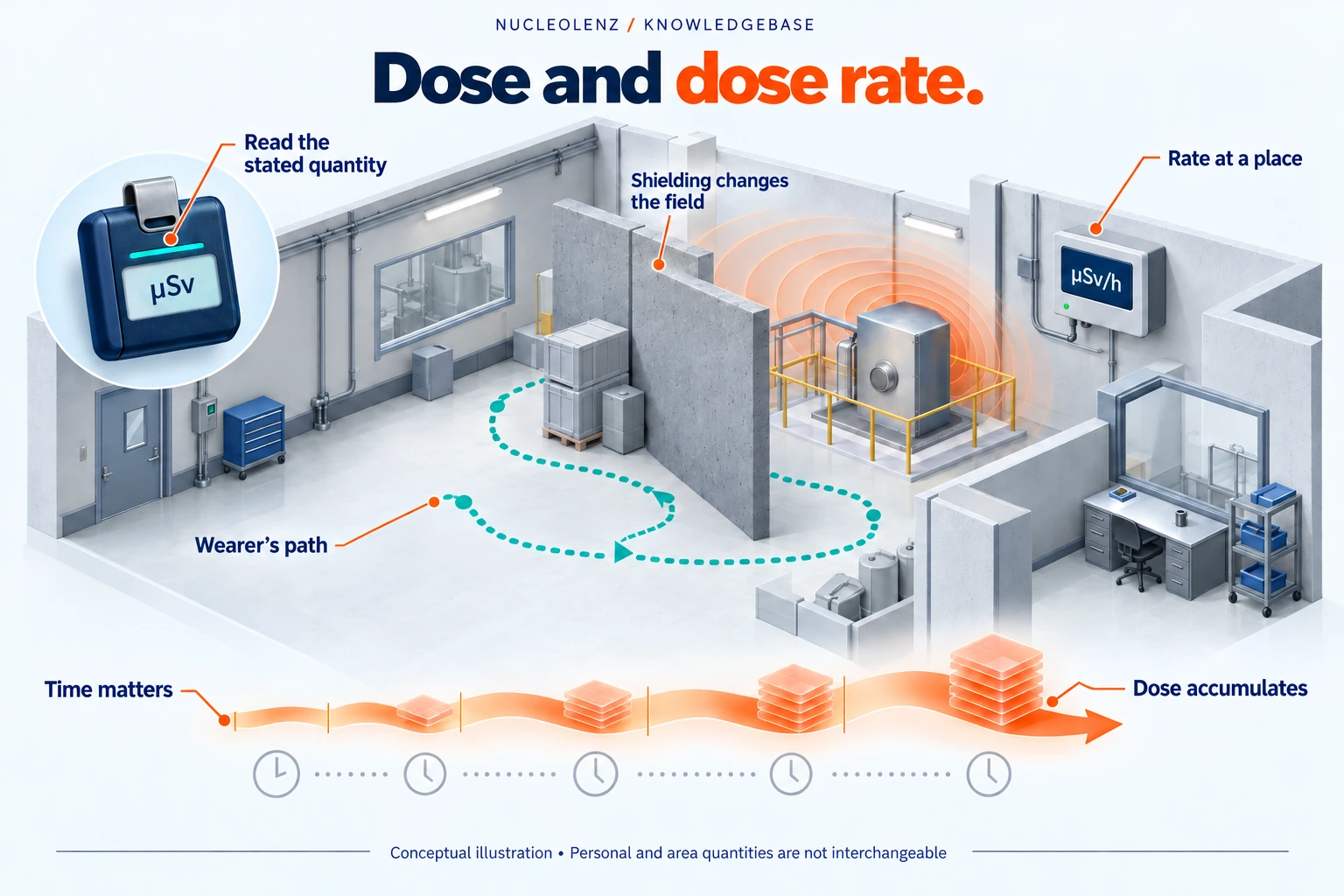
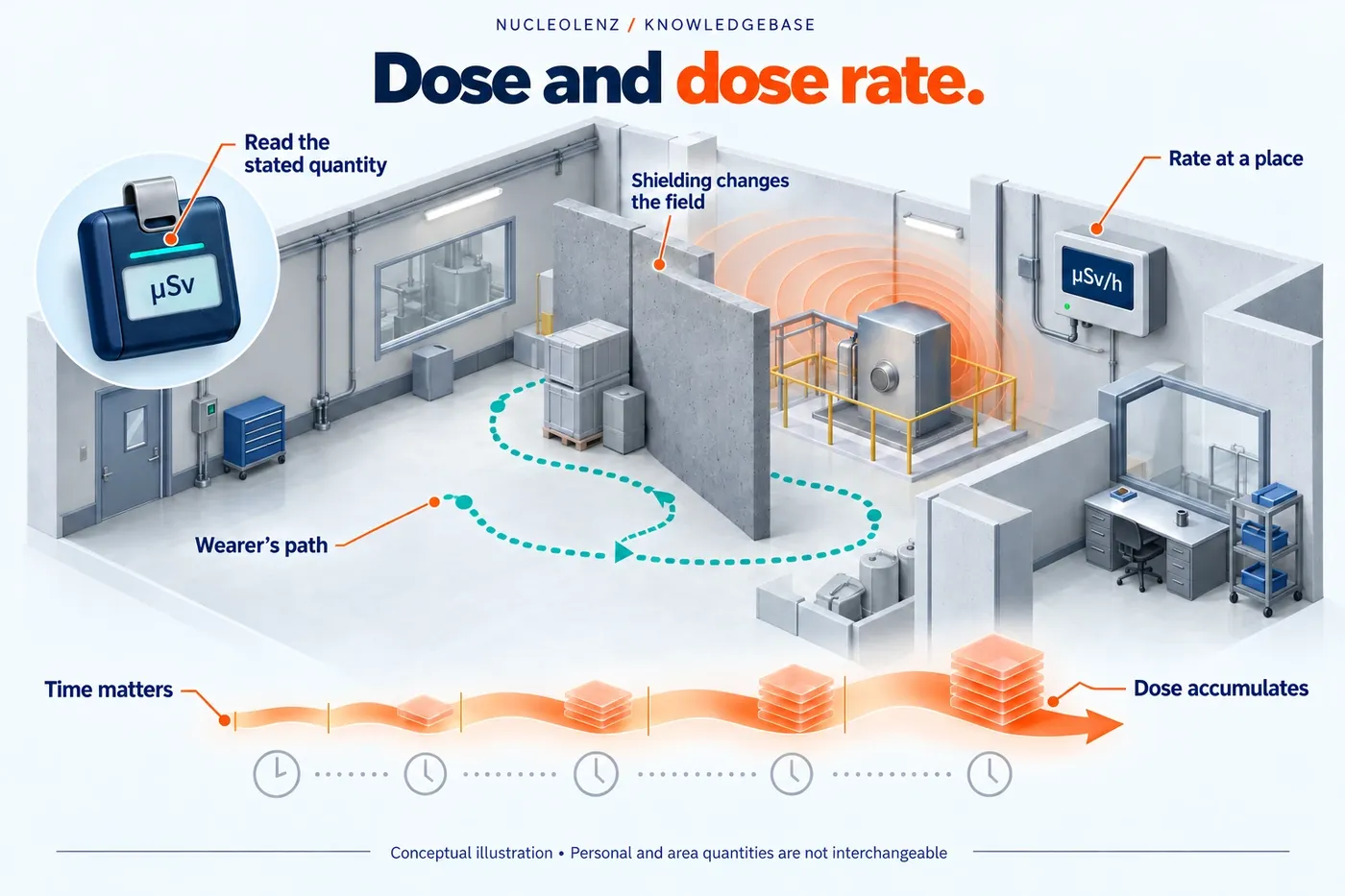
An area measurement refers to the detector's installed position and calibrated quantity. A personal measurement refers to the dosimeter's supported quantity and wearing arrangement. The worker can move between locations while the fixed detector remains in place.
Changing source positions, shielding and occupancy can affect how the two records relate. Their numerical similarity or difference needs an explanation grounded in those conditions.
Use a timeline to connect the information
A timeline helps relate the records; it does not replace required personal dosimetry. Any use of workplace measurements in dose assessment needs the appropriate professional method and programme requirements.
Investigate without erasing the distinction
Record the instruments, quantities, time settings and relevant configuration. When an unexpected result appears, review the wearing arrangement and work history along with the area conditions. A quiet fixed monitor does not automatically establish the individual's complete exposure history.
Nucleolenz's Teledosimeter and Indoor Area Gamma Monitor illustrate the difference between a dose/rate instrument and a fixed-location gamma monitor. Verify the quantities, configuration and site suitability for the actual application.
A good monitoring plan describes how the two streams of information support decisions and who reviews discrepancies. It does not force them into one generic “radiation reading.” Retaining their different references makes both records more useful for understanding what happened during the work.
Read a fictional shift as a timeline
A worker spends the first part of a shift near workstation A, then moves behind a shield to workstation B. A fixed monitor remains beside the doorway throughout. The personal record and the fixed trend belong on the same timeline, but the doorway measurement does not automatically represent either workstation. A quiet interval at the doorway is not proof that every position had the same field.
Start with the worker's task times and locations, the installed detector position and the actual monitoring quantities. Check whether the clocks and logging intervals can be aligned. A ten-minute summary and a short personal alarm event should not be compared as if both were instantaneous readings. Where only an accumulated personal result is available, it may not reveal which task contributed to the total.
What each stream contributes
- Fixed monitoring: A continuing observation of the conditions at a selected location, with the response and quantity defined for that installation.
- Personal monitoring: Information associated with the person and the approved wearing arrangement over a stated monitoring period.
- Work history: The locations, durations and process changes needed to interpret how the two records relate.
Instrument units may look similar while the underlying operational quantities differ. Calibration and wearing requirements matter because an on-body measurement and a measurement at a point in the workplace are not the same geometry. Do not treat a dosimeter attached to a wall as an equivalent area monitor without an appropriate assessment.
Make a discrepancy useful
Keep the original records and identify which explanation is being checked: timing, location, shielding, instrument status or wearing practice. Document confirmed facts separately from proposed explanations. The purpose is to improve the exposure assessment and monitoring plan, not to force both datasets to display the same number.
Check your understanding
Put the idea to work
Choose an answer, then reveal the explanation. Your answers stay in this browser.