
After Air Sampling: From Filter Collection to a Radioactivity Result
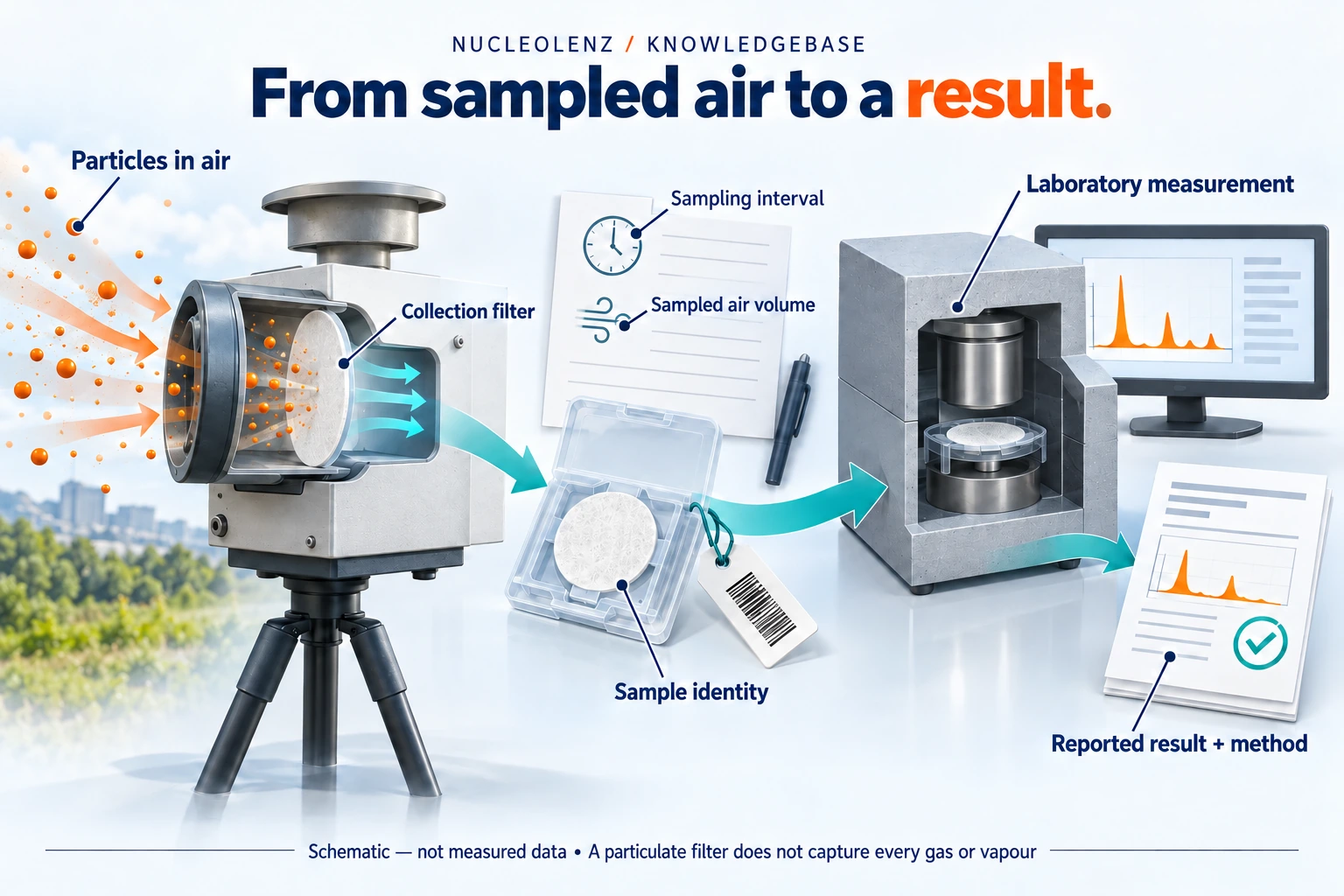
Connect an air filter to its sampling record and laboratory result. Learn why volume, sample identity, collection medium and analysis scope are essential to an air-concentration report.
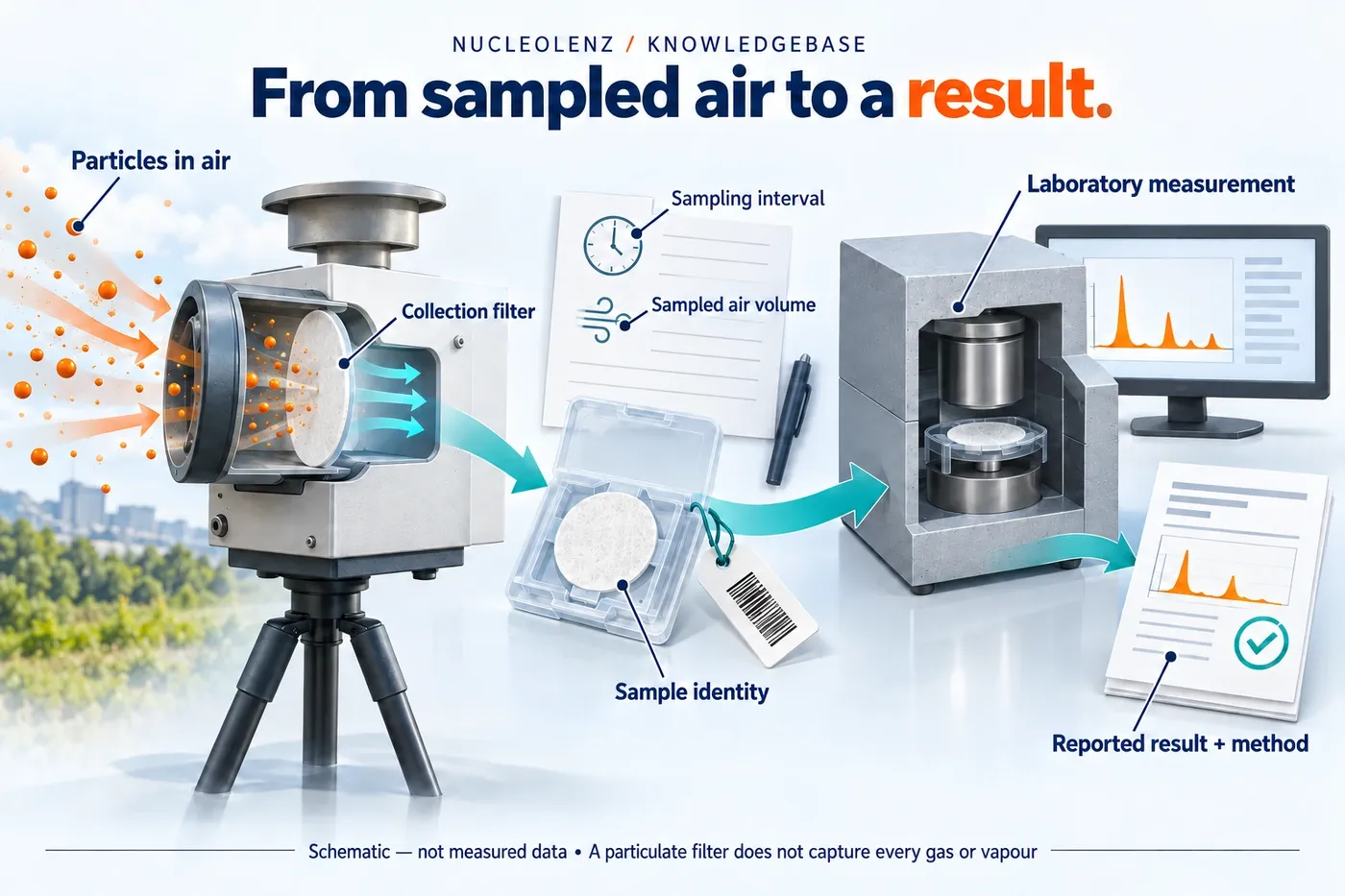
Open the concept graphic at full size ↗
Three key ideas
Keep the sample and its history together
- Collect: Document medium, location, interval and air volume.
- Analyse: Apply the laboratory method to the identified sample.
- Report: State the supported quantity and its limitations.
At a glance
A practical comparison
| Observation | What it tells you | What else you need |
|---|---|---|
| Sampler volume display | Air volume under its supported operating measurement | The corresponding sampling interval and verification |
| Filter laboratory result | The radioactivity result for the submitted material | Analysis method, sample identity and timing |
| Air concentration result | A result linked to a stated sampled-air volume | Validated corrections and representativeness |
Educational comparison; apply the method specified for the instrument and task.
Collecting material from air is the beginning of a measurement workflow. The sampler's operating record and the laboratory's analysis must remain connected if the result is to describe the air that was investigated.
Define what was collected
Record the sampling location, time interval, collection medium and the relevant flow or volume information. A particulate filter does not automatically represent every gas or vapor in the air. The sampling method must fit the material and radionuclides of interest.
The Nucleolenz Air Sampler Y2 is described as collecting airborne particulates and displaying cumulative air volume and elapsed time. Those operational records support sample documentation; they are not themselves a radioactivity assay.
Preserve the sample-to-record connection
Give the collection medium a unique identity and link it with the sampling record. Use the approved handling, packaging and transfer process. Record any interrupted operation or condition that could affect the interpretation.
Use the appropriate laboratory method
The analysis can require a defined counting method, background assessment, efficiency calibration and treatment of relevant timing effects. The laboratory must identify the supported result and its uncertainty or other limitations. A gamma spectrum is not a universal method for every radioactive constituent.
Only combine the laboratory result and sampled volume using the validated method and applicable corrections. State the sampling period and what fraction or material the result represents.
A useful report keeps collection, analysis and interpretation separate but linked. It identifies what the sampler did, what the laboratory measured and how the final quantity was obtained. This prevents an operational display from being presented as direct proof of airborne radionuclide concentration.
Follow one fictional filter through the record
Filter AS-014 arrives at a laboratory with a valid sample label but no linked air-volume record. The laboratory may be able to report a result for the submitted filter using its analysis method. It cannot reconstruct the missing sampled volume simply from the filter's size or appearance. A result for the filter and a result expressed per cubic metre of sampled air answer different questions.
The sampler's log is later found, but it covers two collection periods separated by a power interruption. The review must establish which period belongs to AS-014 and whether the recorded volume accounts for the interruption. Copying the full day's operating time into the sample report would conceal an assumption rather than resolve it.
Check the links between collection and analysis
- Identity: The filter or collection medium, sample record and laboratory accession number refer to the same item.
- Quantity of air: The volume and its basis belong to the stated sampling interval, with flow verification and interruptions handled by the method.
- Timing: Collection, transfer and counting times are available when radioactive decay or short-lived contributions affect interpretation.
- Scope: The collection medium and analytical method address the material and radionuclides being investigated.
A particulate result should not be relabelled as a measurement of every radioactive gas or vapour. Similarly, a sampler at one fixed location does not necessarily describe the air in each worker's breathing zone. Representativeness is a separate part of the monitoring design.
Write the final quantity explicitly
A report should identify whether it describes activity on the submitted medium, activity concentration in sampled air or another supported quantity. Include the period, relevant corrections, uncertainty and detection statement supplied by the method. An operational flow display supplies useful collection information; it does not directly measure the radioactivity of the collected material.
Check your understanding
Put the idea to work
Choose an answer, then reveal the explanation. Your answers stay in this browser.