
Count Rate vs Dose Rate: Understanding Radiation Measurements
Counts per second and microsieverts per hour describe different quantities. Learn how calibration affects dose-rate estimates and what to record when comparing readings.
Updated 11 October 2026
Radiation instruments may display counts per second, counts per minute or microsieverts per hour. To specify a measurement or explain a result, you need to know which quantity the reading describes.
What is count rate?
Count rate is the number of events an instrument registers during a period of time, usually reported in counts per second (cps) or counts per minute (cpm). For the same averaging interval, 1 cps corresponds to 60 cpm. This changes the time unit; it does not convert counts into dose.
A count records a detector event. It does not mean the instrument has measured every particle or photon the source emitted. Detector response, radiation energy and the measurement arrangement affect how many events are registered, so two instruments can report different count rates in the same field.
What is dose rate?
Dose rate describes how quickly a specified radiation dose quantity accumulates. An instrument might display microsieverts per hour (µSv/h), while another measurement uses grays per hour (Gy/h). Check the quantity and the instrument's calibration as well as the unit.
Absorbed dose, expressed in grays, is the energy deposited per unit mass. Sieverts are used for equivalent and effective dose and for operational quantities in radiation monitoring. A survey-meter reading is not automatically an individual's effective dose: check which quantity the instrument is designed to report.
Can cps or cpm be converted to µSv/h?
There is no universal conversion factor for every detector and radiation field. An instrument may estimate dose rate from detected events using its calibration and response model. That relationship depends on the detector, radiation type and energy range.
Mirion's detector overview describes Geiger-Müller instruments as counting devices that can also report dose rate with suitable processing. This does not make an arbitrary count-rate reading interchangeable with a calibrated dose-rate result. Interpret the display using the instrument's documented quantity, calibration and operating range.
Count rate and activity
Activity is the rate of radioactive decay in a quantity of material. One becquerel (Bq) represents one nuclear decay per second. Counts per second describe events the detector registers. To estimate activity from counts, the measurement model must account for detection efficiency and the source arrangement; cps and Bq are not equivalent by definition.
Why do readings fluctuate?
Radioactive decay is random, so repeated counts can vary even when the measurement arrangement stays unchanged. Under stable conditions, longer counting intervals can reduce relative statistical uncertainty. They cannot correct an unsuitable detector or calibration.
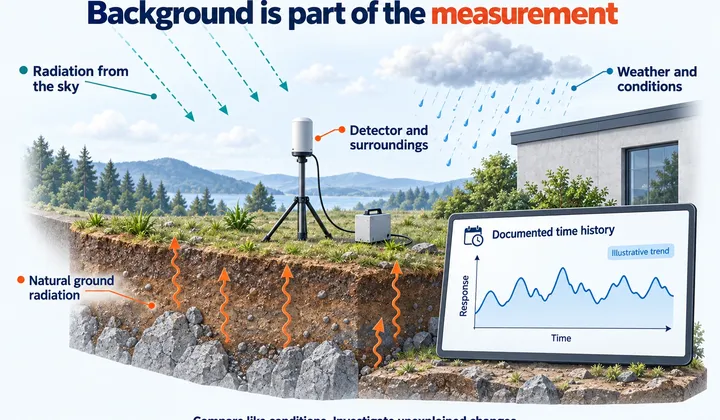
Background also contributes to the observed count rate. State whether the reported result includes background or has been corrected for it. Background-corrected results still have uncertainty, which matters when interpreting a small difference between two readings.
What should a measurement record include?
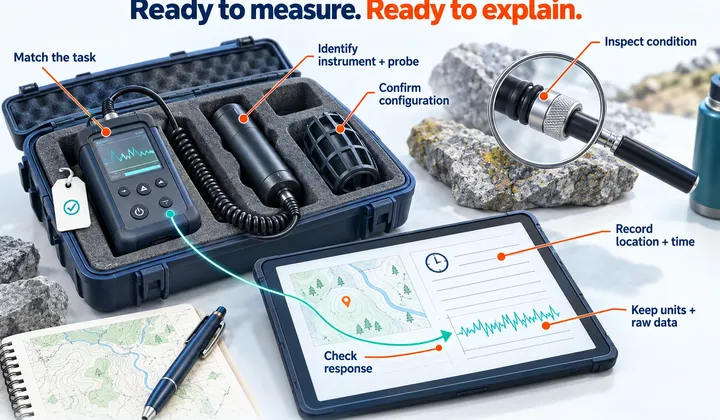
Give another person enough detail to interpret the result:
- The instrument and probe model, and the selected measurement mode.
- The displayed quantity and unit, including whether the value is a count rate or a dose rate.
- The measurement location, detector position and relevant source arrangement.
- The counting interval or display averaging setting.
- Whether background is included or corrected, and how it was measured.
- The calibration reference and applicable instrument range.
When discussing a project with Nucleolenz, specify the quantity you need to report and the radiation you expect to measure. These details guide the choice of detector, electronics and reporting format.
Related reading
Types of Ionizing Radiation introduces alpha, beta, photon and neutron radiation. The references cover detectors, units and counting statistics.