
Contamination Survey Speed: Give the Detector Time to Respond
A contamination scan needs enough response time and consistent coverage. Learn why scan speed, geometry and follow-up measurements belong in one validated method.
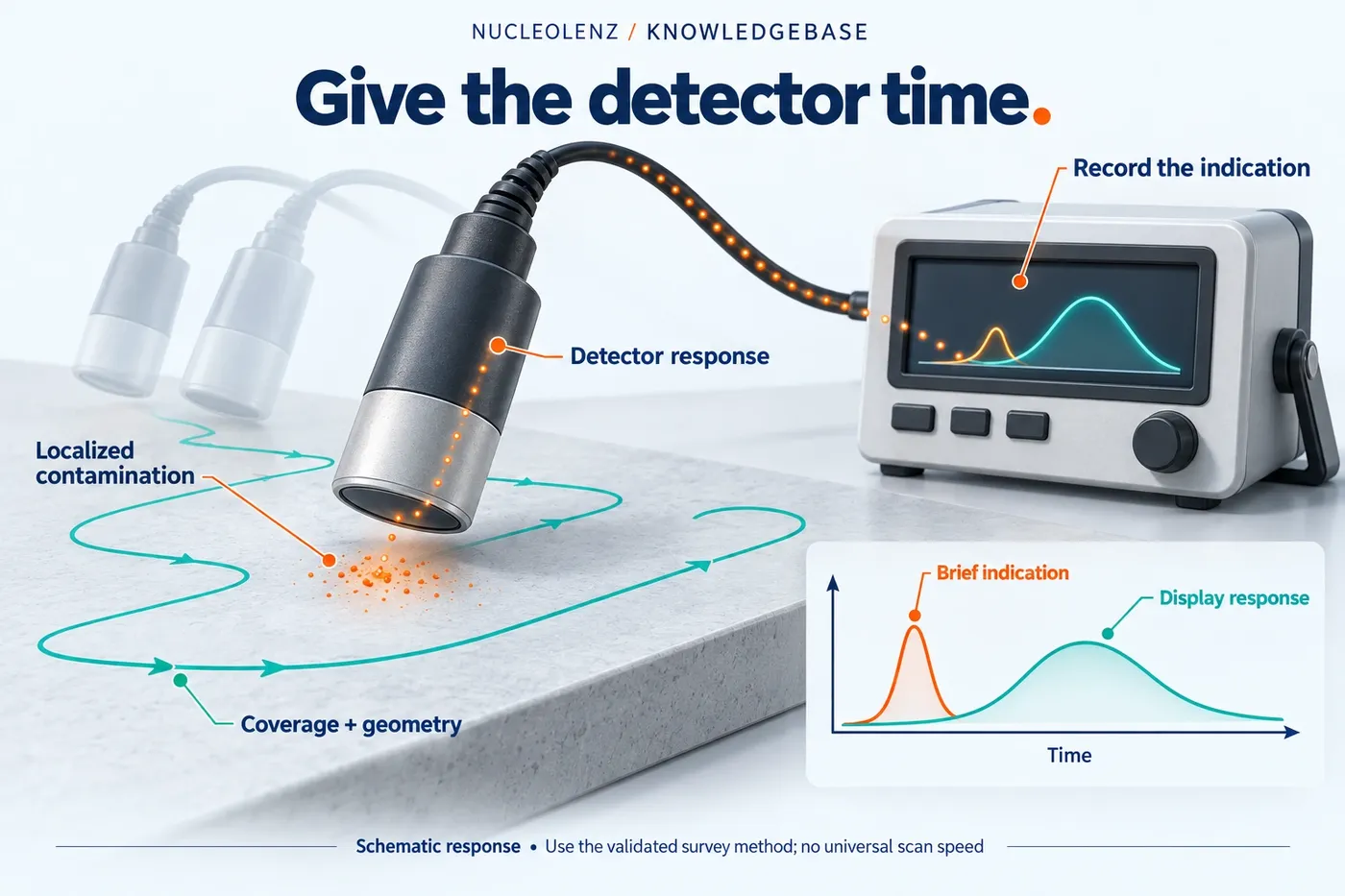
Open the concept graphic at full size ↗
Three key ideas
A scan is a sequence of brief observations
- Coverage: Define the surface and accessible scan path.
- Response: Give the approved setup its required observation time.
- Follow-up: Use a defined method to assess an indication.
At a glance
A practical comparison
| Observation | What it tells you | What else you need |
|---|---|---|
| Moving scan | Helps locate an indication | Validated speed, coverage and detector response |
| Defined static measurement | A result for a stated position and interval | Geometry, background and analysis method |
| Wipe measurement | Material transferred to the wipe | Collection area, recovery assumptions and counting method |
Educational comparison; apply the method specified for the instrument and task.
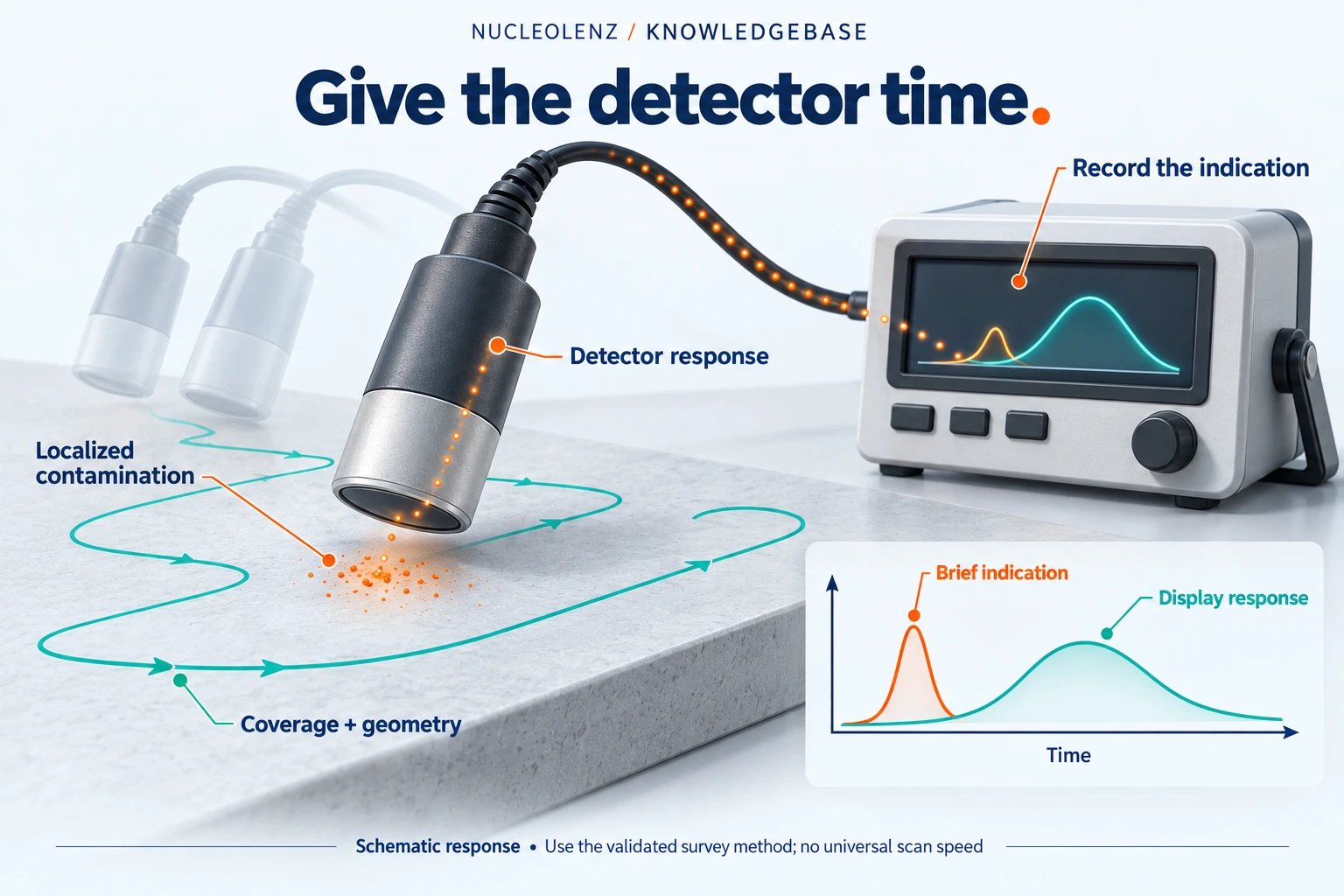
A scan can miss a localized indication when the probe spends too little time over it. Slower movement alone is not a complete method, however: detector suitability, position and the required sensitivity also matter.
Think about the measurement opportunity
The instrument needs an opportunity to detect events and present a response. If the detector passes quickly over a small region, the available counting time may be limited. The displayed response can also lag behind a change in the radiation reaching the detector.
The appropriate scan speed must come from the procedure validated for that detector, expected emissions and measurement objective. A speed quoted for another instrument or laboratory should not be adopted automatically.
Keep distance and coverage controlled
Define the detector-to-surface distance and how the scan covers the area. Surface shape, access and obstacles can change the arrangement. A very sensitive detector is not helpful if its relevant window never passes over the place being investigated.
Distinguish a scan from a quantified result
A scan can help locate an indication. A follow-up measurement under a defined arrangement may be needed to quantify it. A wipe measurement, when appropriate, addresses removable material and answers a different question from the direct scan.
Record the survey method, area, probe, settings and observations. An entry that says only “surface checked” does not show what could have been detected or how the scan was performed.
The practical goal is a repeatable survey that supports the intended decision. Follow the approved method and seek technical review when equipment, surfaces or objectives change. Do not replace that review with a general rule that every survey should be performed at one fixed speed.
What a rushed pass can hide
In a fictional training discussion, two records describe the same bench. The first says checked quickly and contains no path, probe identity or settings. The second identifies the approved method, the detector used, accessible surfaces, obstacles and any areas that could not be surveyed. Even if both operators reported no indication, only the second record begins to explain what the observation covers.
This comparison is about evidence, not a claim that a slower scan proves a surface is clear. A detector that is unsuitable for the emission, a covered window or an inaccessible recess can limit the survey regardless of the time spent. Recording an inaccessible area explicitly is more useful than allowing it to disappear inside an all-clear statement.
Separate three timing questions
- Time over a location: How long is the sensitive region in a position to receive emissions from the feature being investigated?
- Display response: How does the selected response or averaging mode present a change in detected events?
- Follow-up counting: What defined observation does the procedure require when a scan produces an indication?
These times describe related but different parts of the task. A smoothing setting may make a display easier to read while changing its response to a short observation. An audible indication, where provided, must also be understood in the context of the instrument and method.
Review a changed surface before reusing the method
A method suitable for a flat bench may not transfer unchanged to a curved pipe, a rough surface or equipment with narrow gaps. Describe the changed access and geometry to the responsible radiation protection specialist. The decision is whether the method still supports the required detection capability, or whether a different measurement is needed. Keep that decision with the survey record.
Check your understanding
Put the idea to work
Choose an answer, then reveal the explanation. Your answers stay in this browser.