
Where Should an Area Gamma Monitor Be Installed?
Choose an area gamma monitor position from its monitoring purpose, radiation-field evidence and maintainability—not just the nearest power outlet.
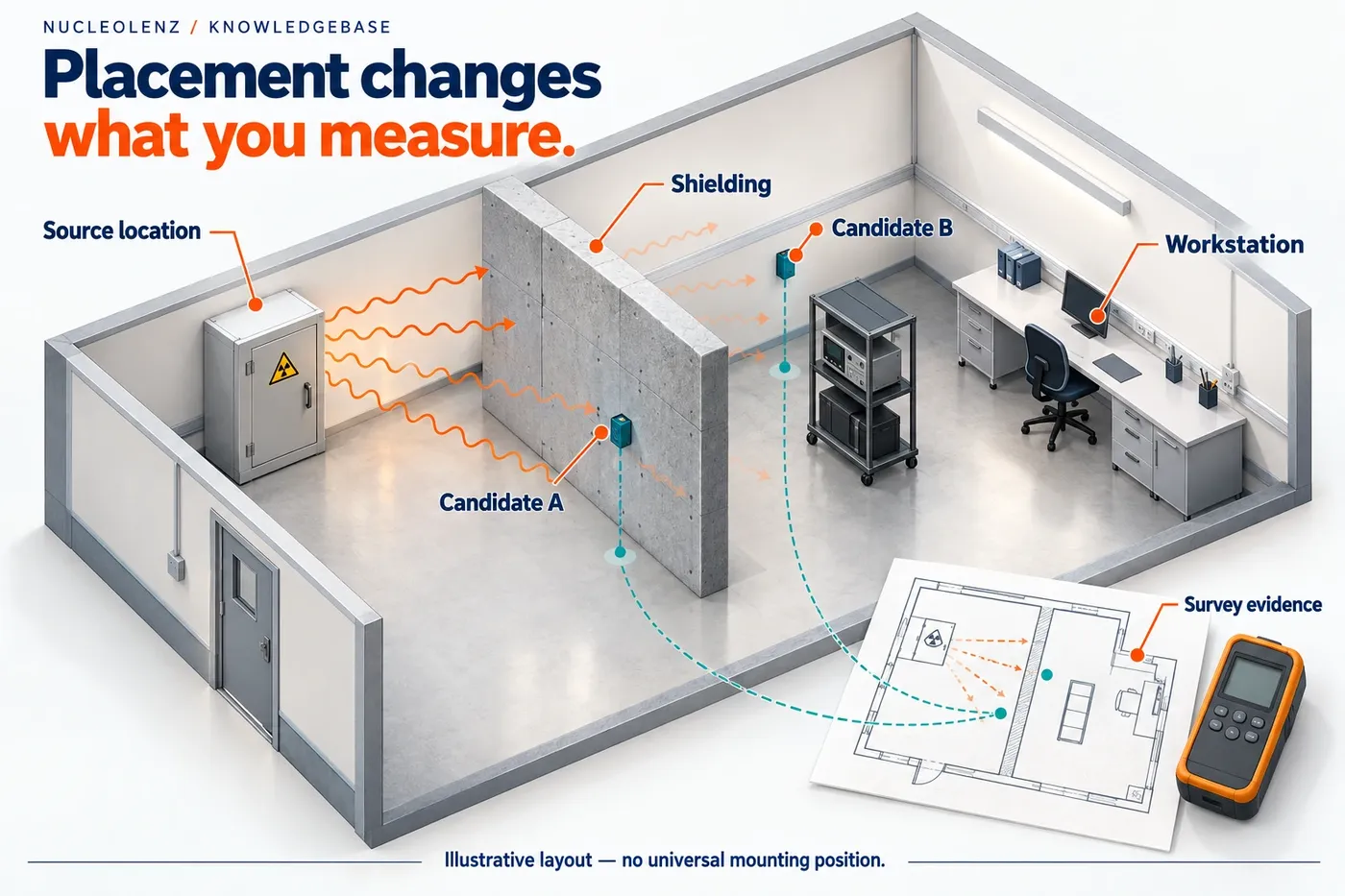
Open the concept graphic at full size ↗
Three key ideas
Location is part of measurement design
- Purpose: State which conditions the detector should observe.
- Evidence: Assess source states, shielding and occupied positions.
- Installation: Plan access, power, signals and future review.
At a glance
A practical review guide
| Review point | Evidence to look for | What it does not establish |
|---|---|---|
| Monitoring purpose | Defined conditions and intended coverage | Representation of every occupied position |
| Candidate location | Assessment and survey context | A universal mounting height |
| Interfaces | Verified path to responsible personnel | Working communication from a local display |
| Change review | Layout, shielding, occupancy and process changes | Continued coverage because the detector has not moved |
Use the applicable instrument documentation and the approved site programme for operational decisions.
An area gamma monitor measures conditions at its detector position. That simple fact makes location part of measurement design. A convenient wall, a clear view of the display and nearby power can help installation, but none establishes that the detector represents the condition the monitoring programme needs to observe. Start with the question the proposed position must answer.
Define the monitoring purpose
Identify the sources or processes of interest, relevant operating states and locations occupied by people. Decide what information the detector is expected to provide and who will use it. A monitor intended to observe one work area does not automatically represent every occupied point in a building. Document the intended coverage and its limits so that the eventual display is interpreted in the context of the installation rationale.
Understand how the field can change
Shielding, equipment, source movement and process changes can alter the field at a detector. Survey information can help evaluate candidate positions when it describes the relevant conditions and geometry. A measurement during one operating state should not be applied silently to every other state. There is no universal mounting height or distance that makes one detector appropriate for all facilities. The responsible radiation-protection assessment and model-specific guidance determine the arrangement.
Draw the measurement question on the plan
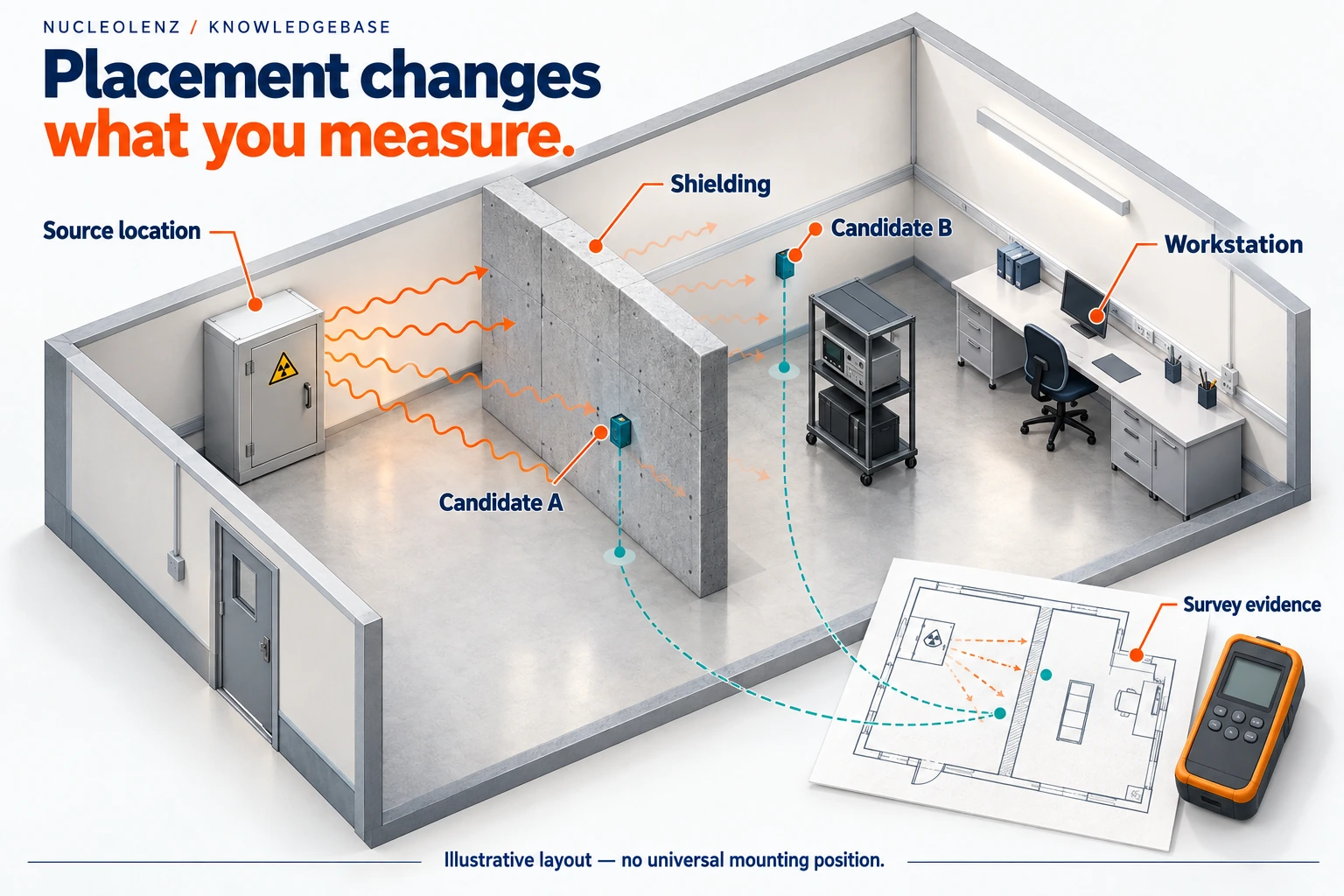
An annotated site plan can connect the proposed detector position with sources, occupied areas, shielding and relevant movement. Mark what each candidate position is intended to observe and which conditions remain outside that coverage. Link the drawing to the supporting survey or assessment. This makes the rationale reviewable by people who were not present during the initial site visit and easier to revisit after a layout change.
Practice: a new storage rack
In a fictional workshop, a monitor remains fixed to the same wall while a new equipment rack is installed between the detector and part of the work area. The monitor is powered and its display appears normal. The mechanical installation has not changed, but the environment relevant to the original assessment has. A review should establish whether the new arrangement affects the monitoring purpose and what evidence is needed to reassess it.
The lesson is not that every layout change requires relocation. It is that a change should be assessed against the documented purpose rather than dismissed because the detector itself has not moved. A clear drawing and installation record help the responsible team make that distinction.
Plan access and information paths
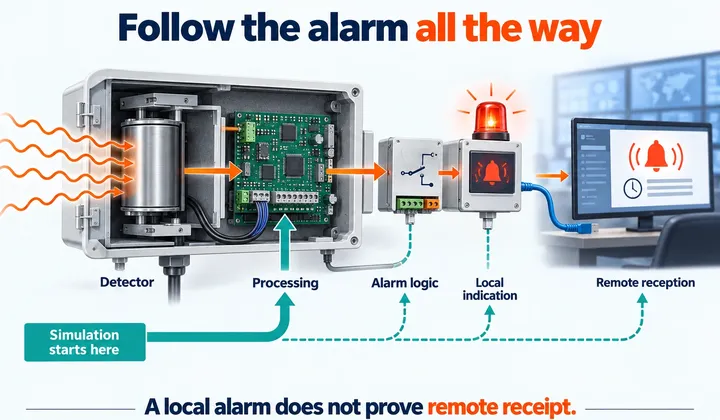
Include access for inspection, approved response checks, calibration arrangements and service. Review power and signal routing, environmental suitability and the visibility or audibility required by the site plan. Where alarms or measurements are sent elsewhere, trace their path to the receiving system and responsible person. Loss of power or communication needs a defined status and response; a silent remote screen should not be assumed to mean normal conditions.
Keep a commissioning record that can be reused
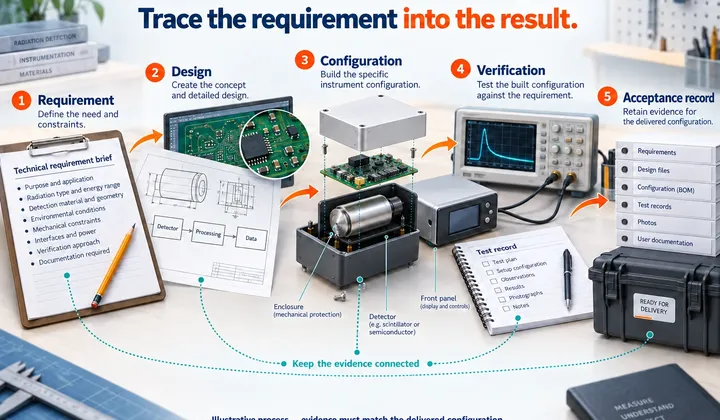
Record the detector identity, installed configuration, location rationale, applicable drawings, checks performed and unresolved limitations. Identify the changes that should trigger review, such as altered shielding, occupancy, source position or process. Nucleolenz's Indoor Area Gamma Monitor and Outdoor Area Gamma Monitor can be considered against a defined project requirement. Confirm the actual supplied model and its limits before selecting the installation arrangement. A useful commissioning record explains both where the detector is and why it belongs there.
Check your understanding
Put the idea to work
Choose an answer, then reveal the explanation. Your answers stay in this browser.