
An Emergency Radiation Monitoring Kit Should Begin With the Task
Build an emergency monitoring kit around assigned measurement tasks, trained users, supporting records and communication—not a universal equipment list.
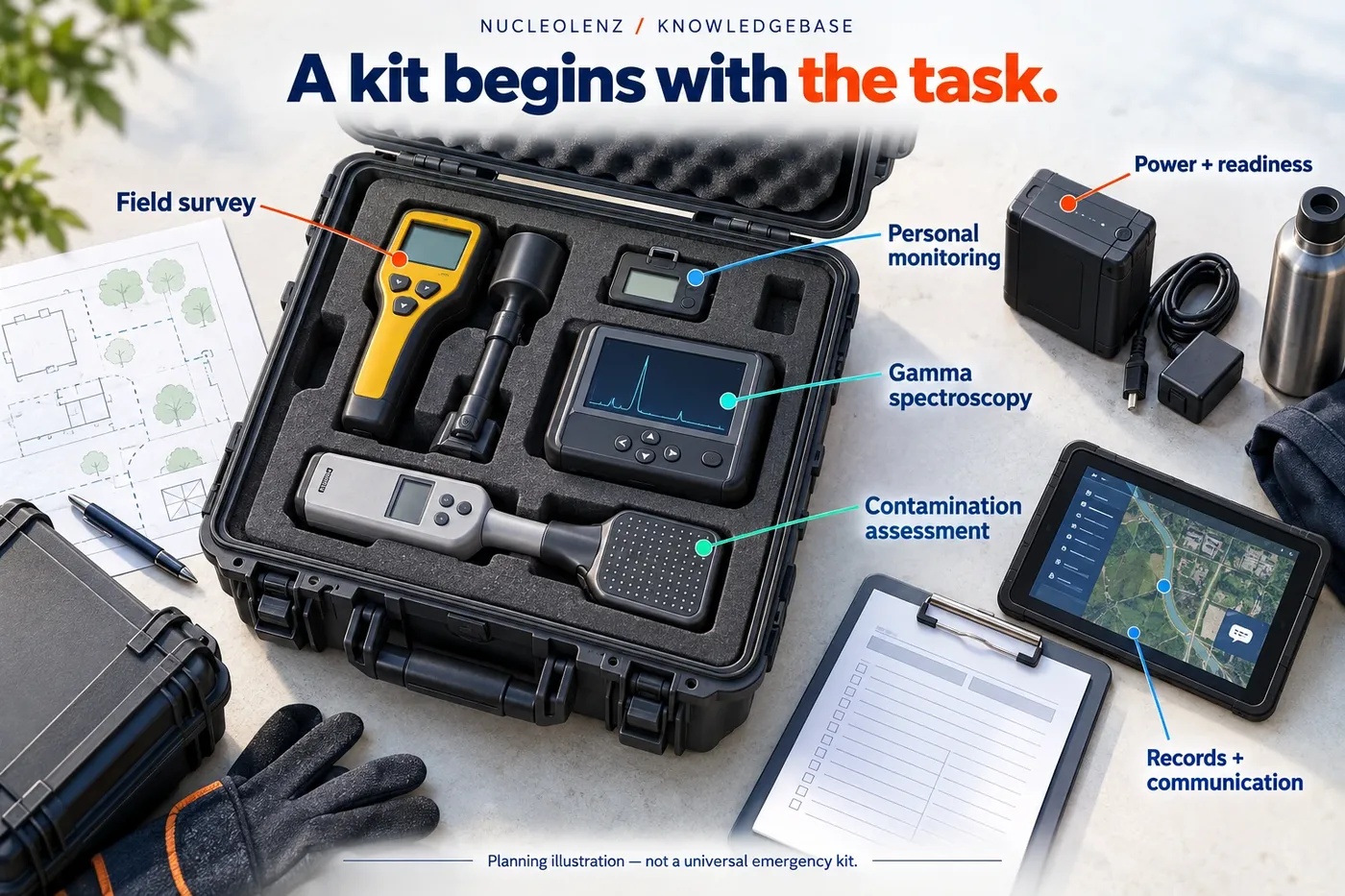
Open the concept graphic at full size ↗
Three key ideas
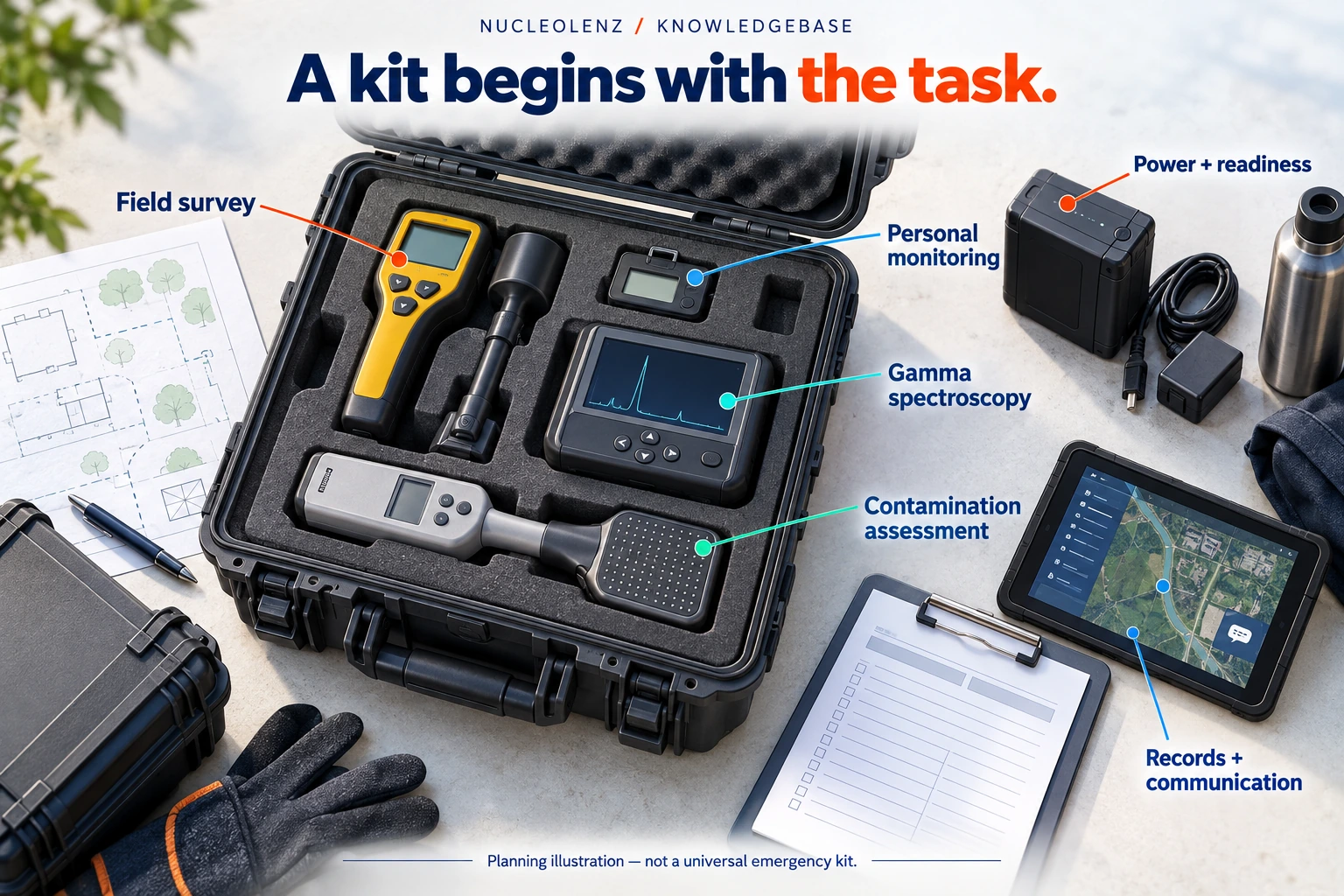
Build the kit from the assigned tasks
- Questions: Separate field, personal, contamination and identification tasks.
- Capability: Match instruments, trained users, power and approved methods.
- Handover: Preserve results and an established communication route.
At a glance
A practical review guide
| Review point | Evidence to look for | What it does not establish |
|---|---|---|
| Measurement task | Quantity, radiation and approved method | All tasks covered by one gamma detector |
| Readiness | Equipment identities, calibration and checks | Equivalent capability from any spare |
| Interpretation | Assigned competent role and context | An operational decision from a software label alone |
| Communication | Approved route and alternatives | A completed handover because a local display works |
Use the applicable instrument documentation and the approved site programme for operational decisions.
An emergency monitoring kit should begin with the tasks assigned to its users. A full case of instruments can still leave a critical question unanswered if the equipment, training or communication arrangements do not match the response plan. This article supports planning and tabletop review by authorized organizations; it does not provide instructions for entering an affected area or investigating an unknown source.
Separate the measurement questions
List the information the team is expected to provide. External-field measurement, individual dose monitoring, contamination investigation, radionuclide identification and sampling are distinct tasks. They can require different detectors, methods and interpretation. A gamma instrument should not be assumed to cover every radiation type or every form of radioactive material. The response organization defines the scope of deployment and the decisions assigned to each role.
Map equipment to a task and a user
For each assigned question, identify the required quantity, instrument, detector and operating mode. Link the approved method and the training needed to apply it. Record what the proposed instrument cannot establish. A device capable of displaying a result is not sufficient if no assigned person can interpret its limitations or relay the finding correctly. Likewise, a software identification label should not automatically become an operational decision without the responsible assessment.
Include the support that makes equipment usable
Plan approved power supplies, accessories, configuration records and current instructions. Identify how readiness will be established and how equipment with an unacceptable check will be handled. Include the means of recording and communicating results in the intended setting. The physical case is only one part of the kit; the equipment-control process should keep its contents, status and documents aligned as items are serviced or replaced.
A useful inventory links each instrument to its calibration and check records. It also identifies who maintains the inventory and which changes require reassessment. A spare device with an unfamiliar configuration is not automatically an equivalent replacement merely because it fits in the same compartment.
Practice: the communication link is unavailable
In a fictional tabletop exercise, a team has suitable instruments and current records, but its intended data link is unavailable. The exercise asks who receives the results, what information must accompany them and which approved alternative communication route applies. It does not assume that a working local display solves the coordination problem. Another scenario can remove one detector and ask which assigned tasks remain supported and which require additional specialist assistance.
These exercises are useful before deployment because they reveal capability and handover gaps without exposing anyone to an actual event. Keep the fictional assumptions separate from claims about the organization's real performance.
Preserve observations so others can use them
Record the location, time, equipment combination, quantity, unit, mode and relevant conditions for each result. Distinguish an observation from its interpretation and from the decision made by the authorized role. Identify unavailable, interrupted or questionable measurements clearly rather than entering a reassuring zero. The receiving team needs enough context to understand both what was measured and the limits of that information.
Nucleolenz's GS200 gamma spectrometer and Teledosimeter illustrate different product roles to assess against defined requirements. Their presence here is not a claim that Nucleolenz supplies a universal emergency kit or that either device satisfies every response task. Review the proposed assembly through the organization's exercises and equipment programme, retaining clear boundaries on what the team is equipped and authorized to do.
Check your understanding
Put the idea to work
Choose an answer, then reveal the explanation. Your answers stay in this browser.