
Radiation Detection in Hazardous Areas: Two Suitability Questions
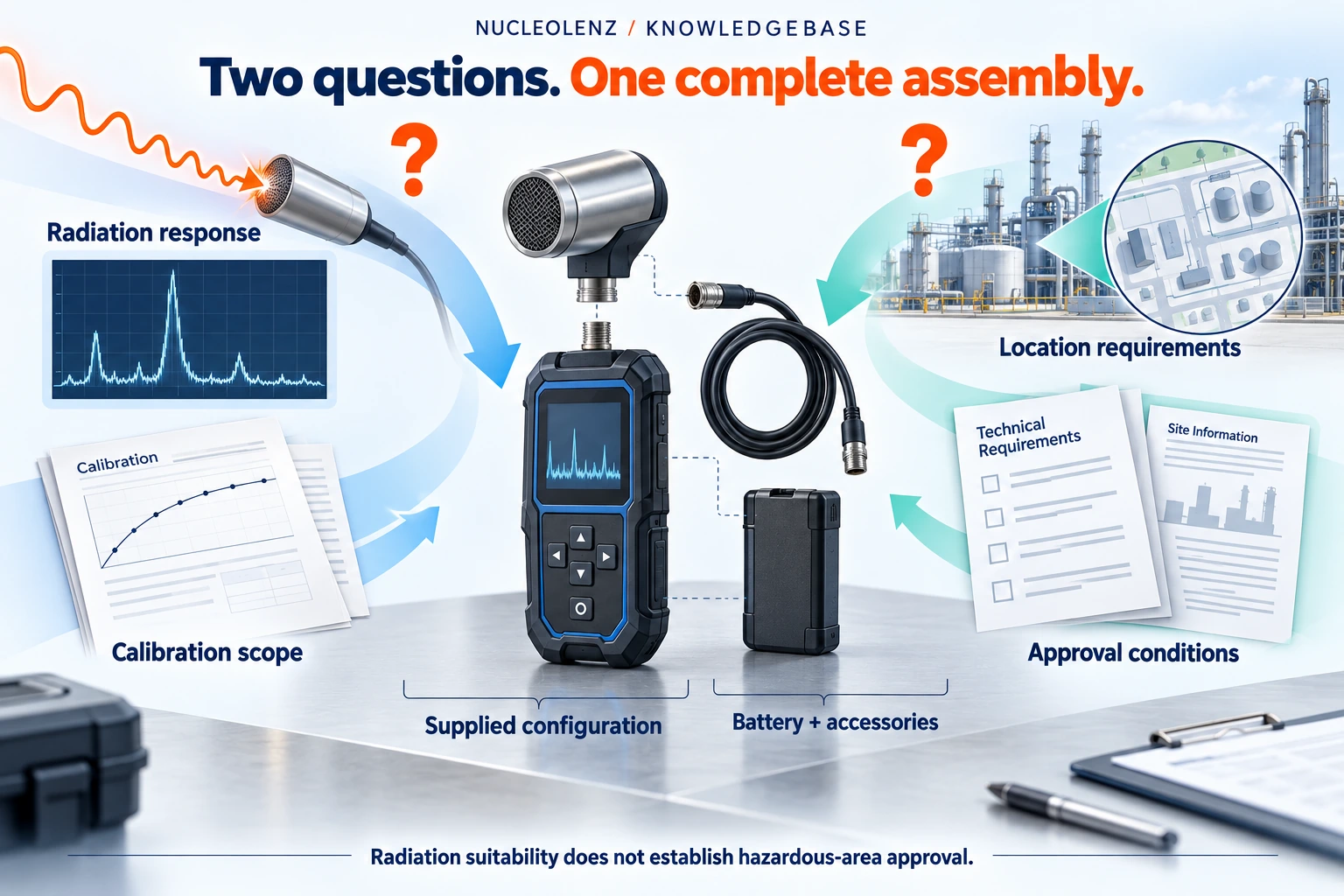
Radiation performance and hazardous-area suitability are separate checks. Match both to the complete equipment configuration and the actual location.
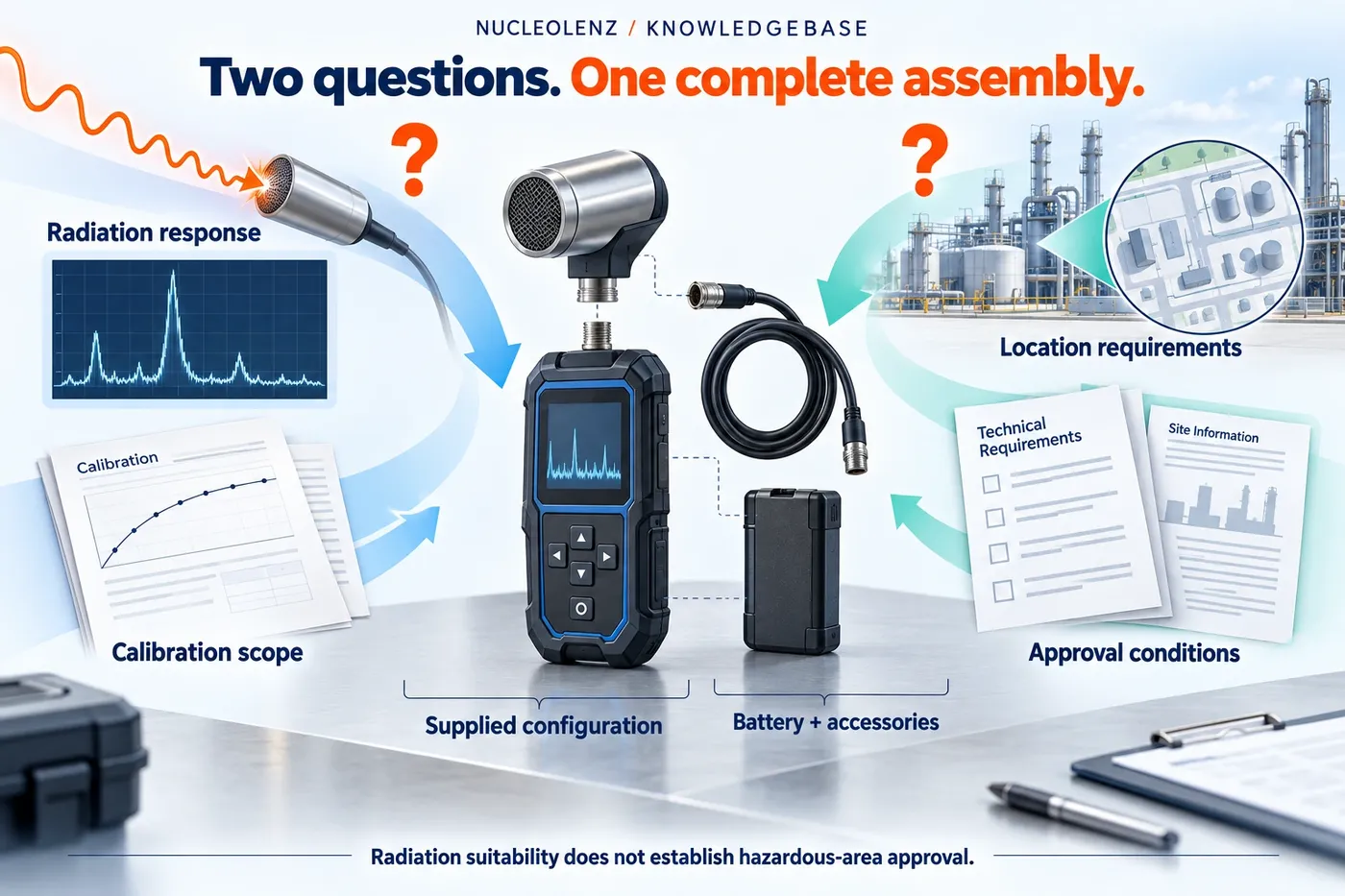
Open the concept graphic at full size ↗
Three key ideas
Two suitability questions, one assembly
- Measurement: Can this configuration answer the radiation question?
- Location: Is it suitable for the classified environment?
- Evidence: Match both decisions to the complete supplied assembly.
At a glance
A practical review guide
| Review point | Evidence to look for | What it does not establish |
|---|---|---|
| Radiation suitability | Quantity, response, configuration and calibration | Hazardous-area suitability |
| Location suitability | Applicable assessment and approval evidence | Adequate radiation measurement |
| Ingress rating | Dust and water protection scope | Explosion protection |
| Accessories | Exact assembly and approval restrictions | Coverage from a product-family name |
Use the applicable instrument documentation and the approved site programme for operational decisions.
A radiation detector can be technically suitable for a measurement while being unsuitable for the industrial location where that measurement is needed. Procurement must answer two questions: will the system measure the required radiation quantity, and is the supplied arrangement permitted for that environment? Completing the first assessment does not complete the second.
Describe the radiation task precisely
State the radiation types, relevant energies, required quantity, expected range and measurement arrangement. Include the detector, operating mode and accessories. Ask what calibration and response evidence applies to the configuration. A general statement that a detector is sensitive cannot establish that it measures the required quantity under the intended conditions. A contamination investigation, gamma dose-rate measurement and radionuclide identification task may need different arrangements.
Have the location requirement established
A classified-area assessment concerns the potentially explosive atmosphere and the applicable equipment-protection requirements. The responsible site specialists establish the relevant classification, substances, conditions and jurisdictional framework. A radiation specialist's approval of detector performance does not substitute for that assessment. Conversely, suitable hazardous-area documentation does not prove that the instrument gives the required radiation measurement. Keep the two reviews visible in procurement and installation records.
A dust or water ingress rating is not evidence of explosion protection. Low power consumption or a small battery also does not establish intrinsic safety. These distinctions matter because superficially rugged equipment can be mistaken for equipment approved for a classified location. Request the actual evidence for the supplied model and configuration instead of relying on descriptive words such as industrial or field-ready.
Examine the boundaries of the approval
Include the instrument, sensors, cables, battery arrangement, accessories and relevant communication or charging equipment in the review. Check the documentation's conditions and restrictions with qualified personnel. A certificate covering one configuration should not be expanded informally to a different assembly. Replacement accessories and later modifications need the same attention as the original purchase because they can change what is being assessed.
The OSHA reference below illustrates these issues within a US regulatory framework. It is background, not a determination of requirements for an installation in India, the Middle East or another jurisdiction. Use the rules and approval arrangements actually applicable to the project.
Practice: two completed boxes, one missing detail
In this fictional procurement review, a detector has a satisfactory radiation-performance assessment. The purchase file also contains a hazardous-area certificate for the product family. However, the offered battery accessory is not identified in the reviewed configuration. The two ticked boxes do not resolve that gap. The team needs configuration-specific clarification from the supplier and the responsible site specialists before accepting the arrangement for the location.
This is a documentation exercise, not a suggestion to test unapproved equipment in a classified area. The purpose is to surface the mismatch while it can still be resolved through design or procurement.
Use one configuration record and two decisions
Record the exact assembly once, then link the radiation-suitability decision and the hazardous-area decision separately. For each, identify the requirement, supporting evidence, reviewer and outstanding limitations. Nucleolenz's public radiation product descriptions should not be read as hazardous-area certification where a specific approval is not documented. If the project needs such approval, make it an explicit requirement and request the applicable evidence. A complete record shows why the instrument is both useful for the measurement and suitable for its intended location.
Check your understanding
Put the idea to work
Choose an answer, then reveal the explanation. Your answers stay in this browser.