
Meter and Probe Compatibility: More Than a Matching Connector
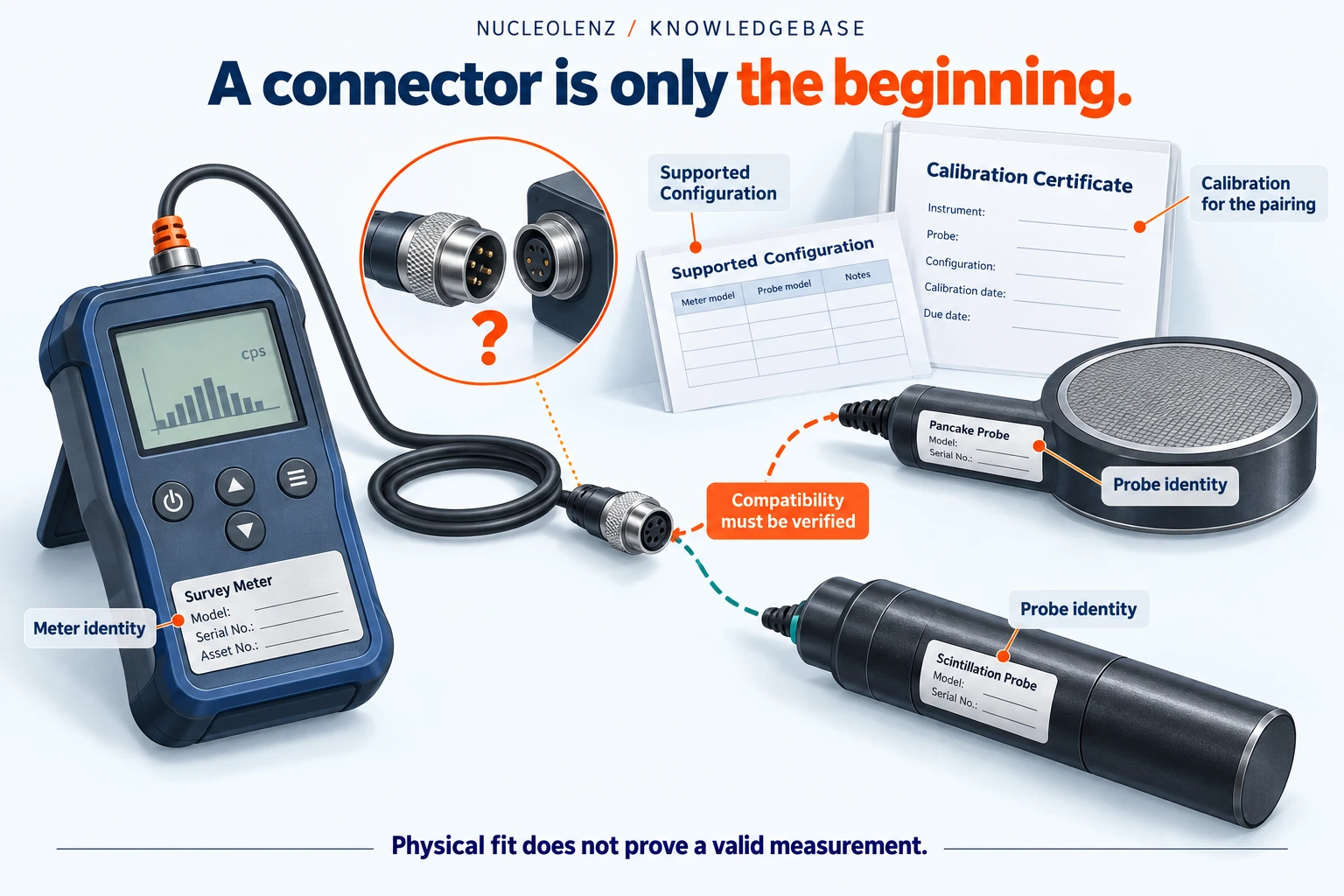
A matching connector is only the start. Review detector requirements, meter configuration, calibration and task suitability before approving a probe pairing.
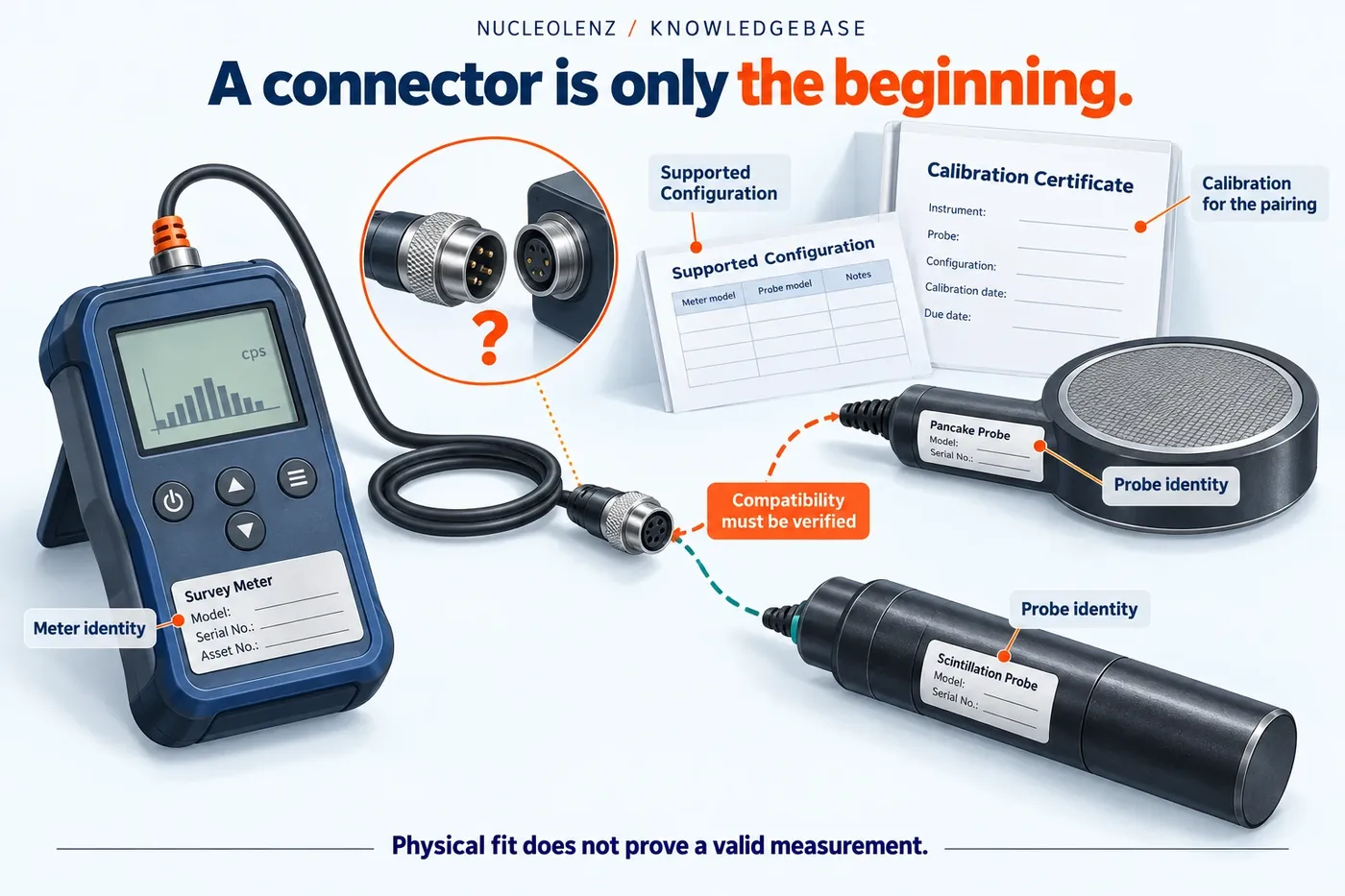
Open the concept graphic at full size ↗
Three key ideas
Compatibility has three layers
- Connect: Confirm the supported detector and electrical interface.
- Configure: Use the documented settings and measurement mode.
- Characterize: Match calibration and response evidence to the pairing.
At a glance
A practical review guide
| Review point | Evidence to look for | What it does not establish |
|---|---|---|
| Physical fit | Specified connector and accessories | Electrical or measurement compatibility |
| Configuration | Supported pairing and detector profile | Suitability for every radiation field |
| Calibration | Evidence for the assembled system | Coverage of an undocumented substitution |
| Survey task | Radiation, quantity and geometry | Equivalence based on a familiar reading |
Use the applicable instrument documentation and the approved site programme for operational decisions.
A probe plugs into a meter, the display responds, and counts appear. What has that demonstration established? It shows that something in the connected system is producing an indication. It does not, by itself, establish compatibility, a valid dose-rate scale or suitability for the intended radiation survey. A reliable pairing connects the detector's requirements with the meter's settings and the measurement evidence for the complete system.
Check more than the connector
Detectors can differ in their operating requirements and signal characteristics. A meter configured for one detector may not be appropriately configured for another, even when both use similar connectors. Manufacturer guidance should identify supported combinations and any required configuration. Do not copy operating settings from an unrelated product or adjust the electronics experimentally to make an unfamiliar probe produce a convenient value. Compatibility needs an approved technical basis.
Separate counts from the reported quantity
A count indication and a dose-rate indication answer different questions. The conversion between them depends on detector response and the radiation conditions for which that relationship is established. A replacement detector can produce counts while invalidating the previous dose-rate conversion. The selected unit on a display cannot create the missing measurement relationship. Review the calibration and configured detector profile, where relevant, before interpreting a substituted system as equivalent to the original.
Build a record for the whole assembly
Keep the meter and probe model and serial numbers together, along with the relevant cable, configuration identifier and documentation. Link the applicable calibration certificate and routine response-check arrangement. If the system has interchangeable detectors, make the approved combinations easy to identify in the equipment record. A label or profile name should point to controlled information; a remembered setting or handwritten nickname is a poor substitute when several similar probes are stored together.
Practice: the spare probe with a familiar reading
In this fictional scenario, a damaged probe is replaced with a spare from a neighboring team. The spare connects and gives a reading similar to yesterday's result. The temptation is to treat the agreement as proof of equivalence. Yet the records do not identify whether the spare has the same response, is configured correctly or is covered by the calibration. A familiar number does not answer those questions.
The useful next step is a documented substitution review by the responsible personnel. It should determine whether the combination is supported and what further checks or calibration are needed. Until that is resolved, measurements should not be represented as results from the original approved setup. Retain the substitution history so later reviewers can identify which combination produced each record.
Questions for the equipment supplier
- Is this exact meter-detector pairing supported, including the relevant accessories?
- Which configuration and operating mode apply to the intended quantity?
- What calibration evidence is needed for the assembled system?
- Which response-check reference applies after the change?
- What limitations matter for the expected radiation and survey geometry?
Keep the task in the compatibility decision
An electrically supported pairing can still be unsuitable for a particular measurement. Detector sensitivity, radiation response and geometry must fit the task. For a Nucleolenz instrumentation enquiry, describe the complete detector-electronics chain and the required quantity. Ask for configuration-specific confirmation rather than assuming that all accessories in a product family are interchangeable. A good compatibility record makes both the approved pairing and its measurement scope clear.
Check your understanding
Put the idea to work
Choose an answer, then reveal the explanation. Your answers stay in this browser.