
Is Your Radiation Instrument Suitable for the Working Environment?
Check the environment at the instrument, the limits of the complete assembly and the evidence for each claim before approving a deployment.
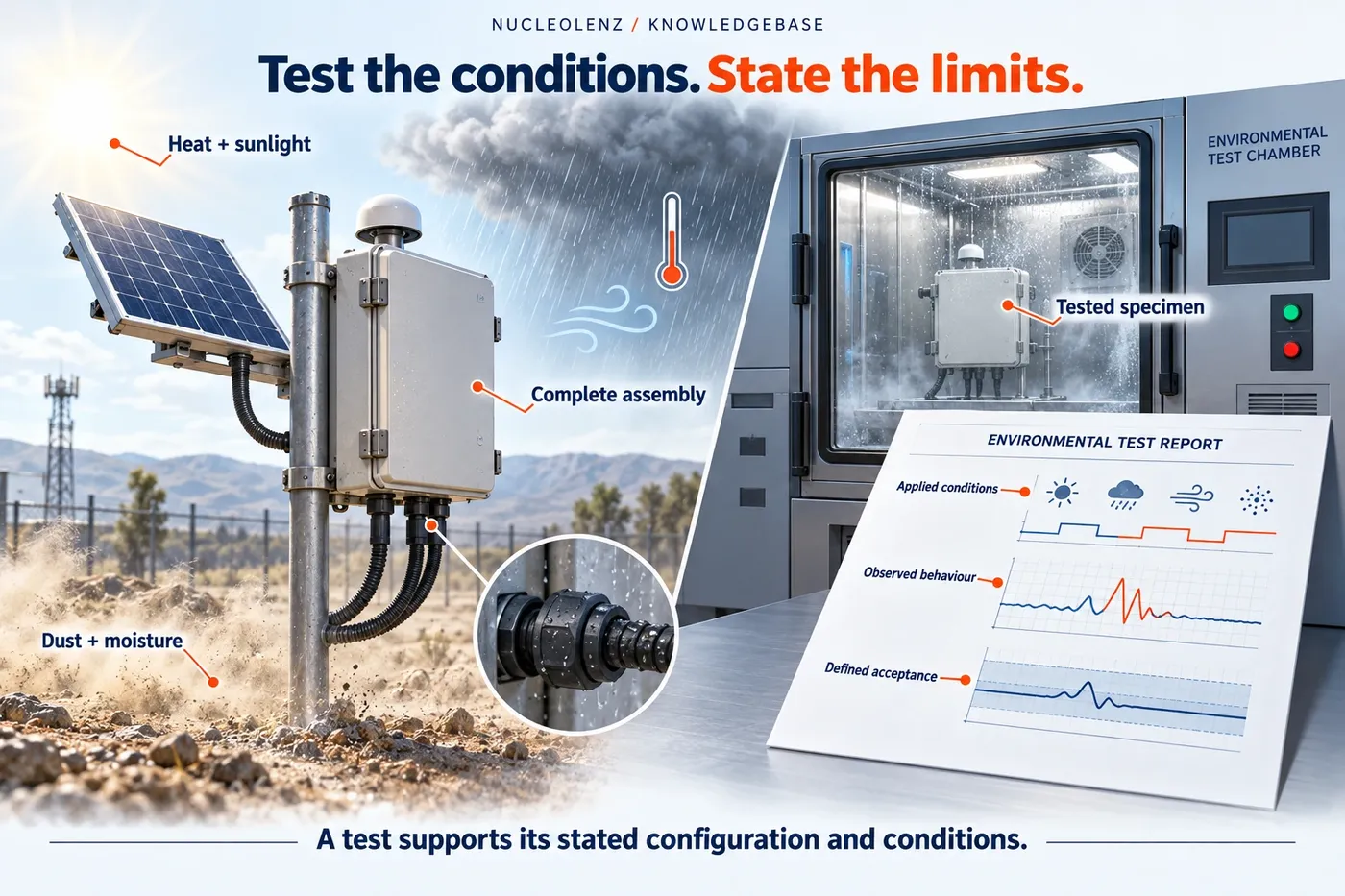
Open the concept graphic at full size ↗
Three key ideas
Match equipment to the actual environment
- Describe: Assess conditions at the installed position.
- Compare: Check limits for the complete supplied assembly.
- Resolve: Close evidence gaps before operational use.
At a glance
A practical review guide
| Review point | Evidence to look for | What it does not establish |
|---|---|---|
| Local environment | Conditions at the actual detector and electronics | Suitability from a city weather report |
| Assembly | Instrument, connectors, power and accessories | Coverage from the enclosure alone |
| Ingress claim | Applicable configuration and documented conditions | Explosion protection |
| Operating limits | Evidence for intended operating conditions | Equivalent storage or transport limits |
Use the applicable instrument documentation and the approved site programme for operational decisions.
Environmental suitability is part of measurement planning. A detector can be appropriate for the radiation but be installed where temperature, moisture, dust or power conditions exceed the supported arrangement. The useful question is specific: does the documented equipment configuration fit the conditions at this position during the intended use? A product described as industrial does not answer that question by itself.
Describe conditions where the equipment will sit
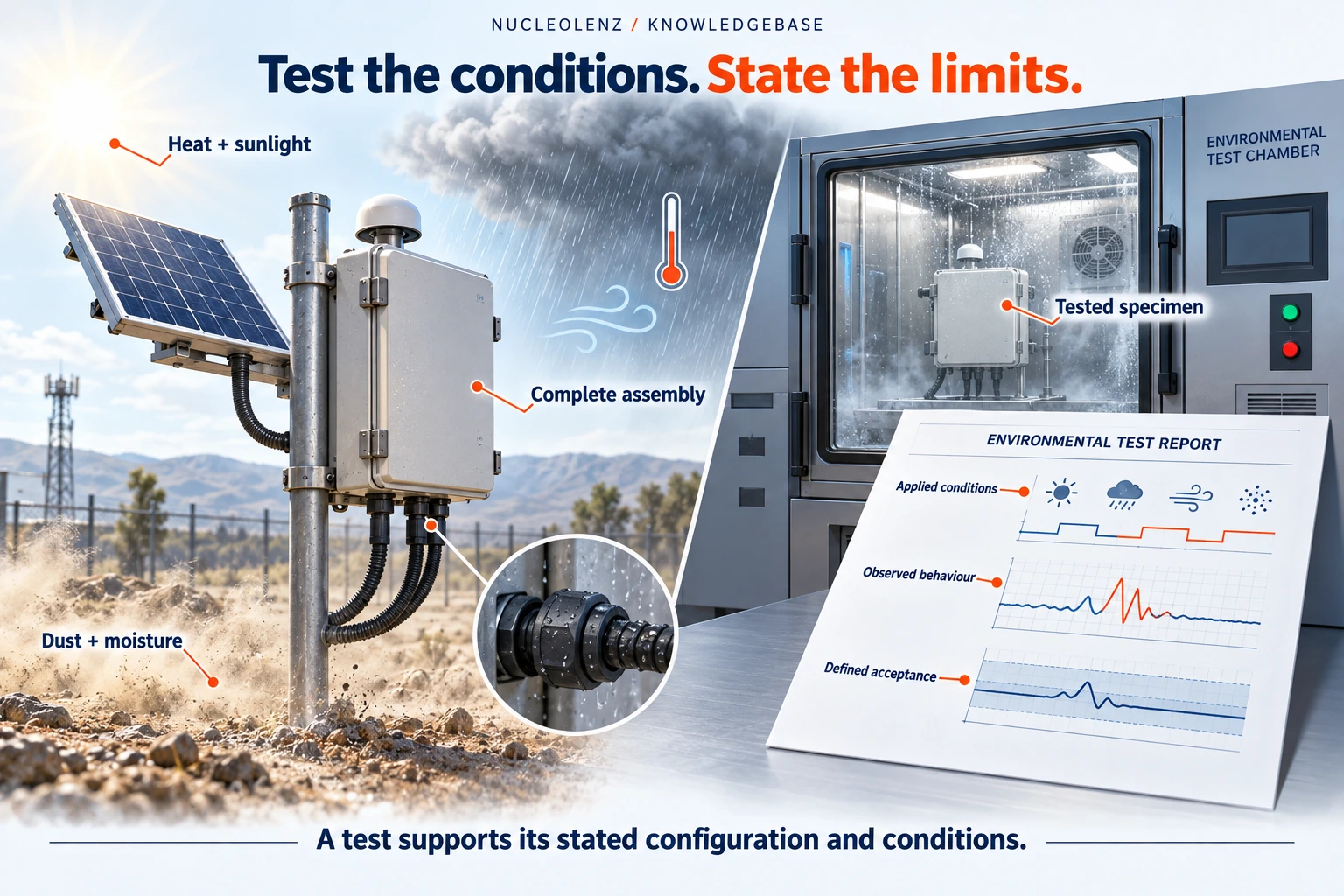
Record the expected conditions at the instrument, rather than relying only on a regional climate description. Direct sunlight, nearby machinery, enclosure ventilation and sheltered mounting can create different local conditions. Include temperature, humidity, dust, water exposure, vibration and relevant electromagnetic surroundings. The site assessment determines which influences matter. Separate operating conditions from storage, transport and charging, because evidence for one does not necessarily cover the others.
Review the complete assembly
The detector, electronics, cable, connectors, power supply and accessories form the installed system. A main enclosure specification may not describe every component. Ask which connector state and mounting arrangement the stated limits assume. If an accessory changes during procurement or maintenance, check whether the original evidence still applies. Keep the delivered configuration identifiable so the installation review is about actual equipment rather than a product-family name.
Give each claim its own evidence
Dust and water ingress, temperature performance, electromagnetic compatibility and explosion protection address different influences. One test or rating should not be used to stand in for all of them. In particular, a robust housing or low power consumption does not establish hazardous-area suitability. If the location is classified for a potentially explosive atmosphere, obtain the separate assessment and configuration-specific approval information required by the responsible specialists and applicable framework.
The OSHA reference below illustrates hazardous-location requirements in a US framework; it does not determine the requirements of an Indian or Middle Eastern project. Keep that jurisdictional distinction visible when using external guidance as background. A procurement record should identify the actual requirement being assessed, not only a document with a familiar acronym.
Practice: the instrument inside another enclosure
A fictional installation moves an instrument from a sheltered location into a protective box near process equipment. The box appears to improve weather protection, but it may also change the temperature experienced by the instrument. The original site review needs revisiting. The appropriate response is to assess the actual assembled arrangement and its conditions, rather than assume that adding an enclosure improves every aspect of suitability.
This example also exposes a documentation issue: a drawing showing the instrument alone no longer describes the installation. Update the configuration record and identify who will confirm the conditions and assess the evidence. Do not fill missing information with an undocumented assumption that the new enclosure is equivalent.
A compact deployment review
- State the condition and where it applies in the assembly.
- Record the expected site exposure and supporting assessment.
- Identify the offered equipment configuration and its documented limit.
- Link the evidence and any installation restrictions.
- Assign unresolved questions and record the authorized decision.
Nucleolenz provides separate indoor and outdoor gamma-monitor product descriptions. Use the exact model documentation to develop the review; the names alone do not establish every environmental requirement. Revisit the record when mounting, accessories or process conditions change. Mechanical security is only one part of continued suitability.
Check your understanding
Put the idea to work
Choose an answer, then reveal the explanation. Your answers stay in this browser.