
Radiation Safety and Radiation Security: Different Goals, Shared Interfaces
Radiation safety and security have different goals but need coordinated information. Learn what an alarm can establish, how roles connect and why a reading cannot reveal intent.
Open the concept graphic at full size ↗
Three key ideas
Safety, security and the handover
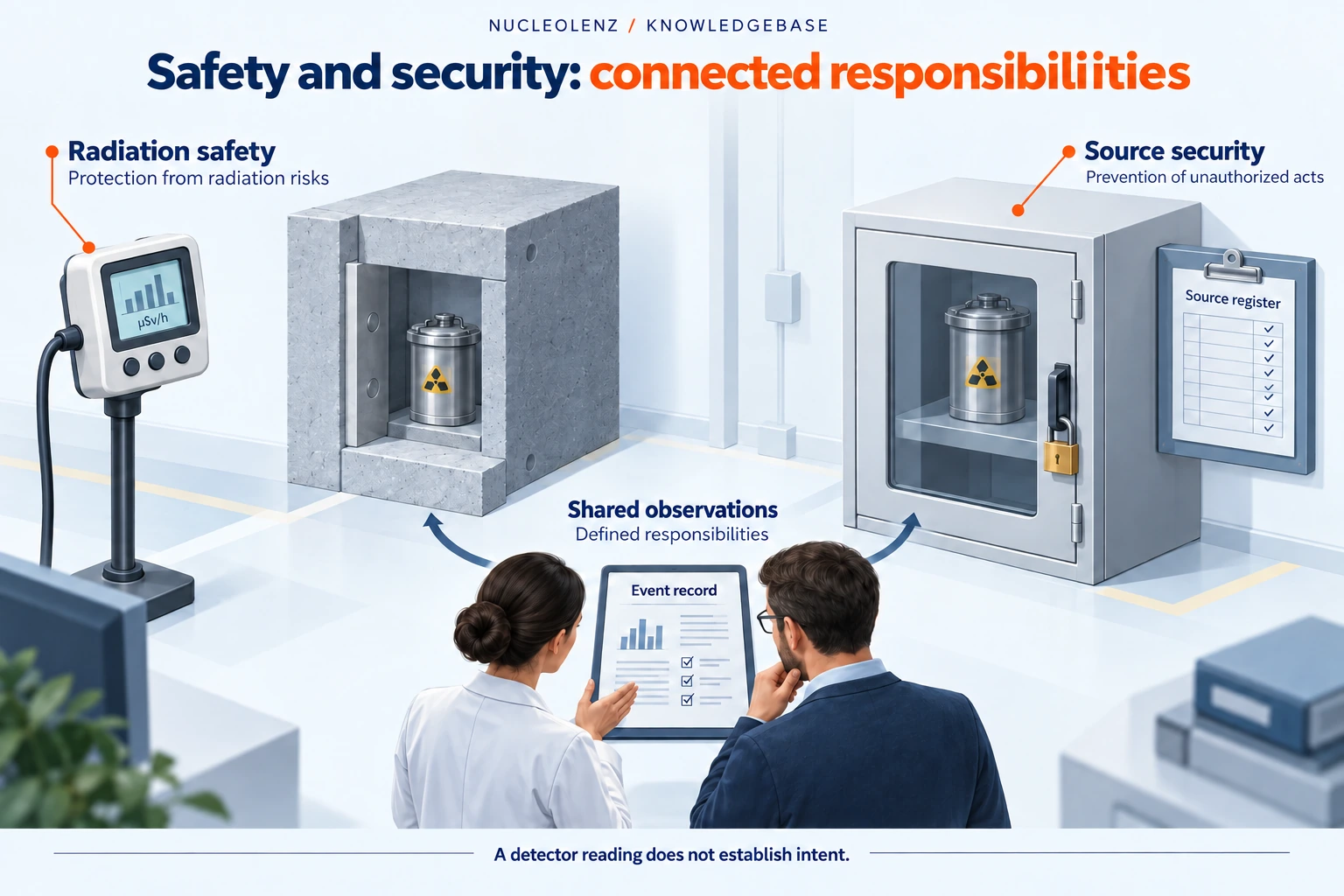
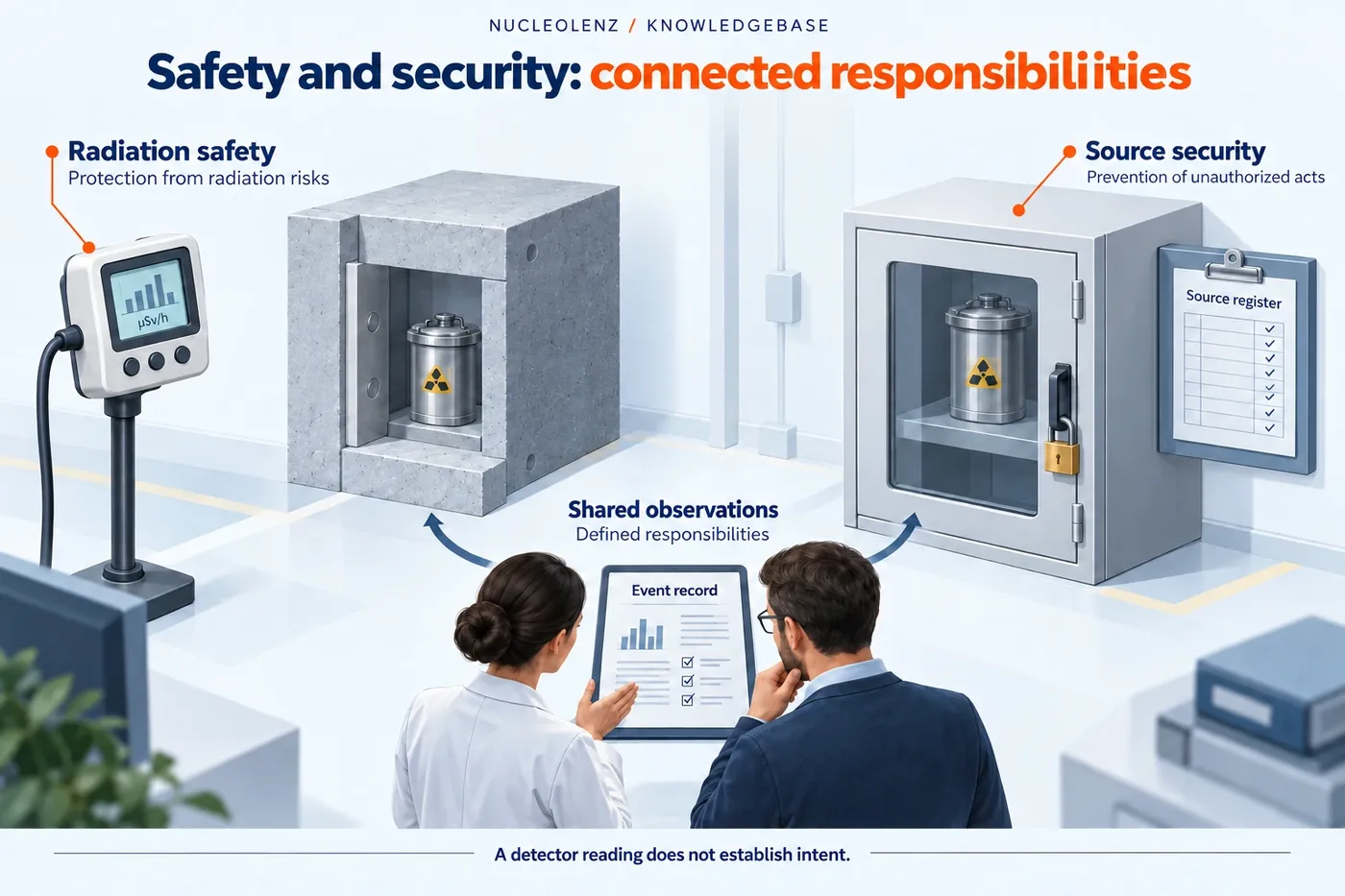
- Safety: Protect people and the environment from radiation risks.
- Security: Prevent, detect and respond to unauthorized acts.
- Coordination: Share relevant observations through approved responsibilities.
At a glance
Compare the key distinctions
| Focus | What it establishes or needs | Important limit or evidence |
|---|---|---|
| Safety | Assess radiation risks and protection | Measurements plus the authorized work context |
| Security | Address unauthorized acts involving material | Accountability, authorization and other relevant evidence |
| Shared interface | Coordinate information and response roles | A defined handover and approved procedures |
The example is fictional and describes coordination principles, not a facility security procedure.
A radiation alarm can lead to a protection question, a security question or both. Clear responsibilities help a facility respond without confusing the purpose of the instruments or the people using them.
Identify the goal of each programme
Radiation safety concerns protection against radiation risks in authorized activities and the prevention or mitigation of accidents. Security concerns preventing, detecting and responding to unauthorized access, removal or malicious use of nuclear and other radioactive material.
For a simple teaching example, an exposure-control discussion asks how an authorized maintenance task will be conducted. A security discussion asks how material is accounted for and protected against unauthorized access. Neither question replaces the other.
Do not infer intent from a detector reading
A radiation instrument can provide information about a field or material. A reading alone does not establish whether an event is malicious, authorized or caused by an operational change. The interpretation requires the site's records, procedures and responsible personnel.
Likewise, an access-control record does not establish the radiation conditions where someone is working. Security information and protection measurements should be connected through a defined process while retaining their different meanings.
Plan the handover between roles
Clarify who receives an alarm, who assesses the measurement and who coordinates any protection or security response. Exercise the communication route using an approved training scenario. Preserve the facts observed instead of immediately assigning a cause.
One observation can need two assessments
In a fictional training exercise, staff receive an unexpected radiation indication near a location used for authorized material movements. The protection team needs to understand the radiological conditions and the applicable response procedure. The security team may need to reconcile the event with authorized activity and material records. Neither assessment should wait for a speculative explanation of the other.
The exercise can be run with invented locations and timestamps. Ask participants to separate observations from assumptions: the instrument state, reported quantity and event time are observations; a claim about who caused the event or why is an interpretation requiring other evidence. This distinction makes the handover clearer.
Use a shared record with controlled detail
- Observed event: identify the instrument, time, location reference and status without assigning intent.
- Measurement context: preserve the quantity, units, relevant operating state and any unavailable information.
- Responsible roles: record who received the information and which approved procedure governs the next decision.
- Follow-up: distinguish confirmed findings from questions that remain unresolved.
The record should give each authorized role what it needs. Public training examples should not reproduce access arrangements, response capabilities or other sensitive facility information. Coordination does not require indiscriminate distribution of every operational detail.
Avoid single-instrument promises
A monitoring device may be one input to a wider programme. Its ability to detect radiation does not establish control of access, continuity of material accountability or readiness of a response organization. Equally, a complete inventory does not describe the dose rate beside a source at this moment.
When requirements cross the two programmes, write separate acceptance questions. Can the measurement be interpreted? Can the relevant authorized people receive and assess it? Are the associated procedures compatible? A tabletop review can expose a missing handover without pretending to certify the whole facility. Keep safety and security connected through responsibilities and evidence.
Nucleolenz's Knowledgebase focuses on explaining measurement roles and their limitations. Selection of an instrument for a security application requires a specific requirement and verified performance; a product described for general monitoring should not automatically be presented as a certified security system.
Check your understanding
Put the idea to work
Choose an answer, then reveal the explanation. Your answers stay in this browser.