Can One Radiation Detector Measure Every Radiation Task?
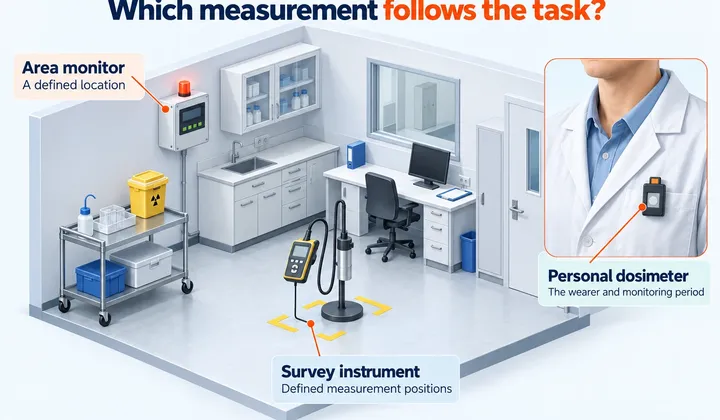
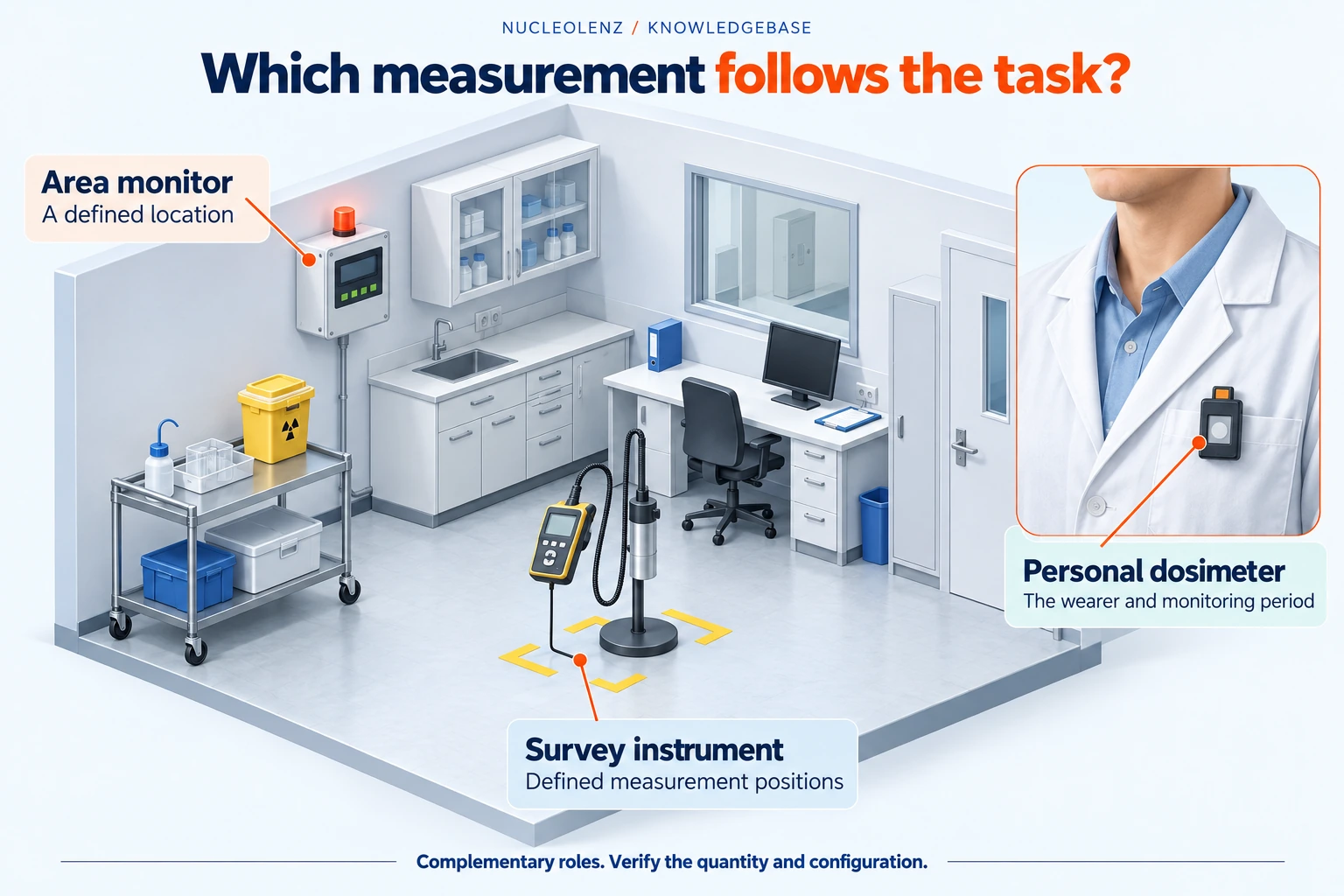
Select radiation instruments by the result you need. Compare field monitoring, contamination assessment, personal dosimetry and spectroscopy without assuming one detector can do everything.
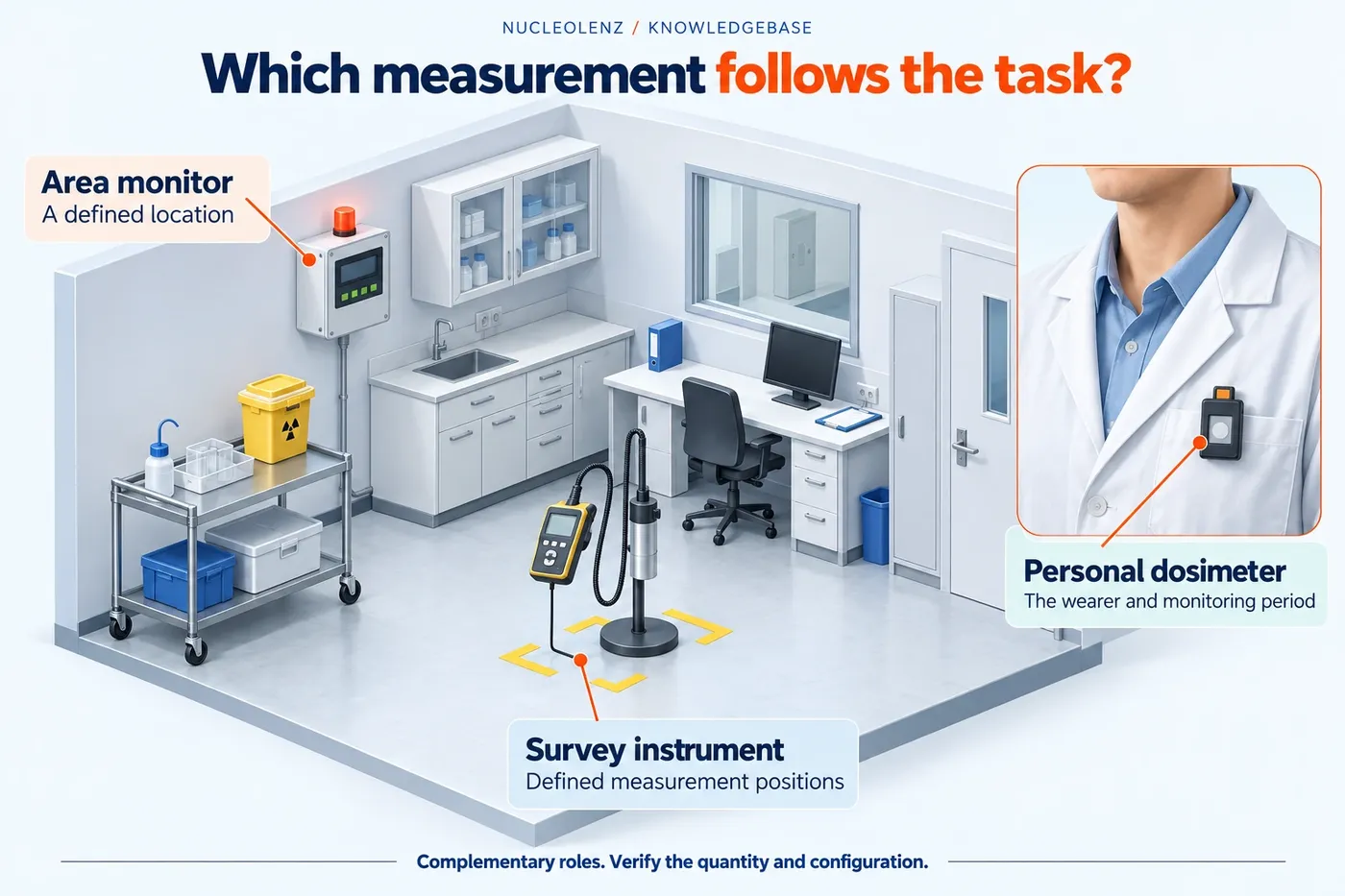
Open the concept graphic at full size ↗
Three key ideas
Choose the result before the detector
- Define the question: Field, surface, person or radionuclide information?
- Check the system: Detector, configuration, calibration and method must fit.
- Verify the limits: Document the tasks the selected setup cannot establish.
At a glance
Compare the key distinctions
| Focus | What it establishes or needs | Important limit or evidence |
|---|---|---|
| Field at a location | Suitable field-monitoring instrument | Radiation response and stated quantity |
| Surface contamination | Suitable survey or sample-counting method | Expected emissions, geometry and sensitivity |
| Individual monitoring | Suitable dosimeter and programme | Wearing conditions and assessed quantity |
| Gamma energy information | Gamma spectroscopy system | Energy response and analysis method |
These are distinct measurement roles; suitability depends on the complete method.
A detector can be versatile without being universal. The right starting point for equipment selection is a description of the question, not a list of every feature on an instrument screen.
Define the result you need
Are you investigating a gamma field at a workstation, radioactive material on a surface, an accumulated personal quantity or the radionuclides in a sample? These tasks differ in what must reach the detector and what the final result must describe.
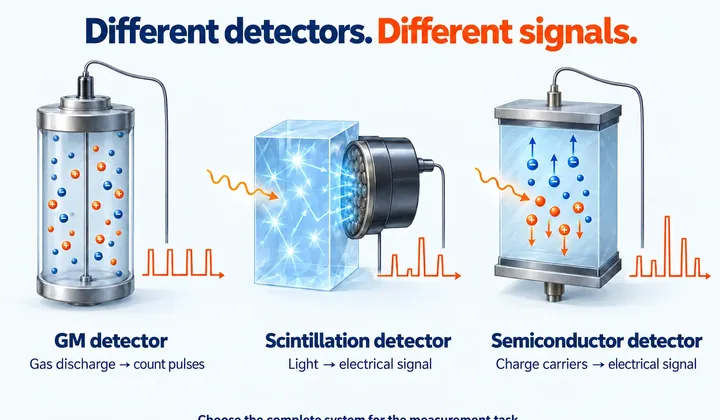
The expected radiation types and energies matter. A detector optimized for one task may give an inadequate or misleading response to another. Consult the existing radiation types guide for the underlying distinctions.
Treat the instrument as a measurement system
The detector is only one part of the system. Electronics, settings, calibration, software and the measurement arrangement influence the result. A surface measurement can depend strongly on the detector window and distance. An identification task needs suitable energy information and an appropriate analysis process.
Build a complementary set when necessary
Specify what each instrument will do, what it will not establish and how the results will be combined. This also clarifies training, maintenance and recordkeeping requirements. A kit with overlapping functions is not automatically a complete monitoring programme.
Nucleolenz offers an Indoor Area Gamma Monitor, a Teledosimeter and a GS200 gamma spectrometer. These are useful examples of different instrument roles. Their presence in a product range does not make any one of them a universal contamination, neutron or laboratory assay system.
Turn a shopping list into a measurement brief
Start a procurement meeting with a sentence such as, “We need to record changes in the gamma field at a defined workplace position.” Add the range of conditions the result must represent and who will act on it. This is more useful than beginning with “We want the most sensitive detector,” because sensitivity without a radiation type, energy and measurement arrangement is incomplete.
For each requested capability, ask for a sample output and the method that produces it. A plot of counts against time, a personal dose record and a gamma spectrum may all look like radiation data on a laptop. Their labels, calibrations and assumptions tell you which decisions they can support.
The tempting all-in-one example
Suppose a department already owns a gamma spectrometer and is asked to check a workbench for removable contamination. The instrument's ability to display a spectrum does not establish a wipe-sampling method, an efficiency calibration or sensitivity to every radionuclide used at that bench. The team should identify the contaminant and required result before proposing a workflow.
The same reasoning runs in the other direction. A surface-contamination instrument that responds to a source may not report a valid gamma dose rate for that field. Detecting a response is valuable evidence, but it is a different claim from measuring a specified quantity with known performance.
Ask what must accompany the instrument
- Which detector or probe configuration supports the intended task?
- Which calibration and check procedure apply to that configuration?
- Which accessories, positioning aids or software are part of the method?
- Which radiation types, rates or environments fall outside its documented use?
- What training and records are needed to use the result?
A useful comparison ends with a coverage map: each task has an assigned method, and every remaining gap is visible. Some devices can serve several roles when appropriately configured. The point is to verify each role separately rather than assume that more display modes mean complete coverage.
The strongest equipment specification names the intended quantity, field and operating conditions. That makes an instrument recommendation testable and avoids buying a familiar device for an unfamiliar measurement.
Check your understanding
Put the idea to work
Choose an answer, then reveal the explanation. Your answers stay in this browser.