
Becquerel, Gray and Sievert: Choosing the Correct Radiation Unit
Bq describes activity, Gy describes absorbed dose, and Sv is used for radiation-protection quantities. Learn to report each without converting unlike measurements.
Open the concept graphic at full size ↗
Three key ideas
Activity, absorbed dose, protection quantity
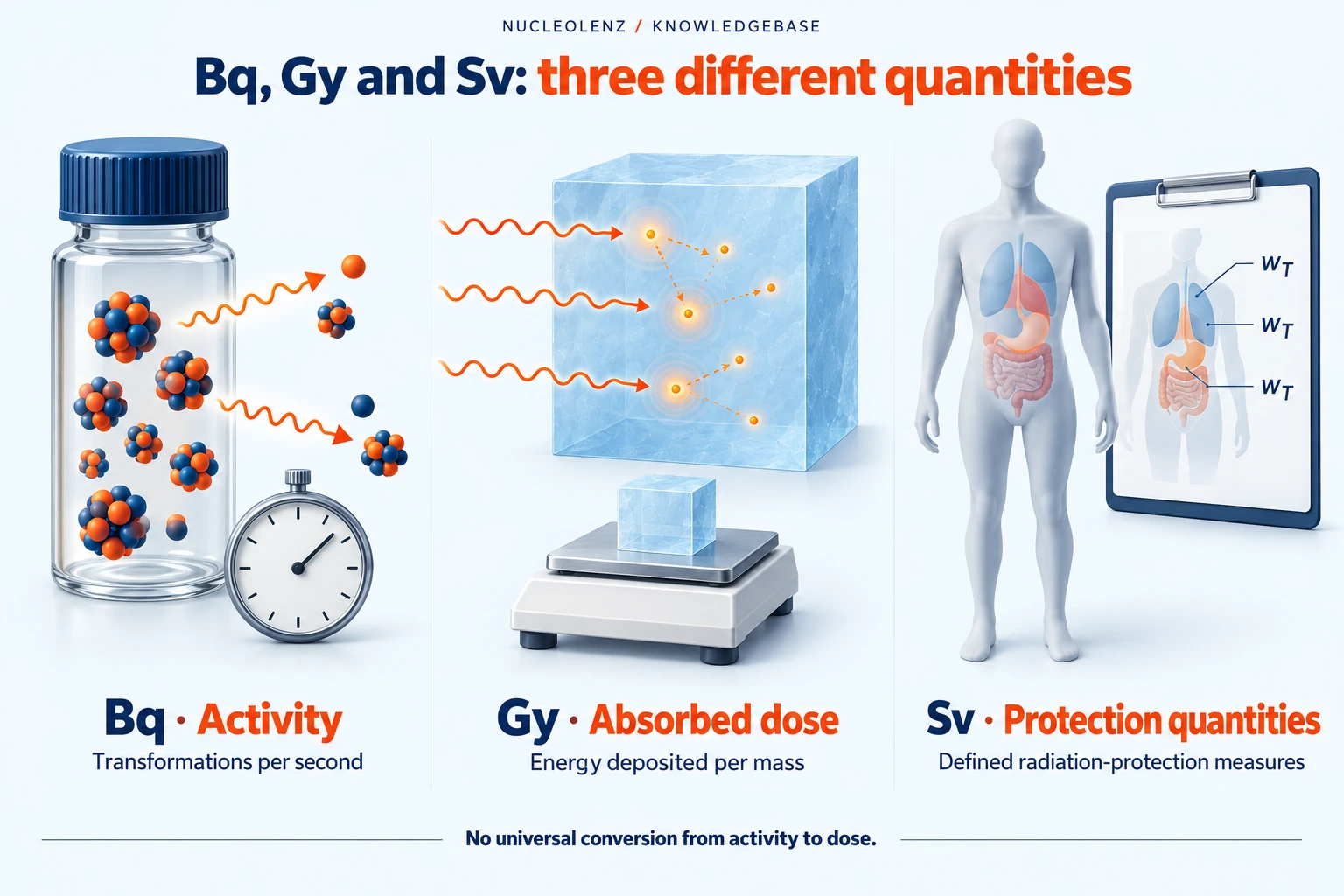
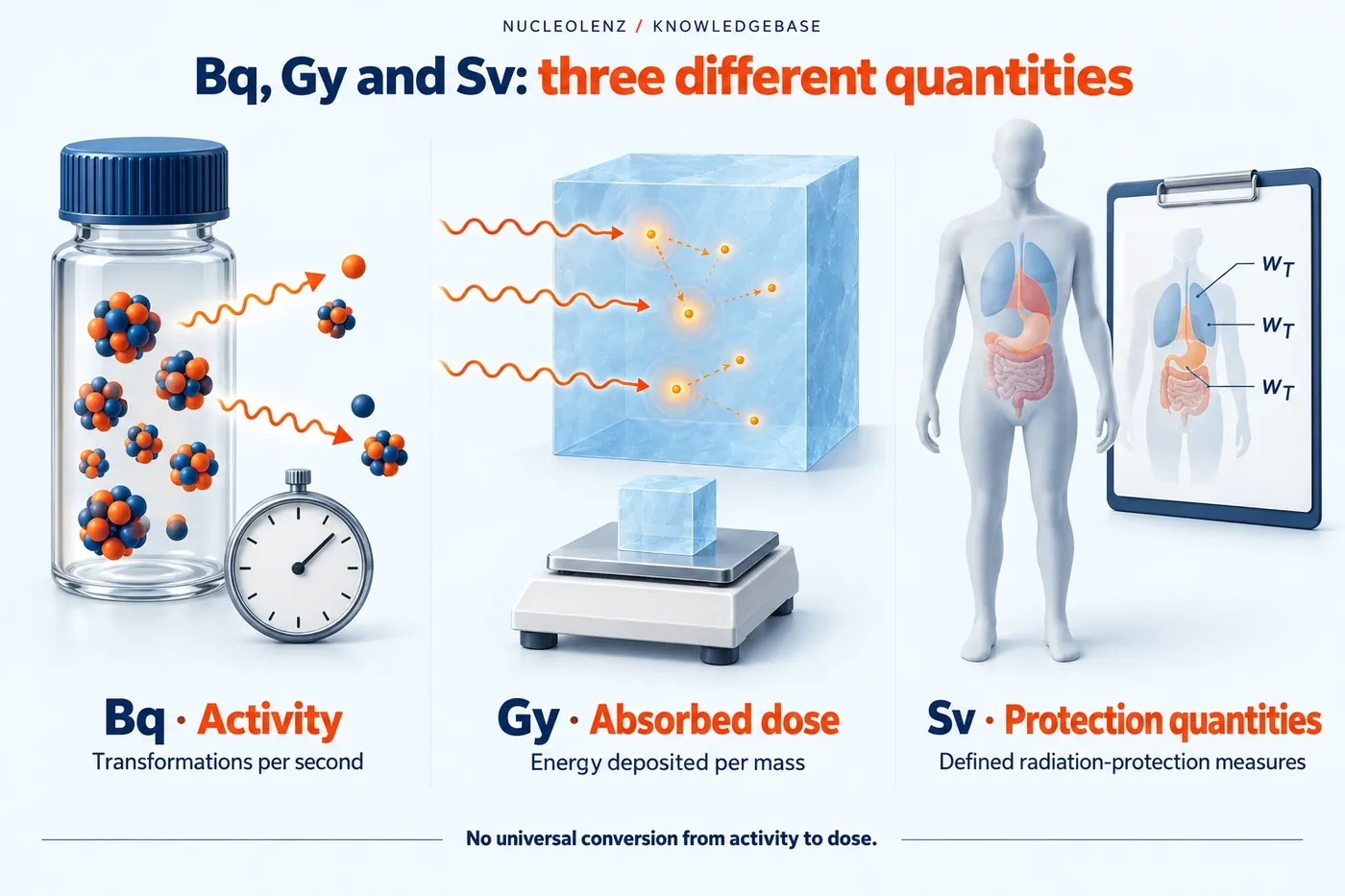
- Becquerel · Bq: How frequently nuclei transform: one transformation per second.
- Gray · Gy: Absorbed energy per mass: one joule per kilogram.
- Sievert · Sv: Unit for defined radiation-protection dose quantities.
At a glance
Compare the key distinctions
| Focus | What it establishes or needs | Important limit or evidence |
|---|---|---|
| Bq | Activity | Specify radionuclide, sample and time reference |
| Gy | Absorbed dose | Specify material or tissue and conditions |
| Sv | Protection dose quantity | Name the equivalent, effective or operational quantity |
| µSv/h | Rate of a defined dose quantity | Preserve the time basis and instrument quantity |
The numerical examples are arithmetic exercises, not exposure guidance or regulatory limits.
A number becomes useful only when its quantity and unit are clear. A sample activity, an absorbed dose and a radiation protection measurement can all concern the same source while describing different aspects of it.
Three quantities to keep separate
The becquerel, Bq, describes activity: one nuclear transformation per second. The gray, Gy, describes absorbed dose: one joule of energy deposited per kilogram. The sievert, Sv, is used for equivalent and effective dose and for operational dose-equivalent quantities used in radiation protection. These quantities involve different definitions and purposes.
The prefix also matters. A millisievert is one thousand microsieverts. Writing only “the reading was 10” leaves the reader unable to distinguish a quantity, a rate or even the scale of the result.
Ask what the measurement actually supports
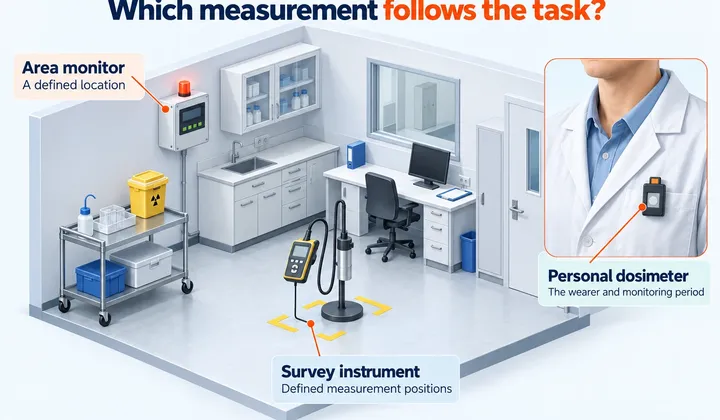
Imagine a laboratory reporting activity in Bq for a sample, while a workplace monitor displays a dose-equivalent rate in µSv/h nearby. The sample result and the field reading are not contradictory. Their relationship depends on factors such as the radionuclide, emissions, arrangement and shielding.
There is no universal conversion from Bq to Sv. Similarly, a count rate is not automatically an activity. A detector does not register every transformation, and its response depends on the measurement setup. A defensible activity result needs the appropriate efficiency and analysis method.
Make units part of the reporting template
Write the measured quantity next to its unit. For a sample, include any normalization, such as activity per mass or volume. For a field reading, include the position and whether the result is a rate. For a dose record, state the relevant period and the quantity assessed.
During a handover, ask a colleague to explain what each reported unit means before discussing whether the result is expected. This simple exercise reveals ambiguity early, especially when several instruments and laboratory reports are combined.
Read the denominator as carefully as the prefix
Bq per kilogram describes activity normalized to sample mass; Bq per litre refers to volume. A value in microgray per hour is an absorbed-dose rate under its stated definition, whereas microgray alone describes dose. Adding or removing “per hour” changes the quantity rather than just the presentation. Similarly, a result per square centimetre cannot be compared with the total activity of an entire wipe until the method and area are understood.
For a simple arithmetic check, 0.5 mSv and 500 µSv represent the same amount of the same dose quantity. This prefix conversion does not turn an area-monitor reading into a personal-dose assessment. Retain the quantity name even when the unit symbol is familiar.
Try a report-editing exercise
Three entries arrive for review: “sample: 80 Bq,” “monitor: 2 µSv/h,” and “badge: 40 µSv.” These are invented teaching values, not limits or typical exposures. The first needs the radionuclide, sample definition and analysis reference. The second needs the operational quantity, position and measurement time. The third needs the monitored individual, period and dosimetric quantity.
Do not rank the three numbers by size. Instead, write a complete sentence for each, leaving a visible blank wherever information is missing. This exercise often reveals that a disagreement is a reporting problem before anyone needs to repeat a measurement.
Why a dose unit still needs a quantity name
Equivalent dose, effective dose and operational dose-equivalent quantities can all use sieverts while serving different purposes. A portable meter does not directly determine an individual's effective dose merely because “Sv” appears on its display. Read the instrument documentation and calibration certificate to identify what is reported. For a handover, preserve the original value, prefix, unit, quantity, location or sample, and time basis together. That complete statement is the starting point for a valid comparison.
The purpose of a unit guide is not to encourage conversion between unlike quantities. It is to make the original measurement question explicit, so that subsequent calculations have a valid starting point.
Check your understanding
Put the idea to work
Choose an answer, then reveal the explanation. Your answers stay in this browser.