
ALARA in Everyday Work: Plan the Task Before Measuring
Turn ALARA into a practical planning conversation: prepare the task, preserve the measurement method and learn from avoidable delays without encouraging rushed work.
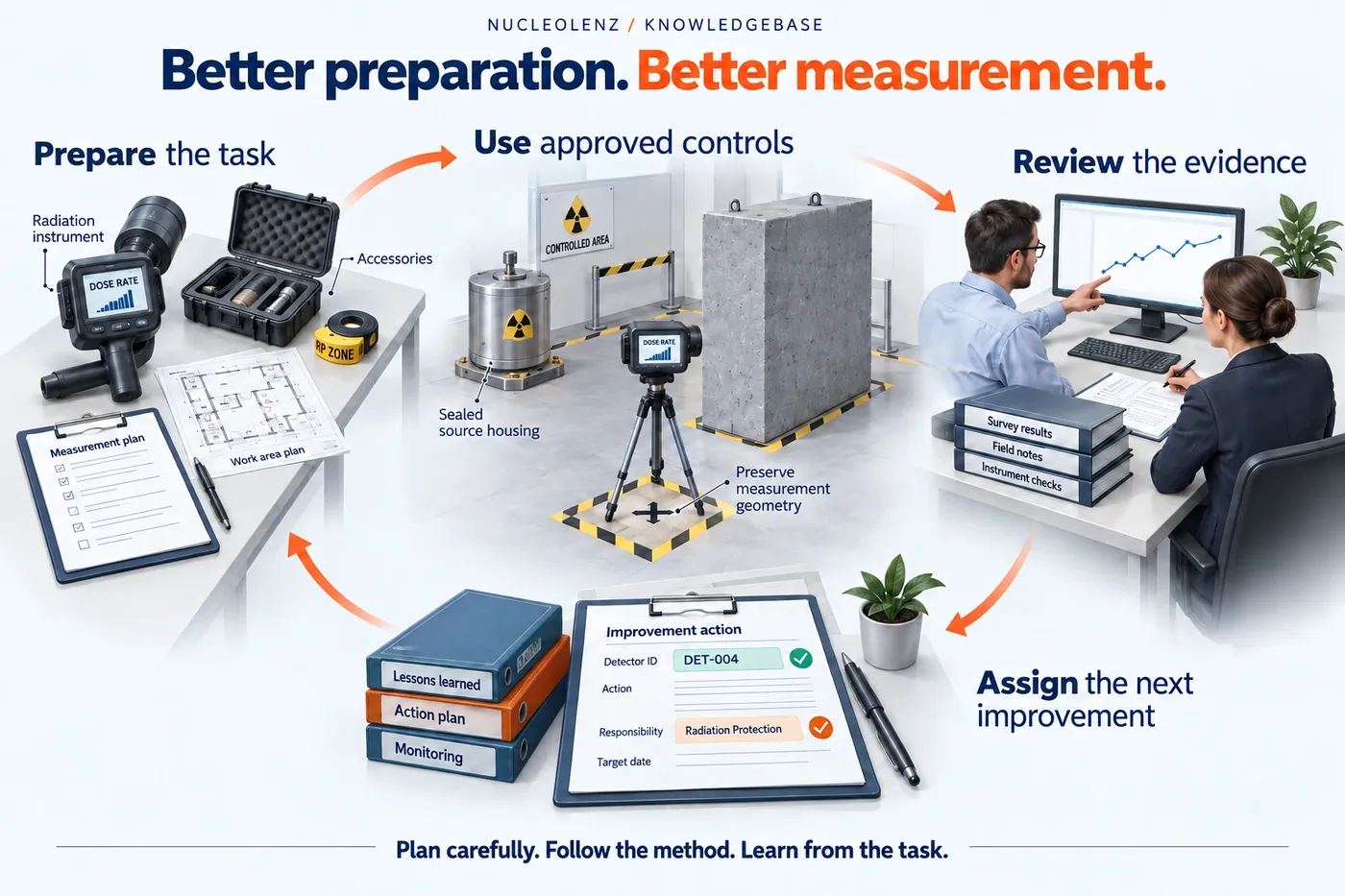
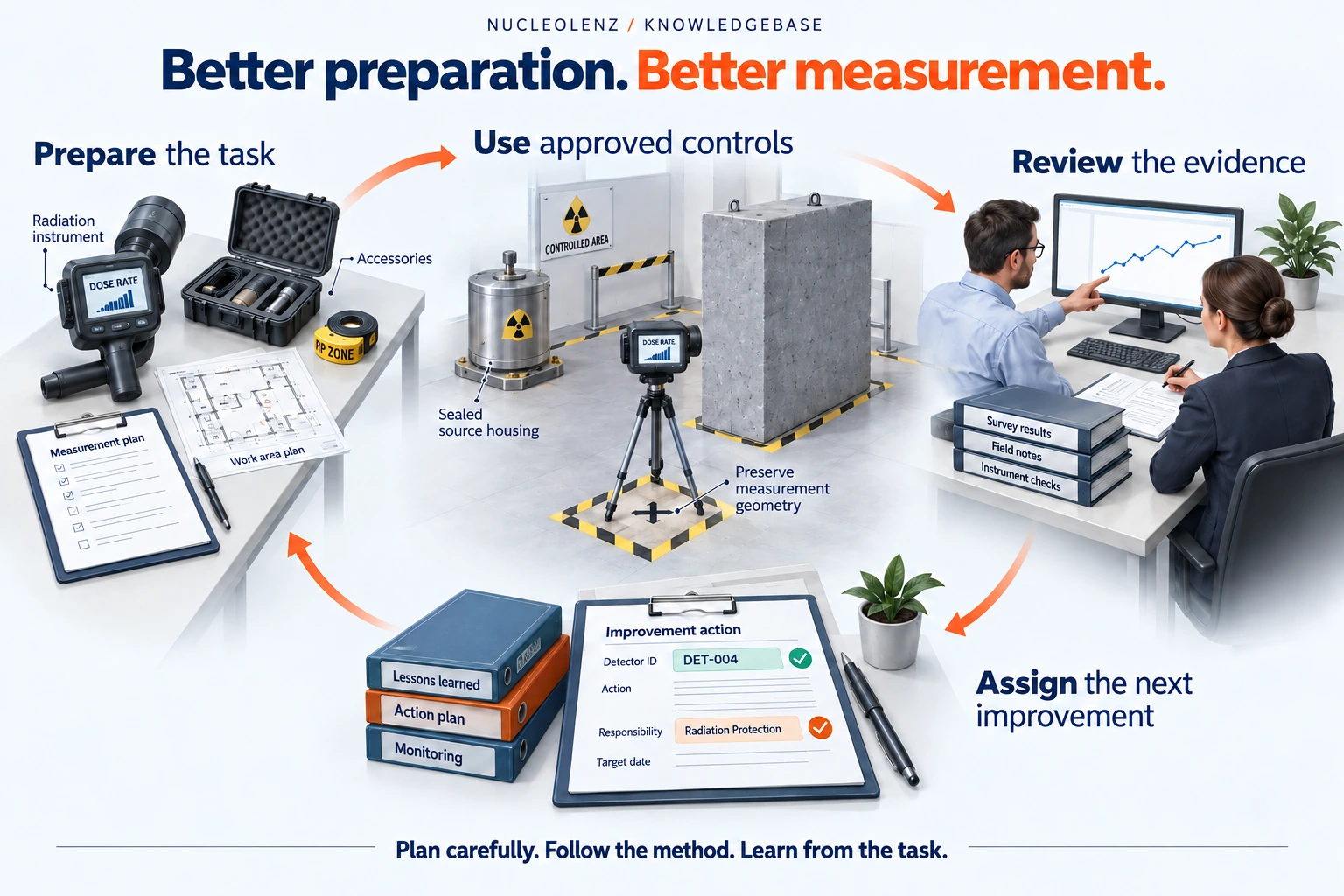
Open the concept graphic at full size ↗
Three key ideas
Prepare, perform, learn
- Prepare: Resolve equipment, roles and method before the task.
- Perform: Use approved controls and preserve the required measurement.
- Learn: Review delays and changes before the next task.
At a glance
Compare the key distinctions
| Focus | What it establishes or needs | Important limit or evidence |
|---|---|---|
| Preparation | Resolve missing tools and information | Rehearse the task sequence |
| Measurement | Keep geometry and acquisition fit for purpose | Review proposed changes before use |
| Communication | Know who assesses changed conditions | Make the response route clear |
| Debrief | Turn observations into improvements | Assign an owner for each action |
This planning framework complements the site radiation protection programme; it does not define operating limits.
Radiation protection begins before an instrument is switched on. A well-prepared task can reduce unnecessary exposure while making the eventual measurement clearer and easier to repeat.
Translate the principle into planning questions
ALARA means keeping exposures as low as reasonably achievable, taking relevant economic and social factors into account. Time, distance and suitable shielding are familiar tools, but their use should fit the source, radiation field and approved work arrangements.
Useful preparation questions include: Can the equipment be assembled away from the radiation field? Does everyone understand the sequence? Is the required information available before entry? Can a suitable observation point or approved remote arrangement reduce unnecessary time near the source?
These are planning questions rather than universal instructions. The appropriate controls must come from the responsible radiation protection assessment.
Avoid turning a slogan into a shortcut
Working more quickly is not helpful if it creates a mistake that requires a repeat entry. Moving an instrument farther away can reduce its response and change the measurement question. Shielding can affect both exposure and the information reaching a detector.
Close the loop after the task
Review what caused avoidable delays, whether monitoring information was available where needed and whether the procedure matched the actual work. Feed those observations into the next planning discussion instead of judging performance only by elapsed time.
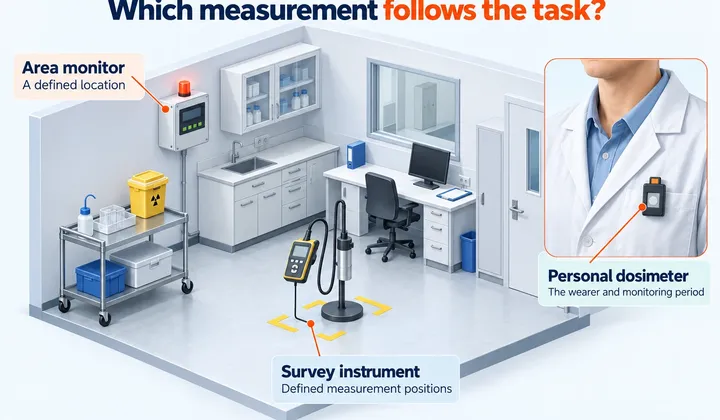
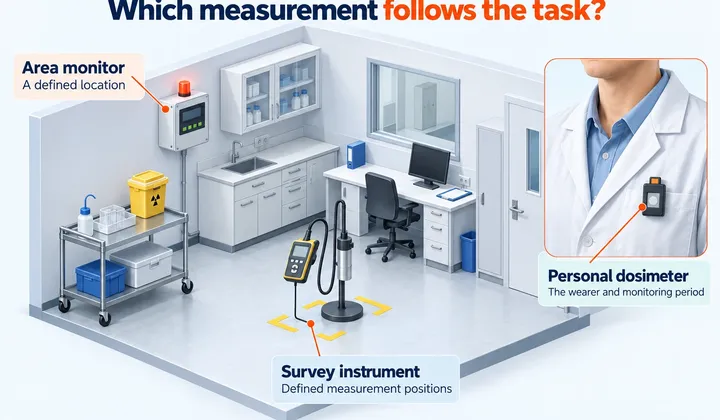
Where fixed gamma monitoring is appropriate, a Nucleolenz Indoor Area Gamma Monitor can be part of the instrumentation discussion. Monitoring provides information; the site's protection programme determines how that information is used.
Rehearse the difficult part away from the source
Imagine a planned survey that requires a probe support, a location sketch and a record form. In a tabletop rehearsal, the team discovers that the sketch labels do not match the form and that one support fitting is missing. Correcting those details during preparation removes a reason for delay or repetition later. The exercise does not require changing the approved survey positions or asking an operator to move faster.
Give the rehearsal a specific output: a complete kit list, an agreed task sequence and a clear communication point if conditions differ from the plan. Preparation is valuable when it removes uncertainty from the work, rather than adding paperwork nobody will use.
Balance exposure control with measurement quality
A detector location is part of a method. Moving the operator farther away may be useful where a suitable remote arrangement exists; moving the detector itself can change the result being sought. Likewise, adding shielding can change which radiation reaches the instrument. Assess those choices together with the responsible radiation protection team.
The same reasoning applies to measurement duration. A shorter acquisition can mean less information, particularly when few events are recorded. A longer acquisition is not automatically justified either. The plan should state the information needed for the decision and how the selected method will provide it within the approved controls.
Use a short debrief with an owner
- Which part of the work differed from the briefing?
- Did equipment readiness or missing information cause a repeat step?
- Were readings and status information available to the person making the decision?
- Which change should be assessed before the next similar task, and who owns it?
A useful review records a specific improvement and its owner. Avoid treating the lowest recorded dose or shortest elapsed time as a competition between workers: different tasks and conditions require different interpretations. ALARA planning succeeds when protection and the quality of the work improve together.
ALARA is most useful when connected to a specific task, an accountable decision and a review of what happened. It should support careful work rather than pressure operators to take unassessed shortcuts.
Check your understanding
Put the idea to work
Choose an answer, then reveal the explanation. Your answers stay in this browser.