Radiation Safety as a Daily Practice: Turn Observations Into Improvements
Turn a recurring radiation-work observation into a specific improvement with an owner, a record and a follow-up check that shows whether it helped.
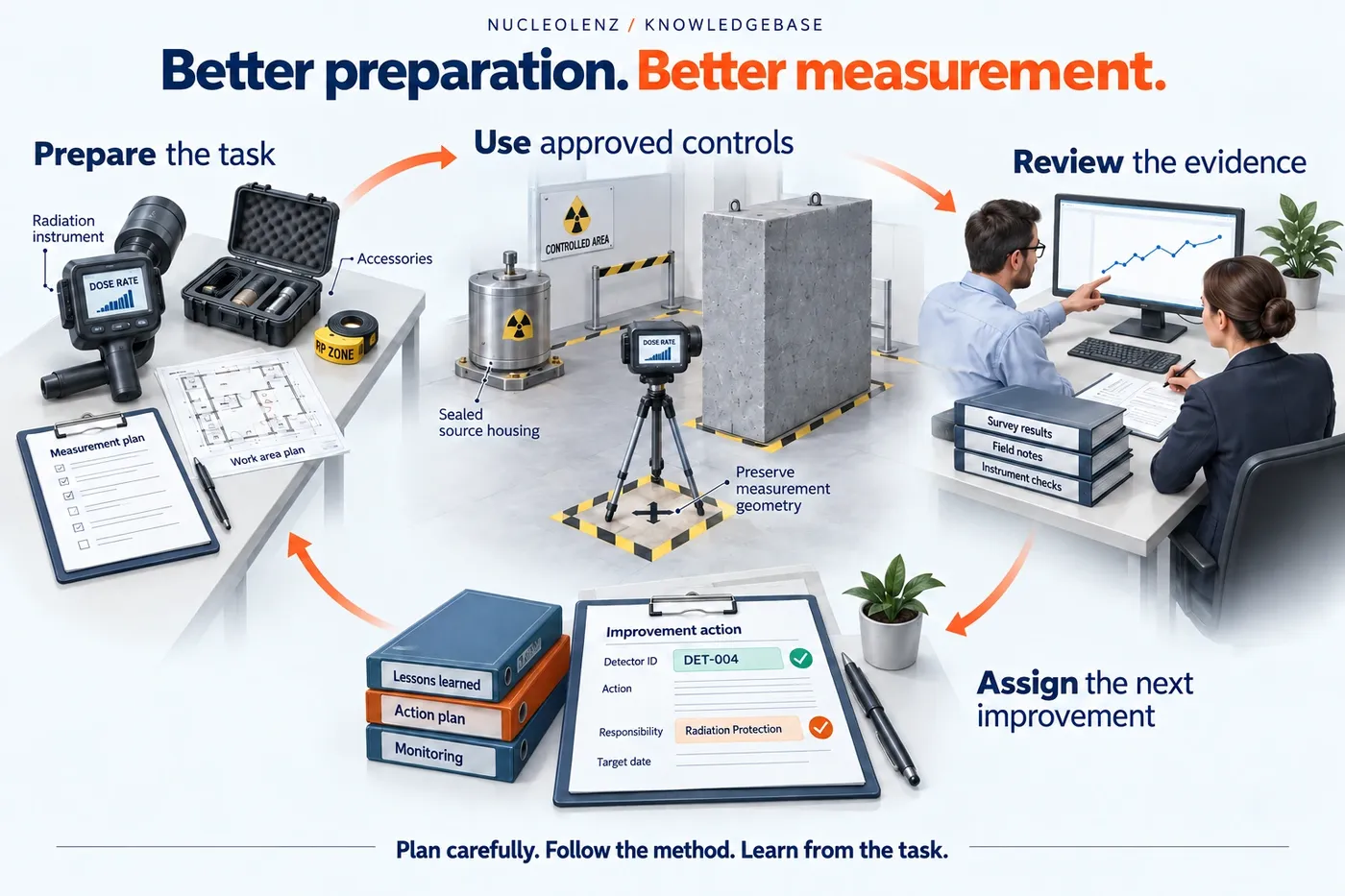
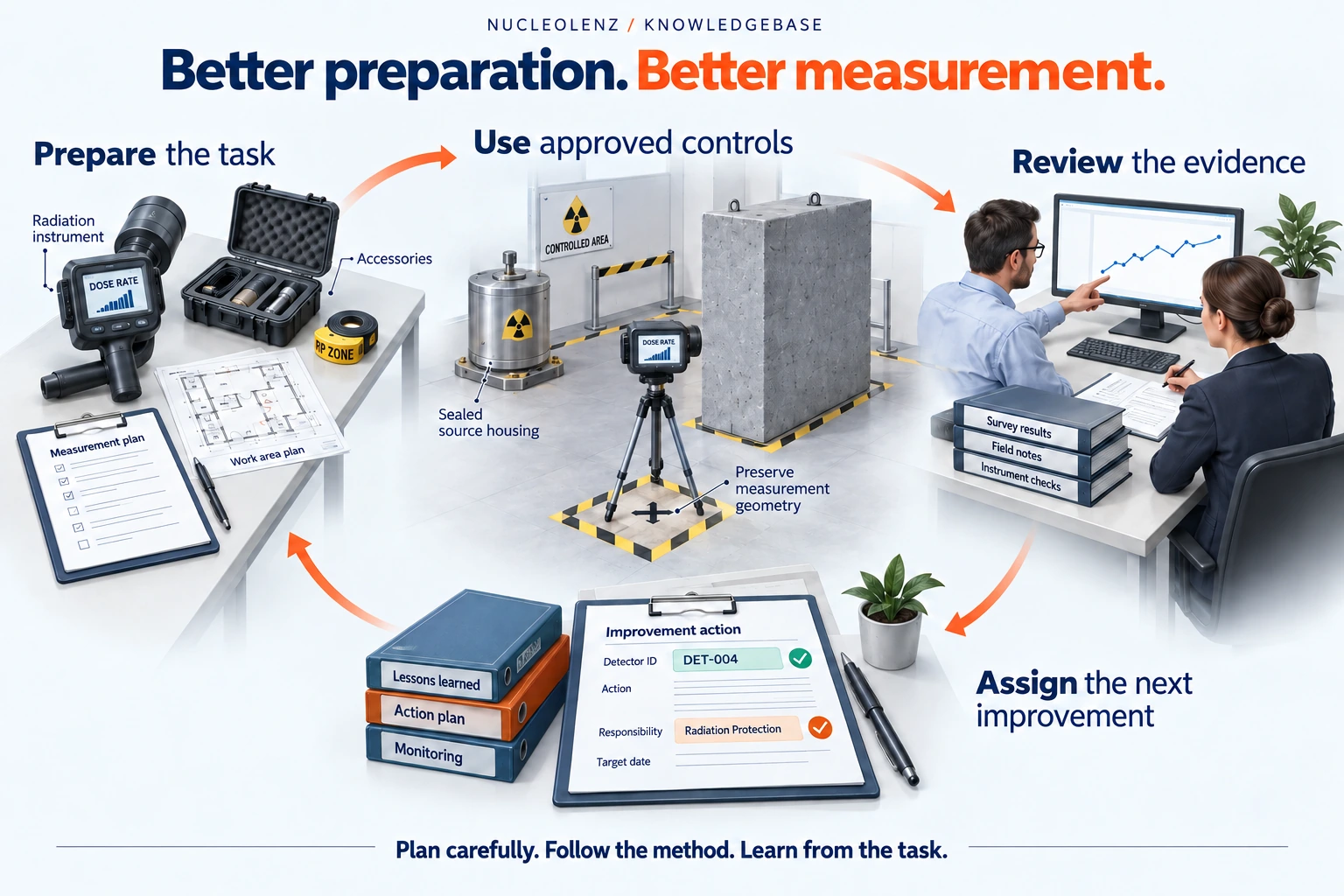
Open the concept graphic at full size ↗
Three key ideas
Turn an observation into a verified improvement
- Observe: Describe the specific gap and preserve its evidence.
- Act: Agree a change, responsible owner and review method.
- Check: Assess whether later records show the intended improvement.
At a glance
A practical review guide
| Review point | Evidence to look for | What it does not establish |
|---|---|---|
| Observation | Specific record or event and its context | An unsupported explanation of cause |
| Action | Agreed change and responsible owner | Completion from a suggestion alone |
| Follow-up | Defined evidence of effectiveness | Success because a form was redesigned |
| Published story | Verified outcome and permission-cleared material | A customer result from a fictional exercise |
Use the applicable instrument documentation and the approved site programme for operational decisions.
Radiation safety as a daily practice includes noticing when information is unclear and making the work process easier to follow. A team does not need to wait for an awareness day to improve an ambiguous record or an unreliable handover. The useful starting point is a specific observation, an agreed action and evidence that the change addressed the problem.
Notice the gap without inventing its cause
Describe what happened in terms another person can review. “The detector identity was missing from three survey records” is more actionable than “the team needs to be more careful.” The first statement points to an observable problem; the second jumps to a judgment. Preserve the relevant records and ask which part of the process allowed the information to be lost. Keep individual observations separate from conclusions about exposure or equipment performance.
Make preparation understandable
People need appropriate equipment, current instructions and a shared understanding of the assigned measurement. A readiness check should have a defined purpose, recorded result and response to an unexpected observation. If staff cannot find the approved instruction or cannot tell which detector record applies, the improvement may concern document access or equipment identification. Repeating a ritual of switching on a display does not resolve those underlying gaps.
Improve the handover as well as the measurement
A useful measurement record connects the quantity and unit with the equipment, location, acquisition conditions and relevant status. The receiving person should also know who reviews the result and how an uncertainty or deviation is raised. A completed form is not necessarily a completed assessment. Look for places where staff have to guess whether a blank field means not measured, not applicable or a normal result.
Practice: the missing detector field
In this fictional improvement exercise, a survey form records the meter serial number but has no field for the external detector. The team agrees to revise the form through its document-control process and explains why the detector identity matters. An owner confirms that the current form is accessible and that obsolete copies are removed from the intended workflow.
The follow-up is more specific than asking whether the new form looks better. Review a defined sample of later records to see whether detector identity is present and usable. If it is still missing, investigate the workflow: perhaps the label is difficult to read or the field is misunderstood. This exercise is an educational example, not a claim about a Nucleolenz team or customer.
Give the improvement a visible record
- State the original observation and why it affects the work.
- Record the agreed change and the responsible owner.
- Identify the procedure, form or training material affected.
- Define how completion and effectiveness will be checked.
- Record the follow-up finding and any further action.
Use learning material in its proper role
Knowledgebase articles can explain measurement concepts and support discussion. The site's approved programme supplies the operational requirements and authority. A team exercise should refer back to those arrangements rather than quietly introduce a new threshold, work method or alarm response. Where a technical issue exceeds the team's role, make the route to qualified support part of the improvement.
A factual improvement story can eventually describe the verified problem, approved action and observed outcome, using permission-cleared material. Until that evidence exists, present the activity as a proposal or fictional exercise. One well-documented change gives readers something they can understand and assess without broad claims that instrument ownership alone makes a workplace safe.
Check your understanding
Put the idea to work
Choose an answer, then reveal the explanation. Your answers stay in this browser.