
From Schematic to Radiation Instrument: Follow the Evidence
Connect a radiation-instrument requirement to design decisions and verification evidence. Learn what a schematic, prototype, calibration and acceptance record each establish.
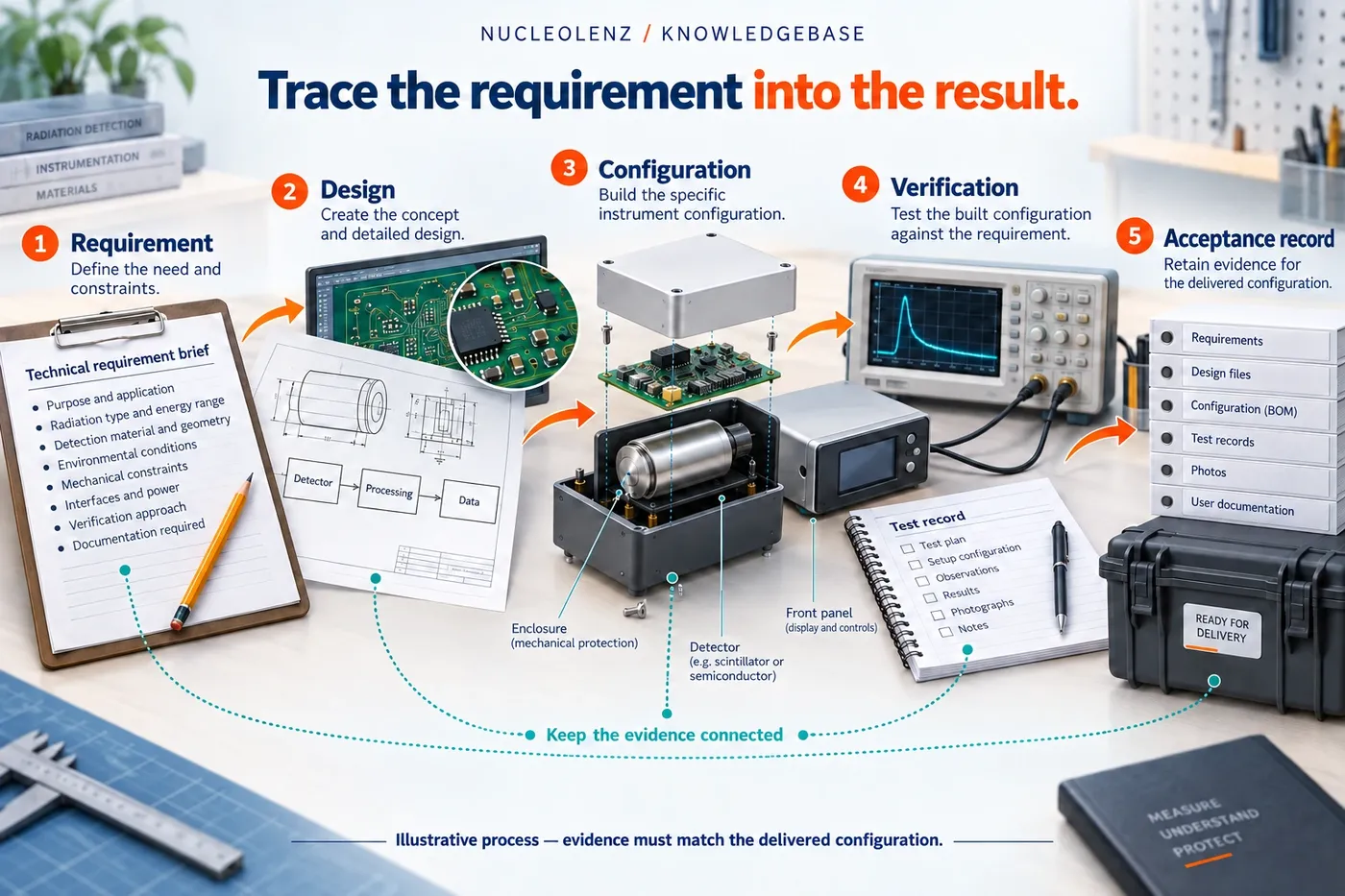
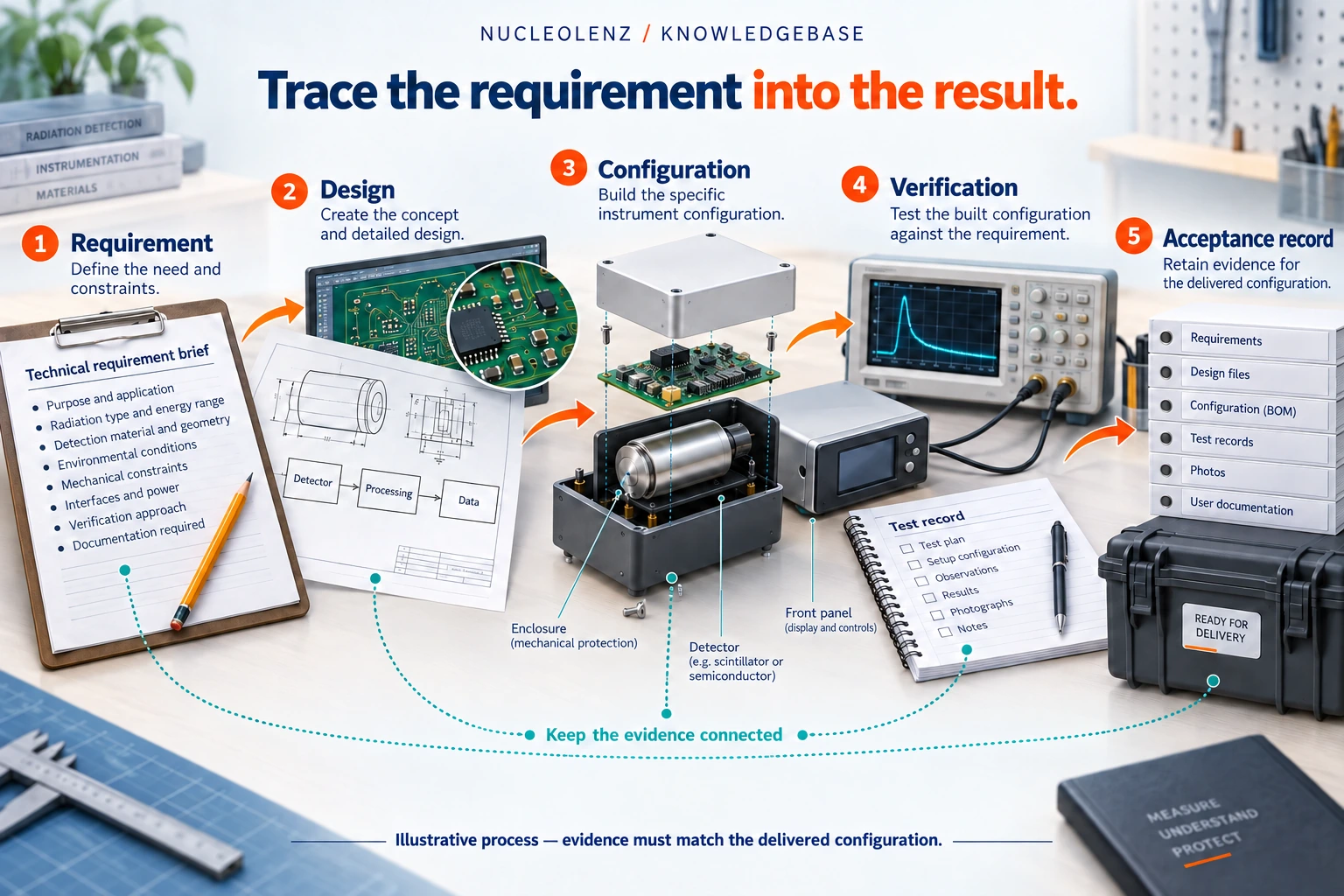
Open the concept graphic at full size ↗
Three key ideas
Requirement, implementation, verification
- Requirement: State the measurement or behaviour the system must support.
- Implementation: Connect the requirement to hardware, software and configuration.
- Verification: Retain evidence for the specified delivered configuration.
At a glance
Compare the key distinctions
| Evidence | What it can establish | Does not by itself establish |
|---|---|---|
| Schematic | Electrical design intent | Complete system measurement performance |
| Prototype demonstration | Observed function in the demonstrated setup | All operating conditions |
| Calibration or characterization | Defined response with stated conditions | Unrelated configurations or tasks |
| Acceptance record | Evidence against agreed requirements | Unspecified future uses |
The examples describe a general evidence trail and do not report an undisclosed Nucleolenz project.
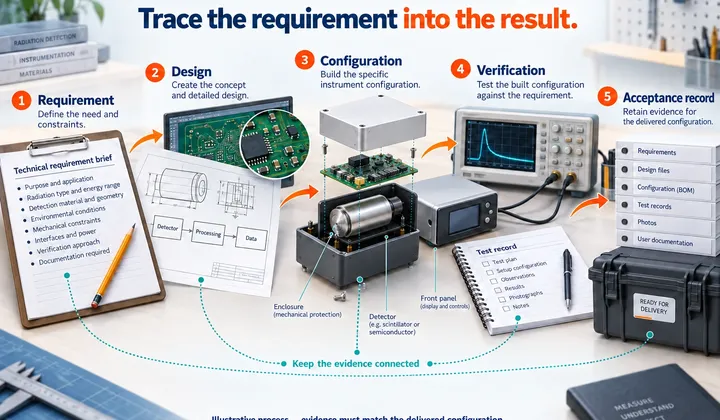
A circuit diagram is one part of an instrument, not the complete evidence that a measurement requirement has been met. A useful engineering story connects each design stage with a question that can be verified.
Begin with the intended result
Define the radiation, quantity, operating conditions and user decisions the instrument must support. State the detector and acquisition requirements before selecting individual electronic components. Otherwise, a working prototype can still answer the wrong measurement question.
The Nucleolenz engineering context includes radiation monitoring and instrumentation. The published product pages describe specific devices; they do not provide a universal account of the development process behind every model.
Connect the physical and digital design
A detector's signal needs suitable electronics, power and processing. Firmware and software influence the configured acquisition, indication and records. Interfaces determine how information reaches the operator or a receiving system.
Describe verification without inventing a factory story
Engineering evidence should identify the configuration, method, reference and result. Distinguish a functional prototype demonstration from a characterized measurement, environmental test or production acceptance check.
For an actual Nucleolenz project profile, use approved design records and permission-cleared team material. Do not present the general stages in this article as proof that particular tests were completed or that a customer accepted a system.
The published GS200 provides a product example involving a detector and multichannel analysis. Any detailed account of its implementation would require its own verified engineering evidence.
Give one requirement a traceable route
Consider a fictional requirement to retain a gamma spectrum together with its acquisition settings. The detector and acquisition chain must provide suitable information; the software must associate the settings with the saved data; the exported record must preserve that association. A schematic can describe the electrical design, but it cannot by itself demonstrate that a user can retrieve an interpretable file.
A development worksheet can therefore contain four entries: the requirement, the relevant design items, the planned verification and the retained result. The worksheet is useful precisely because it reveals when a requirement has hardware evidence but no software or workflow evidence.
Use precise names for engineering milestones
- Functional demonstration: shows that the demonstrated behaviour occurred under the stated conditions.
- Measurement characterization: examines performance for defined quantities, configurations and conditions.
- Environmental test: examines specified behaviour during or after a stated exposure or condition.
- Acceptance activity: checks the delivered system against agreed requirements.
These records may support one another, but they answer different questions. A prototype display that changes in response to an input does not establish a calibrated radiation result. A test of one configuration does not automatically cover every later detector, firmware or enclosure change.
Make a change visible to the next reviewer
Suppose a project substitutes an acquisition board after an initial demonstration. The change record should identify which functions and performance claims might be affected, and which evidence needs reassessment. The purpose is not to repeat every test without thought. It is to preserve a reasoned connection between the delivered configuration and the evidence being cited.
For a public project story, distinguish this general engineering method from claims about an actual Nucleolenz build. Photographs, test results and customer outcomes need their own approved records. Readers learn more from a clearly supported decision and its limitation than from an implied claim that every possible performance question has already been closed.
A good schematic-to-instrument explanation lets readers follow how a requirement became a design decision and how that decision was assessed. It makes uncertainty and open questions visible instead of replacing the evidence with a success narrative.
Check your understanding
Put the idea to work
Choose an answer, then reveal the explanation. Your answers stay in this browser.