
Radiation Monitoring in Oil and Gas: Where NORM Enters the Picture
Explore how NORM can enter oil and gas equipment, residues and maintenance planning. Match field, contamination and sample measurements to the actual decision and industrial environment.
Open the concept graphic at full size ↗
Three key ideas
Connect process, measurement and decision
- Process: Identify equipment history and relevant residues.
- Measurement: Define the field, material or sample question.
- Decision: Link evidence to the planned work assessment.
At a glance
A practical comparison
| Observation | What it tells you | What else you need |
|---|---|---|
| Operating equipment | Field conditions at defined positions | Process state and detector geometry |
| Planned maintenance | Questions about changes in exposure pathways | Task assessment and relevant material history |
| Material characterization | Results for defined samples and methods | Sampling representativeness and analysis scope |
| Instrument selection | A candidate measurement function | Radiation response and industrial suitability evidence |
Educational comparison; apply the method specified for the instrument and task.
Radiation monitoring in oil and gas often begins with materials already present in the geology. The process and maintenance workflow determine where those materials can become relevant to people, equipment and waste decisions.
Connect the material to the process
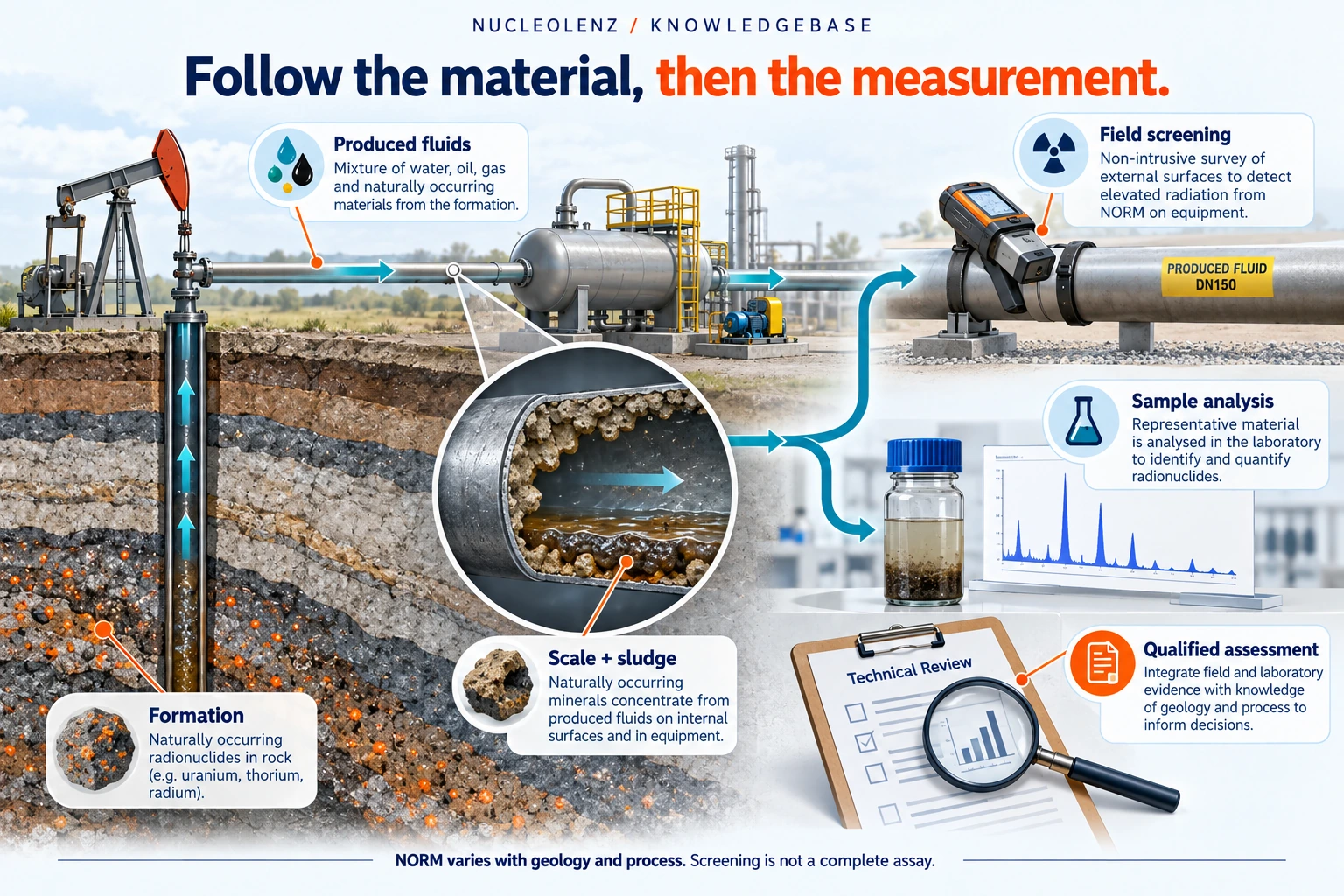
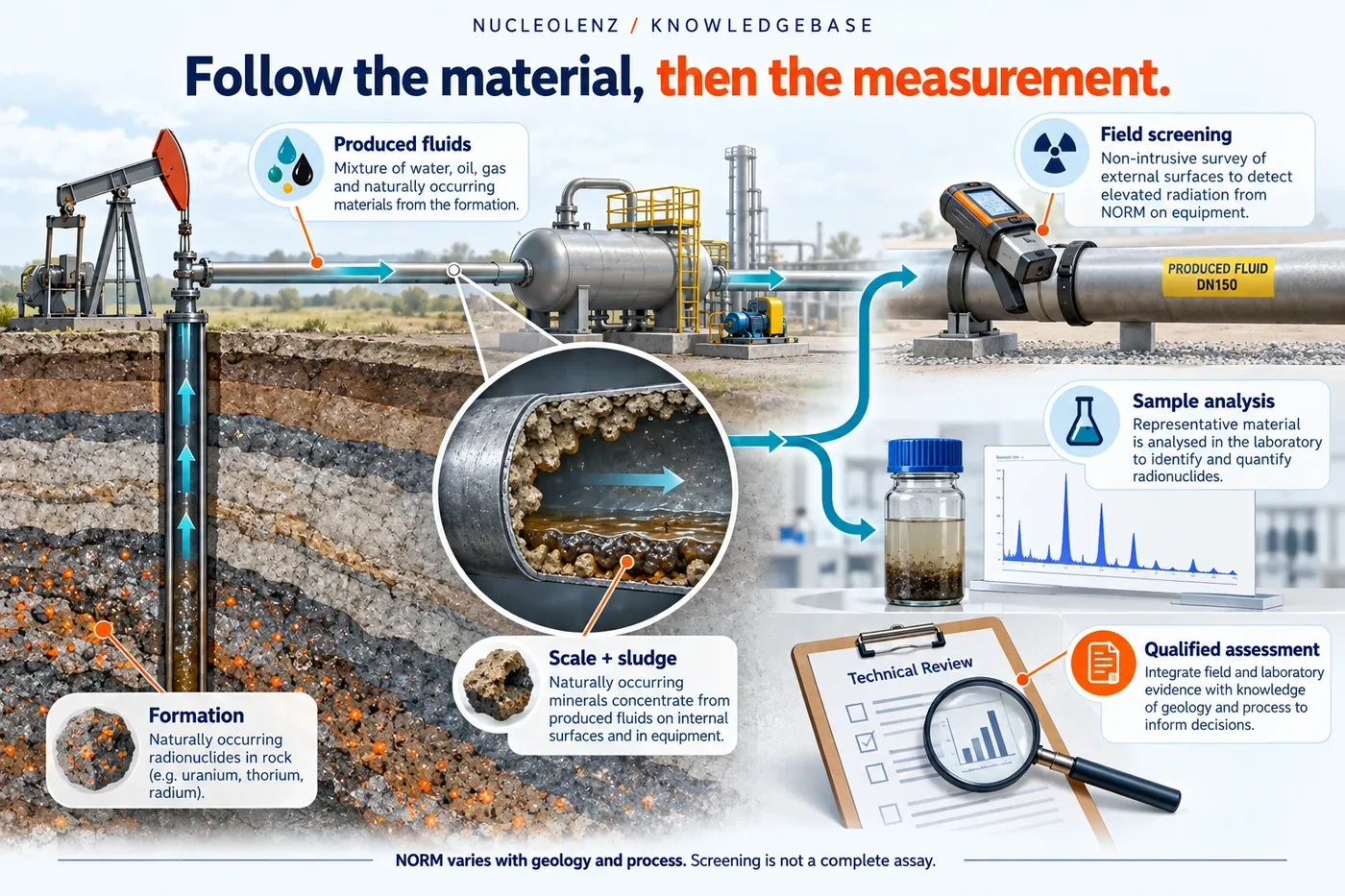
Naturally occurring radioactive material, or NORM, can be present in formations associated with oil and gas. Production can concentrate radionuclides in materials such as scale, sludge and produced water. The location and composition of those materials vary; a generic industry label does not establish the conditions at one facility.
Describe the process step, equipment history and material being investigated. An external reading near a pipe and an analysis of removed scale are different pieces of information.
Plan measurements around decisions
Ask whether the assessment concerns a field at a working position, material on equipment, a sample or a potential intake pathway. Maintenance and material handling can create different measurement requirements from routine operation.
Keep radiation and industrial hazards together
Radiation considerations are one part of the work environment. Temperature, access, chemical hazards and any hazardous-area classification also affect equipment selection and operating arrangements. A suitable radiation response does not establish suitability for every industrial condition.
Nucleolenz's GS200 gamma spectrometer is a product to discuss where gamma spectral information is part of a defined requirement. Confirm response, analysis scope and environmental suitability before assigning it a NORM application. Do not present a general product description as certification for hazardous-area use.
A useful monitoring plan connects a material, a measurement and a decision. It also identifies the additional laboratory or radiation protection assessment required when an initial field observation cannot answer the complete question.
A fictional component through three work stages
Consider a pump associated with a produced-water system. During operation, a monitoring question might concern the external field at a defined working position. Before planned maintenance, the questions may extend to the history of internal deposits and whether the task could change exposure pathways. During later material assessment, the question may concern the composition and activity concentration of a representative sample. This is a planning example, not a report of a contaminated customer installation.
The observations from one stage remain valuable at the next, but their meaning does not expand automatically. An external reading beside an intact component does not fully characterize material inside it. A laboratory result for one submitted sample does not by itself describe every similar-looking component in the facility.
Make the planning handover specific
- Process history: Identify the equipment and which fluids or residues it has encountered.
- Planned activity: State the question arising from operation, maintenance or material management.
- Measurement evidence: Attach the field or sample records with their units, geometry and methods.
- Remaining decision: Name the specialist assessment or additional information still required.
Production can redistribute and concentrate naturally occurring radionuclides; the term TENORM is used when human activity enhances their concentration or potential exposure. It does not mean that the industrial process created every radionuclide from scratch. Conditions vary by geology and process, so published examples should inform the questions without becoming assumed results for a new site.
Specify the industrial environment separately
Record temperature, dust, moisture, access and any classified-area requirements in the instrument brief. Radiation sensitivity and electrical or environmental suitability require their own evidence. If a product page documents gamma spectroscopy, that description alone does not establish approval for use in a flammable atmosphere. Resolve these requirements before selecting the instrument configuration for the task.
Check your understanding
Put the idea to work
Choose an answer, then reveal the explanation. Your answers stay in this browser.