Planning a Radiation Teaching Laboratory Around Learning Outcomes
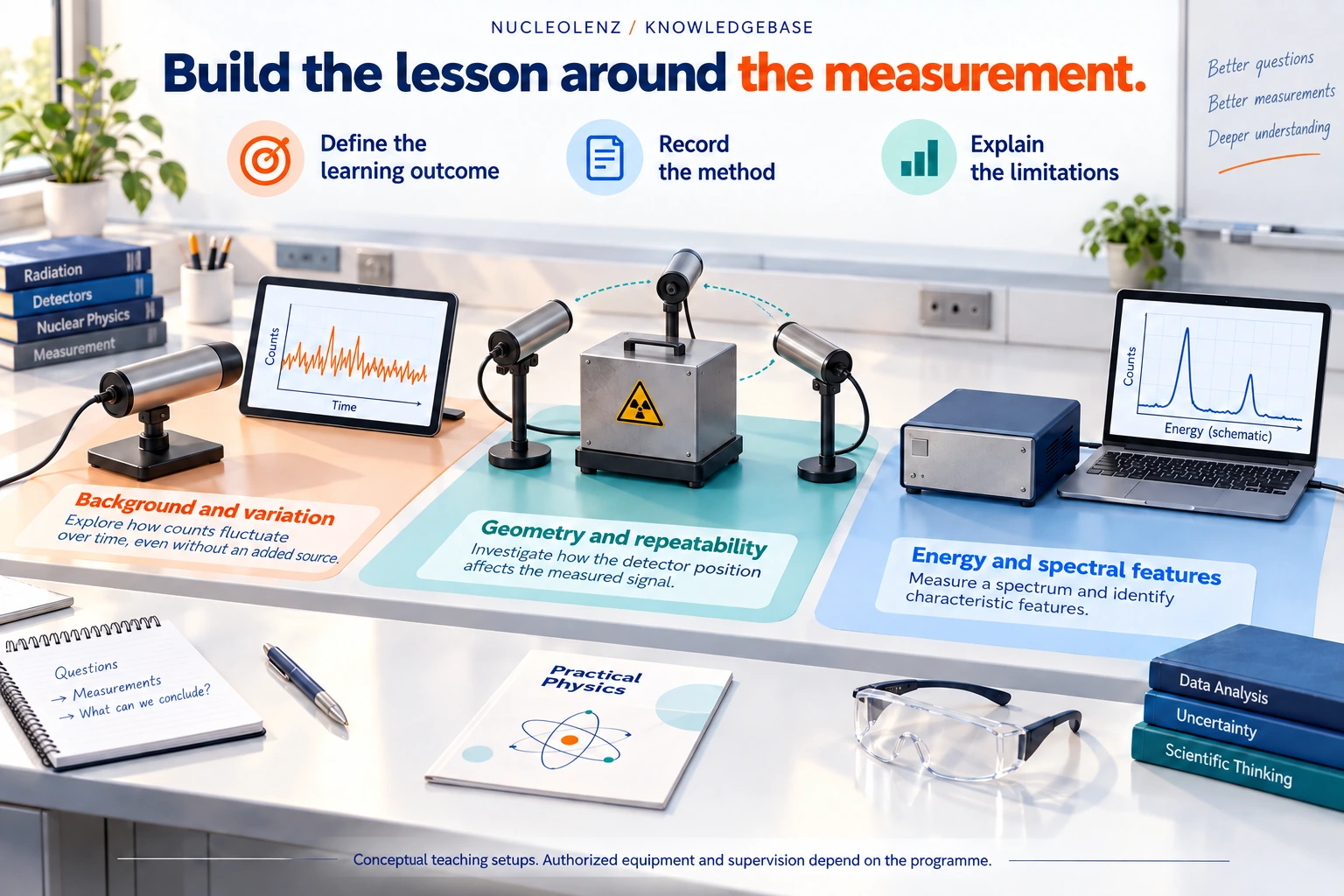
Design a radiation teaching laboratory around what students should understand: quantities, counting variation, spectra and the evidence behind a result.
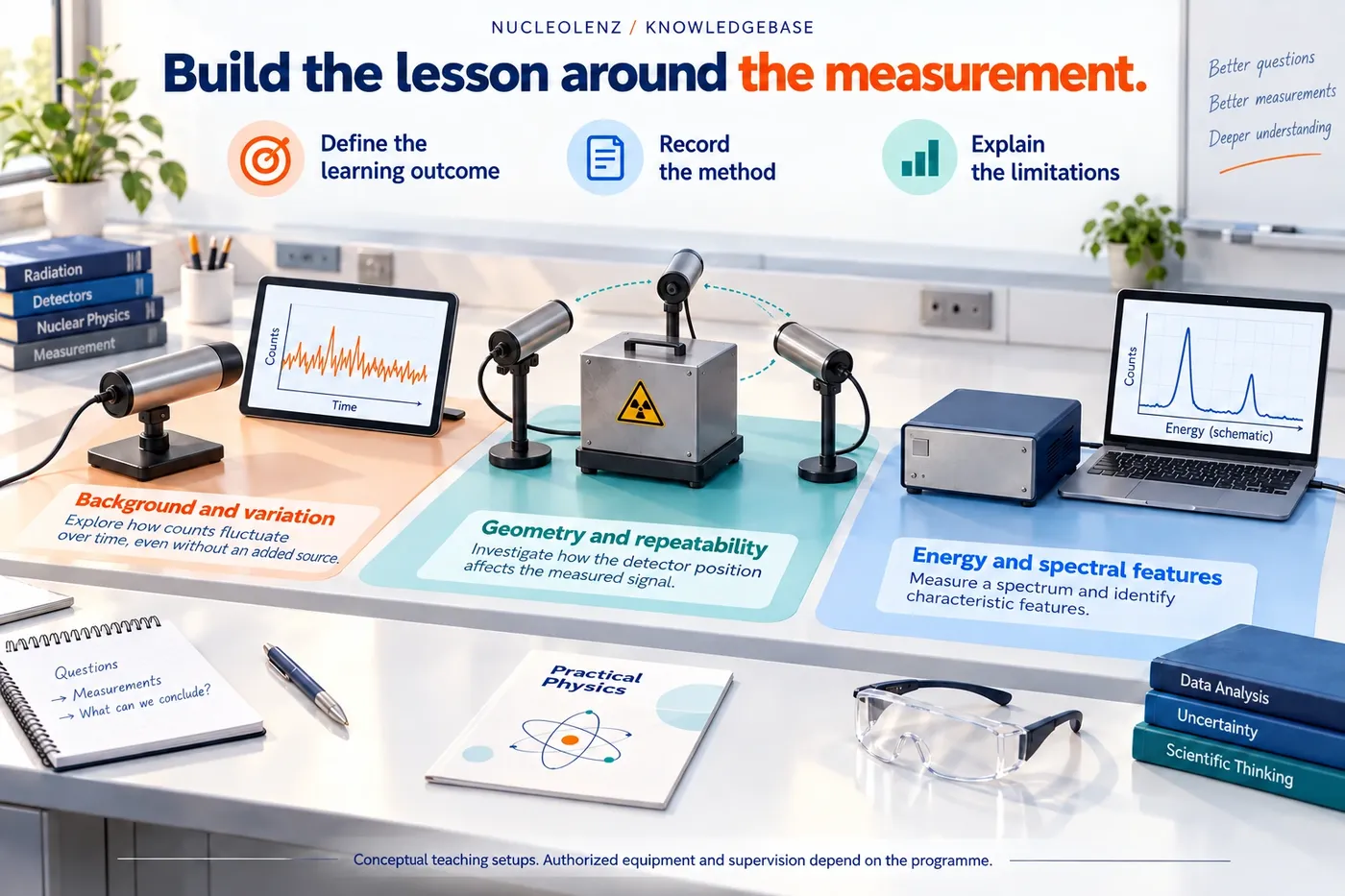
Open the concept graphic at full size ↗
Three key ideas
Outcome, observation, explanation
- Learning outcome: Define what the learner should be able to explain.
- Measurement record: Make arrangement, settings and acquired data visible.
- Supported conclusion: Ask what the evidence establishes and what remains unknown.
At a glance
Compare the key distinctions
| Focus | What it establishes or needs | Important limit or evidence |
|---|---|---|
| Units and quantities | Label a result completely | Quantity, unit, sample or location and time |
| Counting variation | Compare repeated or supplied datasets | Acquisition conditions and interpretation |
| Gamma spectra | Explain axes and features | Calibration, background and acquisition record |
| Reproducibility | Reconstruct a measurement | Equipment, settings, geometry and raw data |
Exercises must fit the institution’s authorization, supervision and approved source arrangements.
A teaching laboratory should help learners understand how a result is produced and what it means. Selecting equipment is easier when each exercise begins with a specific learning outcome.
Define the concepts to demonstrate
Examples include identifying a measured quantity, observing counting variation, reading a gamma spectrum and understanding how geometry changes a result. Write the intended observation and the information students should record for each exercise.
The exercises must fit the institution's authorized facilities, source arrangements and supervision. A general equipment article is not permission to acquire sources or conduct an exposure.
Make the measurement chain visible
Specify the detector, acquisition system, supported software and data format. Include sample positioning or shielding where required by the approved design. Learners should be able to connect the arrangement to the settings and the resulting dataset.
Include repeatability and recordkeeping
Provide exercise records with equipment identity, configuration, measurement duration and relevant conditions. Preserve raw data so that a learner can revisit the analysis after changing a display or interpretation setting.
Nucleolenz's Table Mount Gamma Spectrometer provides a product context for bench spectroscopy. The published laboratory workstation case study describes an integrated detector, analyzer, shielding and acquisition workflow. Confirm the supplied configuration and institution-specific requirements rather than treating the case study as a universal laboratory design.
Build an exercise backwards from its assessment
If the learning outcome is “explain why two count totals differ,” the assessment should ask students to examine counting time, arrangement and statistical variation. It should not reward only finding the correct software button. If the outcome is “read a spectrum,” students need to identify the axes and distinguish an observation from an interpretation supported by calibration.
A planning sheet can pair each outcome with a dataset, the records students must produce and the question they should answer at the end. This makes gaps visible before equipment is selected. It can also show where existing recorded or synthetic data are enough for an introductory lesson.
Try a deliberately incomplete dataset
Give learners a synthetic spectrum labelled only “sample A,” clearly marked as fictional training data. Ask what else they would need before interpreting it. Useful answers include the horizontal-axis definition, acquisition time, detector configuration, calibration and background information. Reveal those details progressively and ask which conclusions become possible at each stage.
Next, supply two records with different measurement durations and ask whether their raw counts can be compared directly. This exercise teaches students to challenge missing context without acquiring or handling radioactive material. Any later practical measurement should follow the institution's authorized arrangements, equipment instructions and supervision.
Specify the complete teaching workflow
- Before class: confirm equipment readiness, the approved exercise and available reference data.
- During class: give each group a consistent way to identify equipment, configuration and acquisition conditions.
- After class: retain raw data with analysis settings so conclusions can be revisited.
- Assessment: ask learners to explain a limitation or missing piece of evidence as well as report a result.
For procurement, include computer access, supported exports, training and maintenance alongside the detector and analyzer. A technically capable instrument can still frustrate a class if the workflow prevents students from retrieving their own records. The desired outcome is a learner who can explain and reproduce the measurement, including where its interpretation stops.
Plan operator training and the approved equipment checks alongside the experiments. A teaching setup is successful when students can state what was measured, repeat the arrangement and distinguish an observation from a conclusion. Those capabilities are more durable than familiarity with one instrument's menu layout.
Check your understanding
Put the idea to work
Choose an answer, then reveal the explanation. Your answers stay in this browser.