
Nuclear Medicine Workplaces: Several Questions, Several Measurements
Nuclear medicine monitoring involves distinct field, surface, personnel and intake questions. A fictional workplace example shows how to keep the measurements and responsibilities clear.
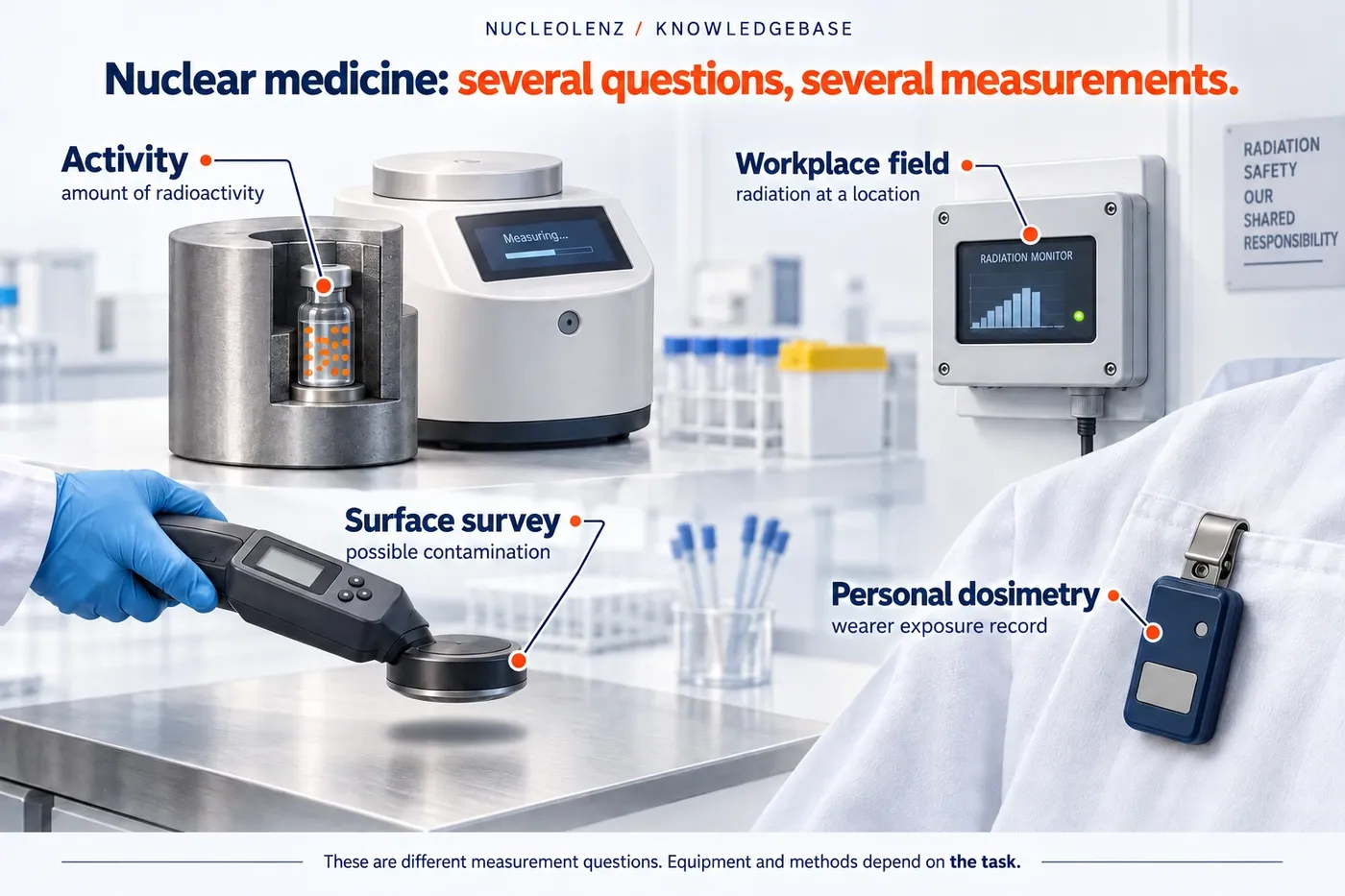
Open the concept graphic at full size ↗
Three key ideas
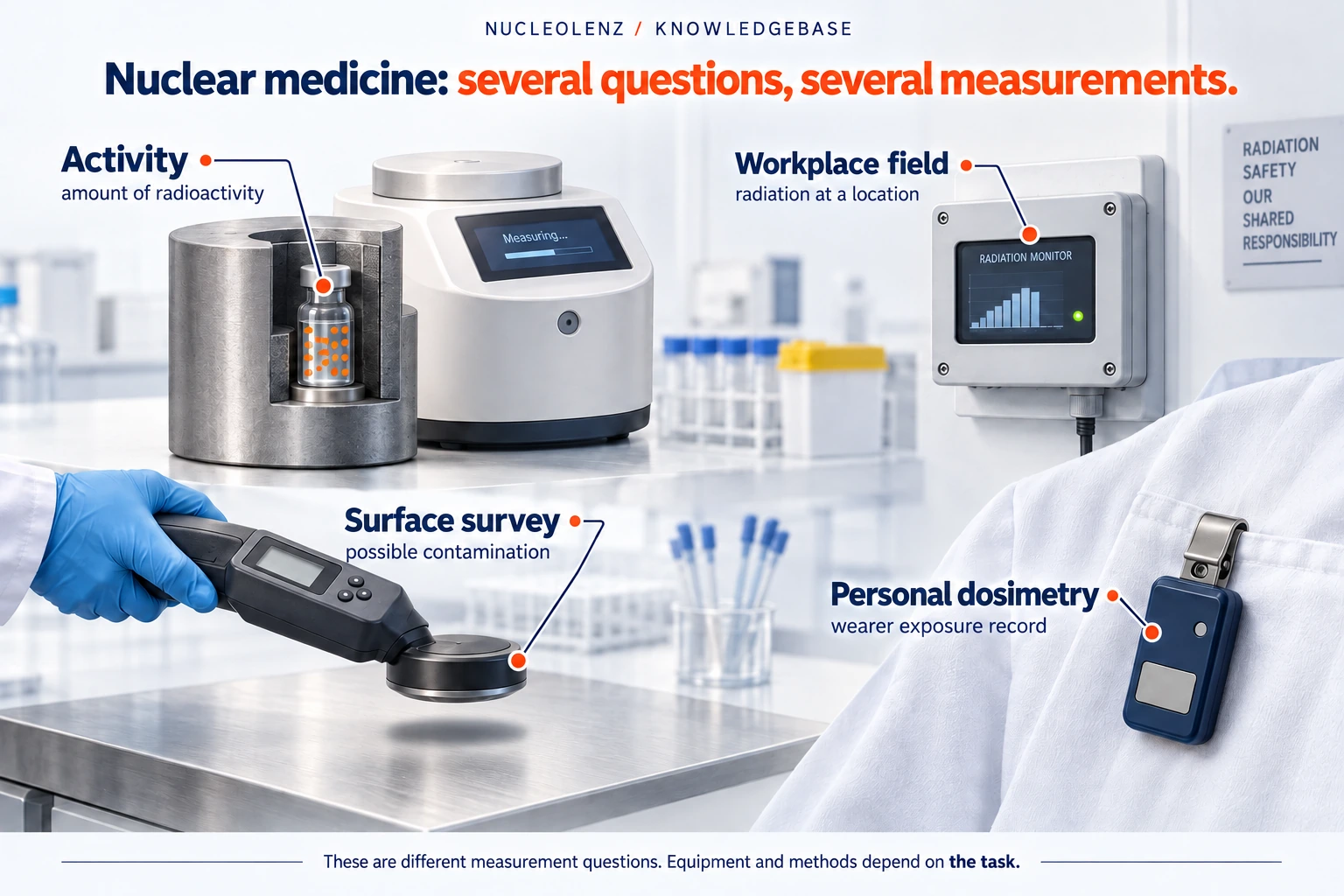
Several questions need distinct measurements
- Radiation field: A supported quantity at a defined location.
- Surface material: A suitable contamination measurement.
- Personnel: Monitoring matched to worker tasks and exposure.
At a glance
A practical comparison
| Observation | What it tells you | What else you need |
|---|---|---|
| Area gamma measurement | The field at the detector’s installed position | Placement, response and facility monitoring objective |
| Surface or wipe measurement | The surface or collected-material result within its method | Emission suitability, collection and detection capability |
| Personal dosimetry | The supported quantity for an assigned wearer | Wearing arrangement, period and task context |
| Clinical activity assay | Activity measured for its defined clinical purpose | A separate validated clinical measurement method |
Educational comparison; apply the method specified for the instrument and task.
A nuclear medicine workplace can involve radiation fields and radioactive material handled in different forms. The measurement plan needs to distinguish those questions instead of placing every result under one generic “radiation level.”
Map the quantity to the location and task
A field measurement concerns radiation at a defined position. A surface-contamination measurement concerns material on a surface using an appropriate method. Personnel dosimetry supports the monitoring quantities and arrangements selected for the worker. Other assessments may be needed where intake pathways are relevant.
The radionuclides, emissions, working arrangements and clinical activities influence the requirements. A gamma-sensitive instrument should not be presumed to provide every alpha, beta or surface measurement needed by the facility.
Keep the information streams distinct
Do not convert a quiet fixed-monitor trend into a statement that all surfaces are free of radioactive material. Equally, a wipe result does not describe every external radiation condition experienced by a worker.
Specify the actual instrumentation requirement
Nucleolenz's Indoor Area Gamma Monitor can be discussed for a defined fixed gamma-monitoring requirement. Its role, detector configuration and installation should be assessed against the facility's programme. The product description does not establish a complete nuclear medicine monitoring suite or clinical certification.
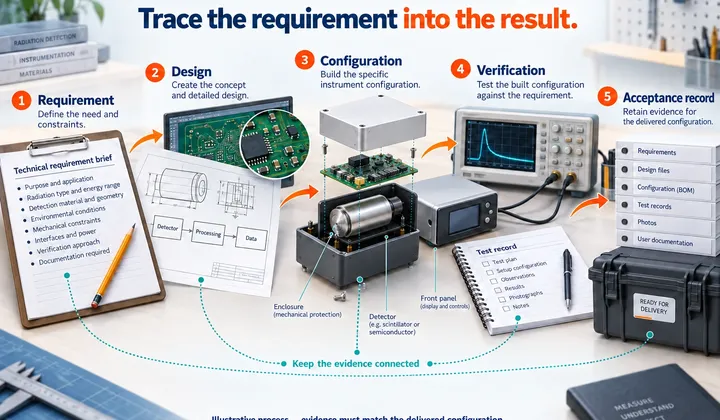
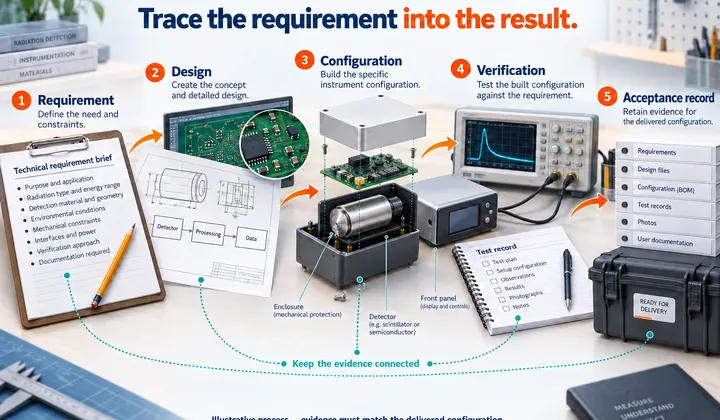
Keep the measurement records linked to procedures, instrument identities and relevant operational conditions. Clinical decisions, personnel monitoring arrangements and any post-procedure instructions remain the responsibility of the qualified clinical and radiation protection teams.
A useful plan explains both what each measurement establishes and what remains outside its scope. That clarity supports equipment discussions while avoiding the assumption that one instrument reading can represent an entire healthcare workflow.
A fictional room, three different records
Imagine a preparation room with a fixed gamma monitor near one wall, a documented surface-survey programme and staff personal dosimetry. The fixed trend can help describe the field at its installed position. A suitable surface measurement addresses radioactive material on the investigated surface. A personal record belongs to the assigned wearer and monitoring arrangement. These records can support one programme while answering different questions.
If the wall monitor's trend does not change, a reviewer still cannot conclude that every work surface is free of contamination. If a wipe has no detected activity under its method, that result does not establish the worker's external dose. Each conclusion should name the evidence that actually supports it.
Distinguish workplace protection from the clinical assay
An instrument used to assay activity in a radiopharmaceutical for clinical use has a different purpose from a workplace survey instrument. A field reading cannot substitute for that assay, and a clinical activity value does not provide a complete workplace monitoring result. The facility's qualified clinical and radiation protection teams define the equipment, methods and responsibilities for each function.
Questions for a monitoring-plan discussion
- Which radionuclides and emissions are relevant to the planned activities?
- Which locations need field observations and which surfaces need contamination measurements?
- Which personal monitoring arrangements address the staff tasks and relevant exposure pathways?
- Who evaluates unexpected results and records the resulting actions?
Intake assessment, extremity or eye monitoring may raise additional questions depending on the work. They should be evaluated through the facility programme; they are not inferred from a generic gamma reading. A proposed new activity should therefore trigger a review of the measurement questions as well as the room layout.
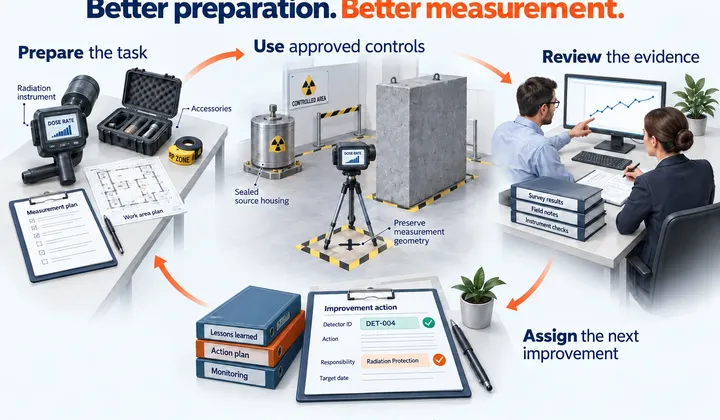
Keep the monitoring plan understandable to the people who use it. For each record, write the quantity, location or wearer, relevant interval and responsible reviewer. This makes it easier to connect the evidence without treating different instruments as interchangeable.
Check your understanding
Put the idea to work
Choose an answer, then reveal the explanation. Your answers stay in this browser.