
Industrial Radiography: Give Each Radiation Measurement a Clear Role
Separate field surveys, personal dosimetry and fixed monitoring in industrial radiography. Match every role to the source, operating state and approved plan.
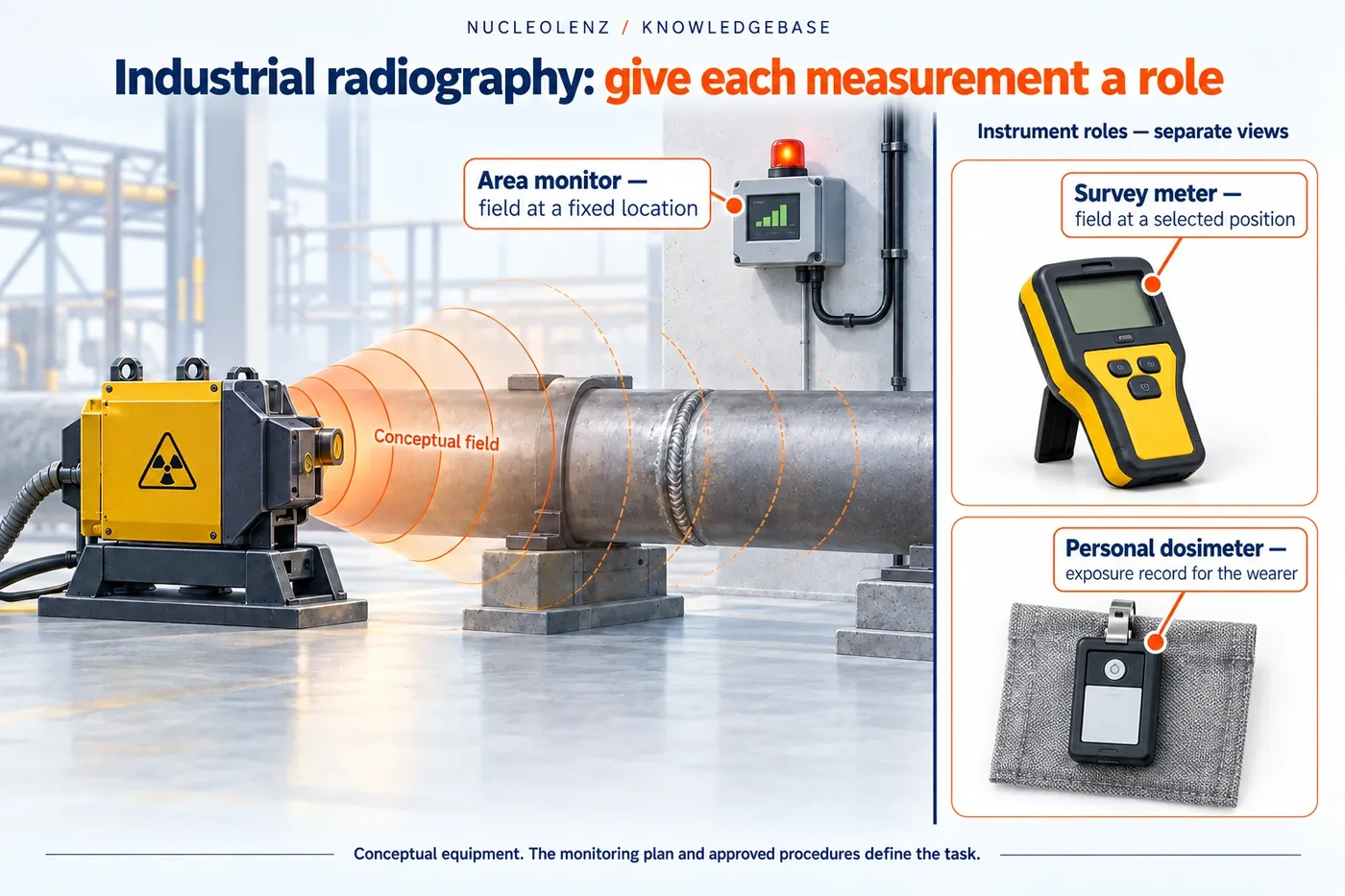
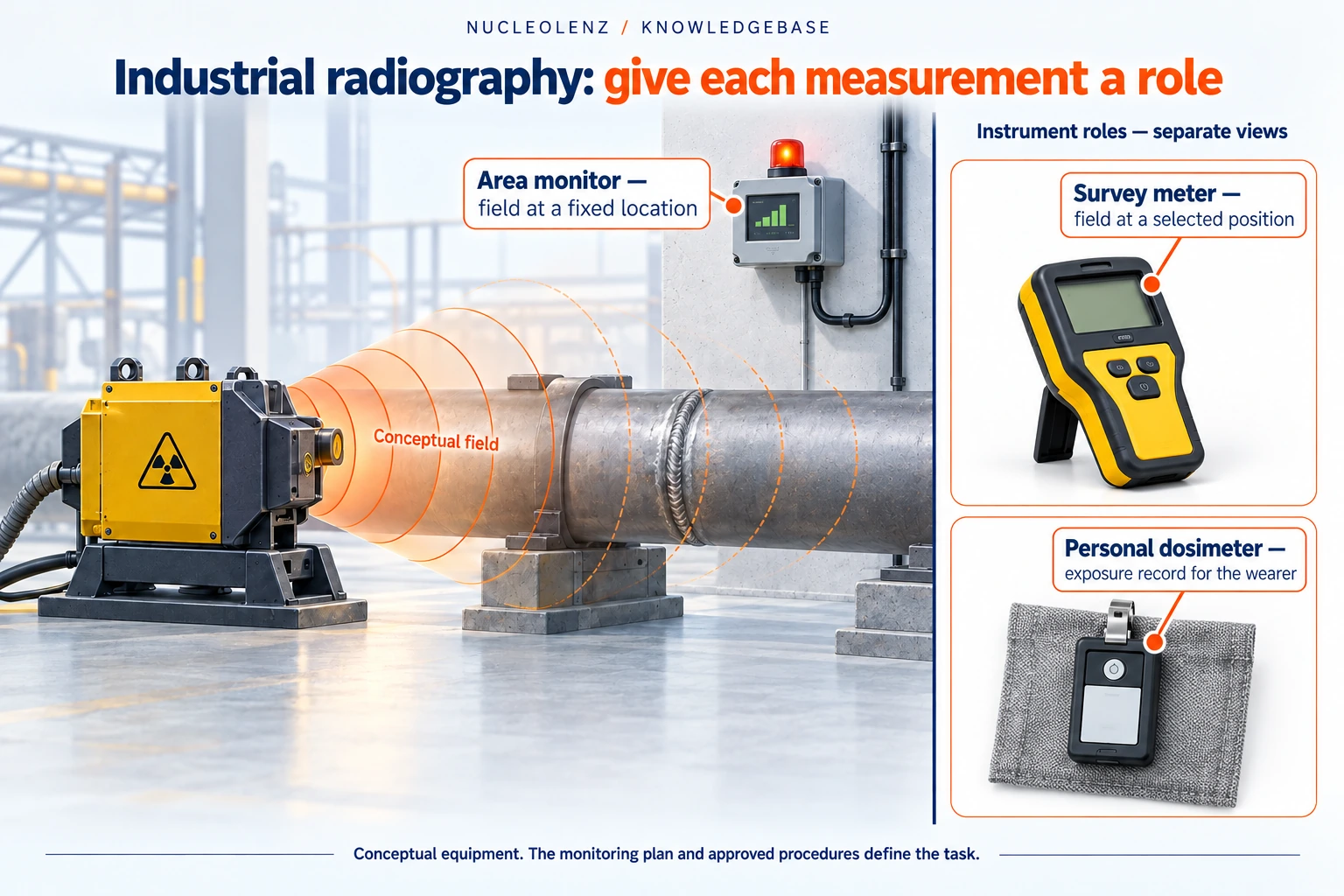
Open the concept graphic at full size ↗
Three key ideas
Different instruments answer different questions
- Field survey: Measure specified positions under defined conditions.
- Personal monitoring: Support the individual monitoring requirements.
- Fixed monitoring: Observe the assessed location and operating states.
At a glance
A practical review guide
| Review point | Evidence to look for | What it does not establish |
|---|---|---|
| Survey instrument | Field suitability, position and source state | A complete personal exposure history |
| Personal dosimetry | Assigned individual and monitoring context | All required field surveys |
| Fixed monitor | Location rationale and defined coverage | Every occupied point or source state |
| Instrument selection | Range, radiation and relevant pulse response | Universal suitability from a gamma-monitor label |
Use the applicable instrument documentation and the approved site programme for operational decisions.
Industrial radiography uses radiation to examine materials without cutting them open. The work can involve an X-ray generator or a radioactive source and can take place in different approved arrangements. These differences matter when planning measurements. A useful monitoring programme gives each instrument a defined role and connects its result with the source state, work location and responsible decision-maker.
Begin with the source and work setting
Describe the radiation source, relevant operating conditions and whether the work takes place in a shielded enclosure or another authorized arrangement. The man-made sources guide introduces the distinction between radiation generated by equipment and radioactive material that continues to emit. The site's approved radiography procedure, competent personnel and regulatory arrangements establish operational controls. This article is an explanation of monitoring roles, not a radiography operating or source-recovery procedure.
Give field surveys a clear purpose
A suitable survey instrument provides measurements at specified positions under documented conditions. The selection must account for the expected radiation, range and field characteristics, including pulsed radiation where applicable. A generic gamma-monitor description does not establish suitability for all radiography fields. Readiness checks and calibration evidence need to apply to the instrument actually used. A faulty, off-scale or otherwise invalid indication is not reassuring evidence of normal conditions.
Keep personal monitoring distinct
Personal dosimetry addresses the individual's assigned monitoring requirements. A reading associated with a worker and a field reading at a survey position have different contexts. The approved programme determines the required devices and how their results are used. Do not assume that a personal dosimeter replaces the survey instrument or that a measurement at one fixed point accounts for every worker's movements and exposure conditions.
Fixed monitoring can provide information at selected positions when it is part of the assessed arrangement. Its coverage depends on location, source state and the intended purpose. The presence of a fixed monitor does not make the other measurement roles redundant.
Practice: three records from one exercise
A fictional planning exercise supplies three items: a survey reading at a marked location, an individual monitoring record and a fixed-monitor trend. Ask what question each can answer and which contextual details are missing. The exercise should not ask participants to derive universal exclusion distances or to authorize work from an isolated number. It should reveal that the same unit on two records does not make their measurement positions, quantities or purposes interchangeable.
A useful discussion identifies the applicable method, source or process state, equipment identity and responsible reviewer for each record. Where the information is insufficient, the conclusion should say so rather than force agreement between unlike measurements.
Build a task-and-record worksheet
List each required monitoring activity, its purpose, responsible role, equipment and supporting record. Reference the approved procedure for boundaries, access, source-state verification and response to unexpected indications. Keep source recovery and investigation of abnormal conditions within the authorized arrangements; they are not tasks to improvise from an educational checklist.
Select equipment against the defined requirement
For a Nucleolenz enquiry, describe the radiation field, measurement quantity, expected conditions and integration needs. Ask for configuration-specific suitability evidence. This article does not claim that a particular product is approved for every industrial radiography task. Clear instrument roles make the resulting records easier to interpret and keep technical measurements connected to the people authorized to make protection decisions.
Check your understanding
Put the idea to work
Choose an answer, then reveal the explanation. Your answers stay in this browser.