

Nucleolenz field study
RFID-based TLD badge control for radiation safety teams
Badge handling is one of the most error-prone routines in a radiation-safety program. The TLD Rack Automation System turns issue-and-return into a near-fully-automated, fully-audited workflow — RFID identification, slot validation, server logging and SMS follow-up, with the operator only placing or picking up the badge.
The challenge
Personnel dosimetry programs at nuclear facilities, hospitals, research labs and industrial radiography sites depend on TLD badges being issued to the right person, returned to the right slot at the end of the shift, and accounted for at every step. In practice this is one of the most error-prone routines in a radiation-safety program: badges are returned to the wrong slot, returned late, or not returned at all — and the radiation protection officer often finds out days later, during the read-out cycle.
The conventional answer is a paper register, a clipboard, or at best a spreadsheet. None of these can prevent a wrong-slot return at the moment it happens, none can chase a non-returned badge on its own, and none can give the central server a live view of who currently holds which badge.
Elementz, through its Nucleolenz product line, was asked to automate this routine end-to-end — identify the badge, validate the slot, light the right indicator, record the event centrally, and chase non-returns by SMS, without depending on the operator for any of it.
- Automated identification, slot validation, logging and alerting
- Wrong-slot detection at the instant it happens
- 144 badges across 9 racks with per-slot visibility
- Alerts that reach the RPO even when the site network is down
- A central server as the single source of truth, audit-ready at any moment
What we built
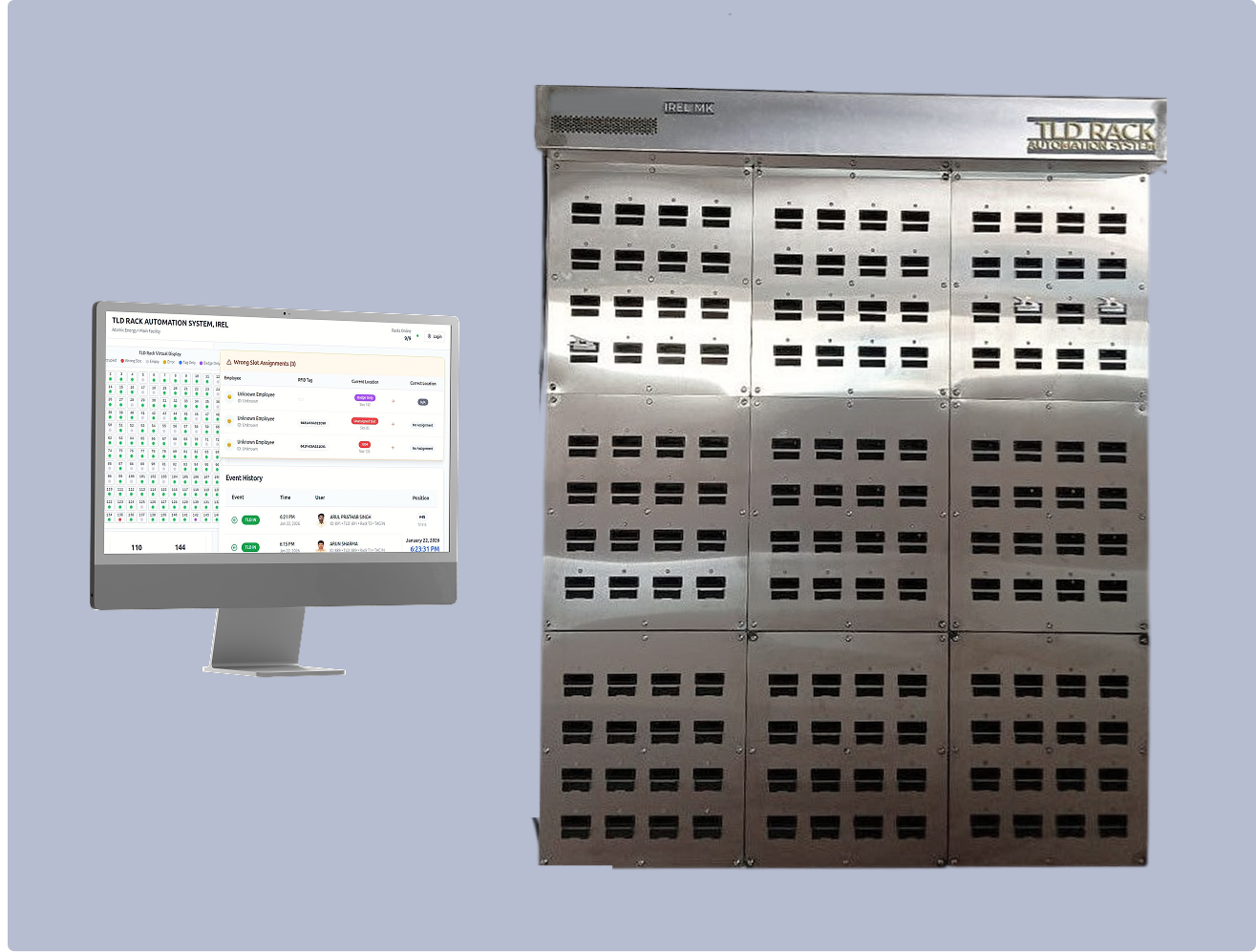
At each slot, an RFID/NFC reader identifies the badge, a mechanical limit switch confirms physical placement, a slot-wise LED indicates the correct slot and a buzzer confirms the event — while the central server logs it. A wrong-slot return triggers an immediate LED blink and audio cue, so the mistake is corrected at the rack, not in a downstream reconciliation report.
The 3 × 3 matrix of nine 16-slot racks is driven from a single PoE backbone: each rack's ESP32 controller is powered and networked through one cable from a 16-port PoE switch — no mains wiring inside the rack. A Raspberry Pi 4 runs the MQTT broker and rack server, holding every badge-to-slot mapping, every placement and every alert centrally.
Alerts that survive an outage
Routine telemetry runs over Ethernet. Critical alerts — a badge not returned within its window — go out as SMS through a Cavli C16QS LTE Cat-1 bis modem, independent of the site network. The two paths back each other up: even with facility Ethernet down, the radiation protection officer still gets the message.
Server-managed, not rack-managed
The rack itself is stateless — it reads the tag, reports, and follows the server's instruction on which LED to light. Reassigning a badge, transferring a user or auditing a slot is a server-side operation, not a physical visit. The 144-slot installation behaves as one managed system, inspection-ready at any moment.
Why it works
Almost fully automated, by design
From the moment a badge reaches the rack the system handles everything: the RFID/NFC reader identifies it, the limit switch confirms placement, the slot-wise LED shows the correct slot, the buzzer confirms the event and the server logs it. The operator only places or picks up a badge — identification, validation, logging, alerting and audit trail all run on their own.
Wrong-slot detection in real time
If a badge goes into the wrong slot, the rack reacts immediately with an LED blink and an audio cue. The mistake is corrected at the rack, not in a downstream reconciliation report — eliminating the most common failure mode in manual TLD handling.
Server-managed, not rack-managed
All slot assignments, badge-to-person mappings and event histories live on the Raspberry Pi 4 server. The rack is stateless: it reads the tag, reports to the server and follows its instructions. Reassigning a badge or auditing a slot is a server operation, not a physical visit.
SMS alerts that survive a network outage
Non-returned badges trigger SMS notifications through the Cavli C16QS LTE Cat-1 bis modem. Because the alert path is cellular and independent of the site Ethernet, the RPO is notified even if the facility network is down.
One cable per rack — PoE everywhere
The rack is powered and networked through a single PoE cable from the 16-port TP-Link switch to the ESP32 Olimex controller. No separate mains wiring, no per-slot power runs — the whole 144-badge installation is one PoE switch and the cables that fan out from it.
Audit-ready, every day
Every badge event — issue, return, slot, time, identifier, alert — is logged on the central server, so the system is inspection-ready at any moment without a clipboard reconciliation step.
The whole point of the TLD Rack Automation System is that the operator stops being the system. They place the badge, the rack does the rest — identification, slot check, logging, alerting, audit trail. The error rate doesn't depend on how careful anyone is anymore.
Elementz / Nucleolenz engineering team
Our role
- Electronics design of the per-slot RFID + limit-switch + LED + buzzer board, and the PoE-powered ESP32 Olimex controller node.
- Mechanical design of the acrylic + stainless-steel slot construction, including the 5 mm reader and 6 mm tag offsets needed for reliable RFID reads at every slot.
- Firmware on the ESP32: RFID read-out over UART, limit-switch debouncing, slot-wise LED and buzzer control, wrong-slot detection logic, MQTT client and OTA path.
- Server software on the Raspberry Pi 4: MQTT broker, rack server, slot-assignment database, badge-ownership records, event history and the operator dashboard.
- Integration of the Cavli C16QS LTE Cat-1 bis modem for automatic SMS alerts when a badge is not returned within its window.
- PoE network architecture, including the 16-port TP-Link PoE switch sizing and the cabling plan for a 9-rack installation.
- In-house assembly, factory testing and commissioning of the production system.
Outcomes
- Badge handling near-fully automated — the operator only places or picks up
- Wrong-slot returns caught and corrected on the spot
- A live, central record of who holds which badge across all 144 slots
- Overdue badges chase themselves — SMS goes out automatically
- Every event timestamped, slotted and logged: audit-ready every day
Requirements
- RFID/NFC: 13.56 MHz, PN532-class readers over UART
- Controllers: ESP32 Olimex PoE per rack; Raspberry Pi 4 server with MQTT
- Power/network: one PoE cable per rack from a 16-port switch
- Mechanical: acrylic + stainless slot construction; limit-switch placement sensing
- Alerts: Cavli C16QS LTE Cat-1 bis modem for SMS
Instruments in this study
Measuring something difficult?
Tell us what you're trying to measure, and we'll share the closest deployment story — or scope a new one with you.
Get in touch