

Nucleolenz field study
Vehicle-based radiation monitoring for mobile surveys
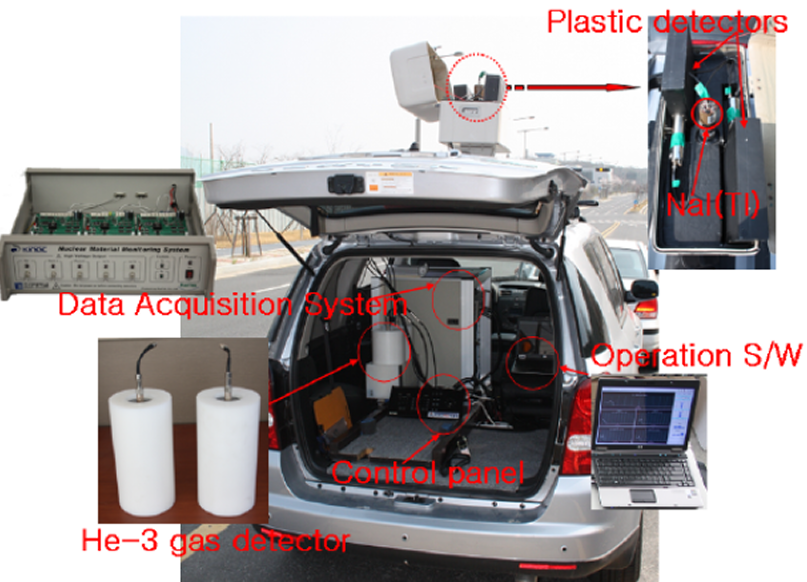
A mobile monitoring team needed one cabin-mounted point of truth for every detector on the vehicle — gamma and neutron, mounted inside and out — during field surveys and emergency response. The Eight Channel Count Reader System brings all of them onto a single display with per-channel rates, alarms and logging.
The challenge
Mobile radiation surveillance lives or dies on situational awareness. A survey vehicle typically carries several detectors — gamma and neutron, mounted on the body and inside the cabin — each producing its own pulse stream. Without a single point of aggregation, the crew is left glancing across separate readouts while the vehicle is moving, and nothing ties the channels together into one picture of the radiological situation around the vehicle.
The team needed every detector signal on one platform: per-channel rates at a glance, programmable integration to match survey speed, alarms that do not require watching the screen, and a log that supports post-survey review — all running from the vehicle's own DC supply, with no inverter and no rack of separate instruments.
- Multi-detector input from one platform
- Per-channel rate monitoring
- Programmable integration time
- Audio/visual alarms
- A centralized in-vehicle display
- Vehicle DC power compatibility
- Logged readings for post-survey review
What we built
The Eight Channel Count Reader System accepts up to eight detectors on one platform — pulse and TTL inputs, gamma and neutron compatible — and meters each channel independently. Integration time is programmable per survey profile, so the crew can trade response speed against statistical smoothness depending on whether they are creeping a perimeter or driving a transect.
Audio and visual alarms fire per channel, so a threshold crossing announces itself while the operator's eyes are on the road. Every reading is logged on board, giving the team a defensible record for post-survey review and reporting. The whole system runs from the vehicle's DC input and presents everything on one centralized in-cabin display.
One platform, every detector
Because the channel front-end is detector-agnostic, the same reader serves emergency-response fits, perimeter checks and environmental survey configurations — the detector mix changes, the cabin workflow does not.
Our role
Outcomes
- One platform handling every detector signal
- Live cabin visibility while the vehicle is moving
- Alarms announce threshold crossings without watching the screen
- Suited to emergency response, perimeter checks, and environmental surveys
- Logged readings to support post-survey review
Requirements
- Counting: per-channel rate meter
- Inputs: pulse and TTL
- Integration time: programmable per survey profile
- On-board logging for post-survey review
Instruments in this study
Measuring something difficult?
Tell us what you're trying to measure, and we'll share the closest deployment story — or scope a new one with you.
Get in touch